
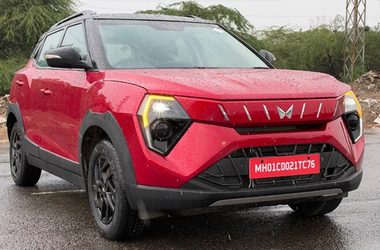


The Mahindra XUV 3XO has spent the past two years proving that a compact SUV need not be short on character, technology or ambition. Now, with the RevX A CNG, it adds a more economical dimension to its personality. But can a turbocharged, feature-rich crossover retain its enthusiasm while developing a sensible relationship with the fuel pump?
The compact SUV segment in India has become a remarkably competitive place. Almost every manufacturer wants a piece of it, every design department seems determined to make its latest creation look angrier than the last, and buyers increasingly expect their four-metre family cars to offer the technology of vehicles costing twice as much. Somewhere in this increasingly crowded contest sits the Mahindra XUV 3XO, a crossover that has never been particularly interested in behaving like the quiet, sensible member of the family.
The XUV 3XO is Mahindra’s attempt to combine the practicality of a compact urban SUV with a generous helping of engineering, equipment and visual attitude. Launched in 2024, the model has developed into one of the Indian manufacturer’s significant products, with more than 2.5 lakh units sold in the country, according to the figures supplied. The 2026 model continues the first generation of the XUV 3XO, bringing a broad powertrain portfolio that stretches across petrol, diesel, CNG and electric propulsion.
Our focus here is the Mahindra XUV 3XO RevX A ZNG CNG, a particularly interesting proposition for buyers who appreciate a turbocharged petrol engine but would rather not devote an unreasonable percentage of their monthly income to keeping it running.
Starting at approximately ₹10 lakh ex-showroom, this version is designed to combine the convenience of a petrol SUV with the potential running-cost advantages of compressed natural gas. And unlike the rather joyless CNG conversions of the past, Mahindra has made a serious attempt to preserve the engineering sophistication and everyday appeal of the underlying vehicle.
Whether that makes the RevX A CNG the cleverest member of the family is worth examining.
From XUV300 to XUV 3XO: More Than a New Name
The story begins before 2024, because the XUV 3XO did not materialise from thin air. Its predecessor was the Mahindra XUV300, a compact SUV that established a reputation for solid engineering and a substantial mechanical foundation.
The transition to the XUV 3XO brought considerably more than a different badge. Mahindra introduced a substantially revised exterior, a more technologically ambitious interior and an expanded list of equipment, repositioning the model for a market where a touchscreen, connected-car functions and sophisticated lighting have become almost as important as the engine itself.
The current vehicle carries the internal development designation S220 and is based on the X100 platform, an architecture associated with the KG Mobility Tivoli and Mahindra XUV400. This shared engineering ancestry helps explain why the XUV 3XO feels conceptually more substantial than its compact exterior dimensions might suggest.
Its styling follows Mahindra’s Heartcore design philosophy, with design leadership associated with Pratap Bose. Bose’s wider automotive portfolio includes work connected with vehicles such as the Tata Nexon, Tiago and Harrier, along with Mahindra projects including the Thar Roxx, BE 6, XEV 9e and the XUV 7XO. The Scorpio Lifestyler also features among the projects associated with his design career.
There is a recognisable family identity running through these vehicles: assertive proportions, distinctive lighting signatures and an almost theatrical willingness to announce their arrival.
Manufacturing and assembly of the XUV 3XO take place in Nashik, Maharashtra, and the model also forms part of Mahindra’s international activities, with exports to markets including Australia and South Africa.
For an SUV designed primarily to negotiate Indian traffic, apartment parking spaces and unpredictable monsoon roads, that is a fairly broad geographical assignment.
Pricing: From Everyday Transport to Something Rather Ambitious
The Mahindra XUV 3XO range starts at approximately ₹7.79 lakh ex-showroom, extending to around ₹15 lakh for the upper end of the line-up.
That is a substantial price spread for a vehicle occupying the sub-four-metre SUV category. It also illustrates just how much the definition of an affordable family car has changed.
The entry variants address buyers who want an SUV-shaped vehicle without an intimidating purchase price, while the more expensive versions pursue customers who expect premium infotainment, sophisticated safety equipment and generous convenience features.
The RevX A ZNG CNG, starting at around ₹10 lakh ex-showroom, occupies an intriguing middle ground. It is not merely the cheapest possible means of travelling on compressed natural gas. Its appeal is the prospect of combining familiar turbo-petrol performance, a respectable equipment package and lower fuel expenditure.
That distinction matters. A customer buying an inexpensive CNG hatchback usually begins with the running-cost calculation. Someone considering an XUV 3XO CNG may also care about design, road presence, safety and whether the car feels like a compromise every time they open the driver’s door.
Mahindra offers two 1.2-litre turbo-petrol engine configurations across the combustion range, along with a 1.5-litre diesel. Manual and automatic transmissions are available on the petrol and diesel models, depending on the variant, while the CNG version examined here uses a six-speed manual gearbox.
The broader XUV 3XO family also extends into electric propulsion, giving the nameplate an unusually varied mechanical identity.
Exterior Design: A Small SUV with a Considerable Opinion of Itself
<em>There are compact SUVs that try to disappear discreetly into traffic. The XUV 3XO is not one of them.</em>
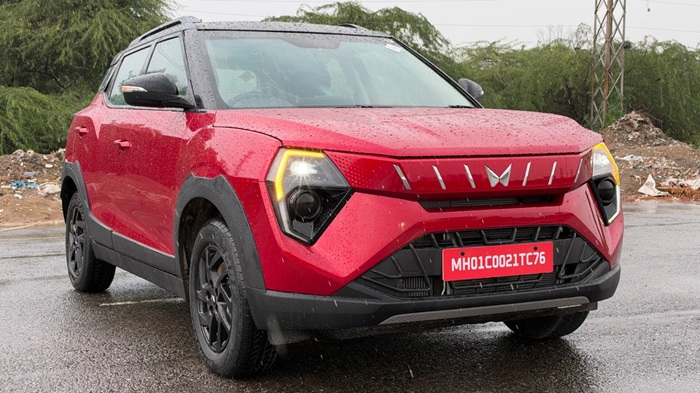
The front end is unmistakably Mahindra, combining a relatively upright stance with a bold lighting arrangement and a newly introduced body-coloured grille on the RevX version. The treatment gives the vehicle a stronger visual identity without resorting to enormous quantities of chrome, which is probably something the automotive industry should celebrate more often.
Automatic LED projector headlamps provide the main illumination, accompanied by LED daytime running lights that contribute much of the vehicle’s distinctive appearance. A follow-me-home lighting function adds convenience after the engine is switched off, particularly in poorly illuminated parking areas.
Rain-sensing windscreen wipers further reduce the number of little jobs the driver must perform manually. Admittedly, operating windscreen wipers has never been considered one of motoring’s great physical challenges, but automatic activation is useful when Indian weather changes its mind without consulting the forecast.
The bonnet has a relatively substantial appearance, helping the front of the vehicle convey the visual confidence associated with a larger SUV. The bumper design, pronounced surfaces and tightly packaged lighting all contribute to the impression of a vehicle determined to look more expensive than its dimensions suggest.
Move around to the side, and the proportions reveal the limitations and advantages of the compact SUV formula.
The XUV 3XO measures approximately four metres long, 1.8 metres wide and 1.6 metres tall. These dimensions create a useful compromise between urban manoeuvrability and road presence. It looks suitably substantial in traffic without becoming an unreasonable proposition for narrow streets or underground parking ramps.
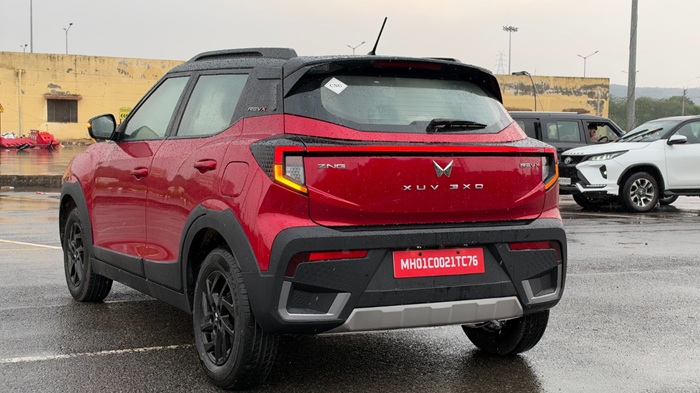
The RevX A wears distinctive badging that separates it from the regular XUV 3XO variants. Electrically adjustable and foldable outside rear-view mirrors incorporate LED turn indicators, contributing both to convenience and to the contemporary appearance.
The example featured here is finished in Tango Red, a colour that suits the car’s rather extroverted character. Other colours mentioned in the range include green, yellow, beige, white, blue, grey and black, with contrasting black or grey roof finishes available as dual-tone options.
The dual-tone treatment works particularly well with the vehicle’s relatively upright profile, visually lowering the roof and making the overall shape appear more purposeful.
The RevX A’s 16-inch piano-black alloy wheels continue the sporty theme. Across the broader XUV 3XO range, 16-inch steel wheels and 17-inch alloy wheels are also offered.
The featured wheel-and-tyre combination uses 205/65 R16 95H MRF Wanderer Ecotred steel-belted radial tubeless tyres at both ends. The relatively generous tyre sidewall is worth noting. On Indian roads, where the difference between a harmless surface imperfection and a suspension-testing crater can be surprisingly small, some additional rubber between the alloy wheel and the asphalt is often welcome.
Disc brakes are fitted at both the front and rear, an encouraging mechanical detail in a segment where cost considerations can sometimes dictate less ambitious arrangements.
At the back, the XUV 3XO uses what Mahindra calls its Infinity LED tail-lamp design. The lighting stretches visually across the rear, adding width to the appearance and creating a recognisable signature after dark.
The rear also includes a windscreen defogger and a wiper with washer functionality, practical details that matter considerably more during a rainy highway journey than they do in a brightly lit showroom.
The result is a compact crossover that looks muscular, modern and deliberately assertive. Some buyers will find the front styling slightly busy, but nobody could reasonably accuse Mahindra of being short of design ambition.
Dimensions and Practicality: Where the CNG Compromise Appears
A compact SUV has to perform several jobs simultaneously. It must look substantial, carry a family, fit into tight parking spaces and retain enough ground clearance to negotiate the extraordinary variety of obstacles found on Indian roads.
The XUV 3XO’s 201 mm ground clearance provides a useful buffer between its underside and the road. The vehicle also has a stated 23.6-degree approach angle and a water-wading capability of up to 350 mm.
These figures suggest reasonable versatility for rough urban roads, steep ramps and occasional waterlogged conditions, although the XUV 3XO remains a front-wheel-drive crossover rather than a dedicated off-road machine.
There is no low-range transfer case or conventional four-wheel-drive system to turn it into a miniature Thar. Its strengths lie in everyday adaptability, not rock crawling.
A stated turning radius of 5.3 metres should also help when navigating tight spaces, although drivers will still appreciate the assistance of the parking camera and sensors.
The biggest practicality difference between the CNG model and the conventional XUV 3XO is found behind the rear seats.
The standard vehicle offers a quoted boot capacity of 364 litres, while the CNG version provides approximately 270 litres.
That reduction is understandable because the gas storage system requires space, but it is not insignificant. A loss of 94 litres can make the difference between comfortably accommodating a family’s luggage and having to conduct a surprisingly complicated negotiation over which bags deserve to travel.
The rear seats offer a 60:40 split-folding arrangement, increasing flexibility when carrying longer or bulkier items. However, folding the seats is obviously less useful when all the passenger positions are occupied.
A 16-inch space-saver spare wheel is also included, offering a practical emergency solution without requiring the packaging space of a conventional full-size spare.
The RevX A CNG therefore makes a familiar trade-off: lower potential fuel expenditure in exchange for reduced luggage capacity.
Whether that compromise matters depends largely on how the vehicle will be used. For an individual or couple making frequent city journeys, the reduced boot may be perfectly acceptable. A family regularly travelling with four people, several suitcases and the accumulated possessions required for a weekend away may need to think more carefully.
Interior: A Serious Attempt at Premium Appeal
The XUV 3XO’s interior represents one of the strongest arguments for considering the vehicle beyond its basic transport function.
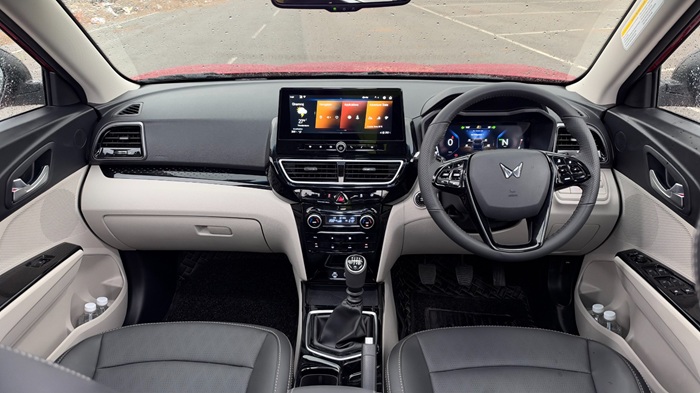
Rather than presenting an aggressively utilitarian cabin, Mahindra has pursued a relatively sophisticated dashboard layout with digital instrumentation, a substantial infotainment display and several features normally associated with more expensive vehicles.
The dashboard design emphasises horizontal surfaces and prominently positioned screens, creating a modern atmosphere. It is a considerable departure from the simple, functional interiors that once defined affordable compact SUVs.
Leatherette finishing on the doors adds a welcome touch of perceived quality, while black leatherette upholstery is available alongside fabric upholstery in the wider model range.
The distinction between genuine luxury and a good impression of luxury remains important. A leatherette insert can make a door panel appear considerably richer, but it does not automatically transform every surrounding plastic into something from a premium European saloon.
Nevertheless, Mahindra has clearly paid attention to the surfaces occupants see and touch most frequently.
The driver’s seat offers height adjustment, making it easier to find a suitable driving position. Height-adjustable front seatbelts are another welcome detail, especially for a vehicle likely to be driven by people of different builds.
The steering wheel has a leather-wrapped finish and integrates controls for the phone, audio system, infotainment and voice commands, with instrumentation and cruise-control functions also accessible through the driver’s interface.
The steering system itself uses Mahindra’s third-generation electric power steering architecture with BLAC motor technology.
There is also a leather-finished gear knob, a small but worthwhile touch in a manual vehicle because it is something the driver interacts with constantly.
The door-mounted driver-side window includes one-touch up-and-down operation, while an auto-dimming interior rear-view mirror is included among the listed equipment.
Dual-zone climate control is another particularly appealing feature within the XUV 3XO range. It allows different temperature settings for the driver and front passenger, potentially bringing a peaceful conclusion to one of the most persistent disagreements in family motoring.
For anyone who has spent several hours travelling with a passenger who considers 18 degrees Celsius tropical, it is a useful innovation.
Mahindra’s panoramic sunroof, marketed as the Skyroof, is also part of the broader equipment offering. It increases the sense of openness in the cabin and helps make the relatively compact interior feel more spacious.
A panoramic roof is rarely an essential mechanical component, of course, but it has become a genuinely desirable feature among Indian buyers. Its usefulness depends on the weather, sunlight and personal preference; on a blazing summer afternoon, a well-insulated roof can be considerably more comforting than an expansive view of the sun.
In the rear, the XUV 3XO’s broad body should be an advantage for shoulder room, while its tall crossover profile helps with the general sense of interior space. The actual quality of rear-seat accommodation, however, depends on more than exterior dimensions alone. Seat shape, cushioning, under-thigh support and the position of the front seats all influence long-distance comfort.
For family use, the combination of a five-seat layout and split-folding rear backrest gives the 3XO the expected versatility of a compact crossover, even if the CNG version sacrifices some luggage room.
Technology: Two Screens and an Ambitious Digital Ecosystem
The XUV 3XO offers a 10.24-inch HD infotainment screen and a similarly sized 10.24-inch HD digital instrument cluster.
The central display supports online navigation, wireless Android Auto, Apple CarPlay, USB connectivity and Mahindra’s Adrenox connected-car system. Built-in Alexa functionality and voice-assistant support add further interaction options.
The infotainment system’s listed functions extend well beyond the usual combination of music and maps. They include weather updates, travel information, ticker-tape content, Justdial, India Today content, horoscope services, personalised greetings, valet mode and drive-video recording functionality, alongside FM radio and other entertainment sources.
Some of these functions are genuinely useful. Navigation, smartphone connectivity, voice operation and basic vehicle information improve daily driving convenience.
Others are more a matter of personal enthusiasm. Whether a driver urgently needs a horoscope consultation from the dashboard is perhaps a question better left to the individual and the stars.
The digital instrument cluster can display navigation information, allowing the driver to keep essential guidance closer to the normal line of sight.
The cabin also includes USB-C connectivity, increasingly important for charging modern smartphones and other devices.
The technology becomes particularly interesting with Adrenox Connect, through which more than 80 vehicle functions and information services can be accessed using a compatible smartphone.
These include remote engine start and stop, climate-control functions, car location, remote door locking and unlocking, remote lighting operation, sunroof control and tyre-pressure information, where supported by the vehicle configuration.
The platform also offers access to vehicle information, driving range, overspeed alerts, high engine-temperature alerts, insurance-expiry reminders, geofencing, time-based restrictions, unauthorised-entry notifications, low-battery warnings, live vehicle tracking, trip history and other car alerts.
For owners sharing a vehicle with family members, some of these functions could be particularly valuable. Being able to locate a parked car, check its security or receive an alert about unexpected movement offers practical convenience.
Naturally, connected-car technology is only as satisfying as its interface, software reliability and network connectivity. A straightforward physical control can still be preferable to navigating several touchscreen menus for a frequently used function.
The XUV 3XO’s audio arrangements are similarly ambitious.
A six-speaker sound system with Dolby Atmos support is listed within the range, while a more elaborate seven-speaker, 380-watt Harman Kardon system is available on selected versions.
The latter should particularly appeal to buyers who spend long periods in the vehicle and consider high-quality music reproduction an important part of the journey.
It is worth emphasising that the XUV 3XO’s full technology catalogue is spread across different variants. Not every feature described here should be assumed to be standard equipment on the RevX A CNG.
The Engine: Turbocharged Petrol Meets CNG Economics
The most interesting engineering element of the RevX A ZNG is undoubtedly its powertrain.
Under the bonnet sits Mahindra’s 1.2-litre mStallion G12 turbocharged, multi-point fuel-injected petrol engine, an inline three-cylinder unit adapted for bi-fuel operation.
In its conventional petrol specification, this TCMPFi engine develops approximately 109 horsepower and 200 Nm of torque.
Those figures are meaningful for a compact SUV, particularly because turbocharging helps provide torque without requiring a larger naturally aspirated engine.
For the CNG application, Mahindra has optimised the turbocharger for operation with two fuels. The company also describes its 10-bar CNG injection system as a first of its kind, intended to improve combustion efficiency and help the engine operate effectively on compressed natural gas.
The distinction is important because CNG engines have traditionally struggled to deliver the same performance characteristics as their petrol equivalents. Maintaining acceptable power delivery while using a cheaper fuel is an engineering challenge involving combustion behaviour, fuel delivery, calibration and thermal management.
Mahindra’s approach attempts to address some of these difficulties without requiring buyers to abandon the familiar character of a turbocharged petrol engine.
The CNG system has a quoted 60-litre storage capacity, while the petrol fuel tank holds 42 litres. As with other CNG vehicles, the gas tank’s litre specification refers to its storage vessel capacity rather than a directly comparable quantity of liquid fuel.
There is also an NGV fast-filling valve intended to simplify and speed up refuelling.
That is a welcome feature, although it cannot eliminate the queues that sometimes form at busy CNG stations. Some engineering problems, regrettably, cannot be solved from underneath the bonnet.
The RevX A CNG is paired with a six-speed manual transmission.
A manual gearbox suits the practical objectives of the vehicle, offering a straightforward mechanical arrangement and giving the driver direct control over engine speed and gear selection.
The vehicle’s stated acceleration figures include 0–60 km/h in 4.9 seconds and 0–100 km/h in 11.8 seconds. These are supplied figures associated with the 1.2-litre powertrain; they should not be interpreted as independently verified performance results for both petrol and CNG operation.
Nevertheless, the underlying engine specification suggests that Mahindra has tried to preserve respectable everyday performance.
The 200 Nm torque figure is especially relevant during city driving and highway overtaking. Torque delivery often matters more than the headline horsepower number when a car is carrying several passengers, climbing gradients or accelerating through traffic.
A turbocharged three-cylinder engine also has a distinctive mechanical character. Such units can be enthusiastic and responsive, although refinement, vibration and the sound produced under load remain important areas to examine during a proper road test.
The XUV 3XO’s engine should be judged not merely by how quickly it accelerates in ideal conditions, but by how consistently it responds when carrying passengers, using the air conditioning and switching between its two fuel systems.
An Important Safety Feature for CNG Operation
Mahindra has equipped the CNG system with integrated gas-leak detection.
If a gas leak is detected, the system is designed to switch the vehicle automatically to petrol operation, reducing reliance on the CNG supply under those circumstances.
It is a valuable precaution because fuel-system safety becomes particularly important when storing compressed gas inside a passenger vehicle.
The presence of this system reinforces Mahindra’s intention to develop the CNG version as an engineered part of the vehicle range rather than simply treating compressed natural gas as a budget-oriented addition.
What About the Other Engines?
One of the XUV 3XO’s greatest advantages is its range of mechanical choices.
For buyers who prefer conventional petrol power without the packaging compromises associated with CNG, Mahindra offers two turbocharged 1.2-litre engines.
The TCMPFi unit produces 109 horsepower and 200 Nm, with quoted fuel-economy figures of approximately 18 km/l for the manual and 17 km/l for the automatic.
The more powerful mStallion TGDi engine uses turbocharging, intercooling and gasoline direct injection to produce approximately 128 horsepower and 230 Nm of torque.
Its quoted consumption figures are around 20 km/l with the manual transmission and 18 km/l with the automatic.
This engine is the more attractive choice for drivers who place a higher priority on performance and effortless overtaking than on minimising fuel expenditure.
The diesel option is a 1.5-litre inline-four turbocharged CRDe engine, producing approximately 115 horsepower and a substantial 300 Nm of torque.
Quoted fuel-economy figures are approximately 20 km/l for the manual and 21 km/l for the automatic version.
That 300 Nm torque figure is particularly interesting. It suggests the diesel has the mechanical characteristics to suit long-distance driving, especially with passengers and luggage aboard.
Six-speed manual and six-speed automatic gearbox choices are listed across the petrol and diesel range, depending on the configuration.
Then there is the electric branch of the family.
The supplied electric-model specifications describe a 39.4 kWh lithium-ion battery combined with an electric motor producing 148 horsepower and 310 Nm. Claimed performance includes 0–100 km/h in 8.3 seconds and a top speed of 150 km/h, with a quoted range of 456 km.
A lower-output electric configuration is also described, producing 108 horsepower and 310 Nm, with the same stated range figure.
These electric specifications are separate from the RevX A CNG and should not be confused with the combustion vehicle’s equipment or performance. The quoted electric range, like any certified range estimate, should not be mistaken for a guaranteed real-world result.
Taken together, the different powertrains illustrate Mahindra’s strategy: offer substantially different approaches to performance and running costs beneath a broadly shared compact-SUV identity.
Ride and Handling: A Serious Mechanical Foundation
Underneath the assertive styling sits a suspension arrangement that is conventional in layout but interesting in execution.
At the front, the XUV 3XO uses MacPherson strut suspension with an anti-roll bar. The rear employs a twist-beam arrangement with coil springs.
This is a familiar configuration among front-wheel-drive compact vehicles, offering a workable balance between manufacturing complexity, interior packaging and chassis control.
The more distinctive engineering detail is Mahindra’s use of MTV-CL dampers, standing for Multi-Tuned Valve Concentric Land technology.
These dampers are intended to improve the balance between ride comfort and handling by controlling suspension movement more precisely across different operating conditions.
That is significant in India, where suspension systems face demands that are unusually varied.
A car may encounter a smooth highway one moment, a sharply edged pothole the next and then a succession of speed breakers apparently designed by someone with a personal disagreement with suspension engineers.
A good damper must absorb the initial impact without allowing the body to continue bouncing excessively afterwards. It must also help control body movement when braking, accelerating or changing direction.
The XUV 3XO’s suspension specification suggests that Mahindra has paid attention to these conflicting requirements.
However, the presence of sophisticated damper technology is not, by itself, proof of exceptional ride quality. The final result depends on tuning, tyre pressures, vehicle loading and the condition of the road.
The steering uses third-generation electric assistance with BLAC motor technology and offers three settings: Comfort, Normal and Sport.
These modes alter the steering assistance and effort rather than fundamentally changing the grip available from the front tyres.
Comfort mode is intended to make low-speed operation easier, while Sport mode offers a heavier steering feel. Normal provides the middle setting for everyday use.
A heavier steering wheel does not necessarily deliver more genuine feedback, but the ability to select steering effort can improve the driving experience for different drivers.
Mahindra also lists three drive modes within the XUV 3XO range: Zip, Zap and Zoom.
The names sound like they belong to a particularly energetic cartoon character, but their purpose is more practical: providing different response characteristics to suit driving preferences and conditions.
As with the steering modes, availability and calibration should be checked for the exact powertrain and variant.
Being front-wheel drive, the XUV 3XO must rely on its front tyres for both steering and propulsion. That is entirely appropriate for the intended use, although it places natural limits on the vehicle’s off-road abilities and high-load traction compared with a purpose-built four-wheel-drive SUV.
The 205-section tyres and suspension geometry must manage the competing demands of ride isolation, body control and steering response.
Under braking, the presence of front and rear discs provides a reassuring hardware specification, although stopping-distance performance ultimately depends on the complete braking system, tyres and road conditions.
On a motorway, stability and refinement matter more than the ability to dart around corners. Here, body control, wind noise, road noise and engine vibration determine whether a compact SUV feels genuinely comfortable during a long journey.
The XUV 3XO’s structural and suspension specifications provide a promising foundation, but independent driving measurements would be required to establish precisely how the RevX A CNG compares with petrol, diesel and rival models.
Fuel Economy: The Main Reason to Choose CNG
The RevX A CNG carries a quoted fuel-efficiency figure of approximately 24 km/kg.
That number is central to its appeal.
For drivers covering substantial distances every month, compressed natural gas can offer meaningful savings where CNG prices are favourable relative to petrol.
The financial benefit depends on local fuel prices, driving conditions, fuel availability and how much time the vehicle spends operating on CNG rather than petrol.
A quoted 24 km/kg also should not be treated as a promise that every owner will achieve exactly that figure.
Traffic congestion, prolonged idling, air-conditioning use, driving style, road conditions and the number of passengers all influence actual consumption.
Nevertheless, the essential appeal remains clear. The RevX A CNG is intended to deliver the SUV’s familiar styling and everyday usability while reducing fuel expenditure.
The compromise, of course, is that the owner must accept CNG refuelling requirements, the additional gas-system hardware and the reduction in luggage capacity.
For someone driving only a few thousand kilometres annually, the advantage may be less compelling. For a driver covering long urban distances throughout the year, the calculation could look considerably more attractive.
Safety: One of the XUV 3XO’s Strongest Arguments
Mahindra has placed considerable emphasis on the XUV 3XO’s structural engineering and crash protection.
The model has received a five-star Bharat NCAP safety rating, an important achievement in a segment occupied by vehicles frequently used as primary family transport.
The structural engineering figures are also interesting.
According to the supplied technical information, high-strength steel accounts for approximately 45 per cent of the vehicle’s stated body or structural composition, while construction involves 5,328 spot welds and 45 metres of structural sealer.
Mahindra’s technical material also refers to an impact-force comparison of approximately 20 tonnes at 64 km/h. Such a figure needs careful interpretation because collision forces depend on the test conditions and should not be treated as an additional independent crash-test rating.
More relevant than any dramatic numerical comparison is the overall structural design, the way crash energy is managed and how effectively the passenger compartment is protected.
The XUV 3XO incorporates a reinforced side-impact structure and a wide range of active and passive safety systems.
Six airbags are included among the specified safety equipment, together with three-point seatbelts, seatbelt reminders and ISOFIX child-seat mounting points.
The vehicle also offers an electronic stability programme identified as version 9.3, traction control, hill-hold control, hill-descent control, rollover mitigation, brake-disc wiping and electronic brake prefill, depending on variant.
Each system has a practical purpose.
Electronic stability control helps manage loss of directional control by intervening when necessary, while traction control limits excessive wheelspin. Hill-hold assistance can prevent the vehicle from rolling backwards when starting on an incline.
Brake-disc wiping is intended to help maintain braking readiness in wet conditions, while electronic brake prefill prepares the braking system for a more immediate response when an emergency braking situation is anticipated.
A rear-view camera, reversing sensors and a tyre-pressure monitoring system add further convenience and safety awareness.
Passive keyless entry also forms part of the convenience offering.
Across the wider XUV 3XO line-up, Level 2 advanced driver-assistance systems are available on selected variants.
These systems can assist the driver in appropriate conditions, but they do not make the vehicle autonomous and should never be regarded as a substitute for attention and judgement.
The featured equipment information also mentions a Safetech fire extinguisher, a sensible additional precaution to have available in a vehicle.
For families, the combination of independent crash-test recognition, a substantial structural package and modern electronic assistance gives the XUV 3XO a persuasive safety proposition.
That is arguably more important than any amount of glossy piano-black trim.
Ownership: Warranty, Assistance and Everyday Considerations
Mahindra provides a three-year, unlimited-kilometre vehicle warranty for the XUV 3XO, according to the supplied ownership information.
There is also a three-year roadside-assistance package that includes breakdown support, assistance following key loss, free taxi support during eligible breakdown situations, emergency fuel assistance and flat-tyre assistance.
The exact terms and eligibility of these benefits should naturally be checked at purchase, particularly for services involving fuel delivery or alternative transport.
For an owner regularly travelling outside major cities, roadside assistance can be a particularly valuable benefit.
The XUV 3XO’s assembly in Nashik and its presence in Mahindra’s established Indian passenger-vehicle range are relevant to the broader ownership experience. Dealer accessibility, local workshop standards, spare-parts availability and maintenance costs will all influence long-term satisfaction.
For the CNG version specifically, owners should also consider the periodic inspections and maintenance requirements associated with the additional fuel system.
Mahindra offers a broad selection of accessories for the XUV 3XO, allowing buyers to personalise both its appearance and its usefulness.
The catalogue includes chrome garnish, door visors, additional side cladding, bumper add-ons, spoilers, roof rails, car covers, mudguards, alloy wheels, seat covers, sunshades, parcel trays, steering-wheel covers, interior trim kits, scuff plates, fog lamps, rear-view cameras, floor mats and pedal covers.
Some of these are practical additions. Others are largely cosmetic.
There is nothing wrong with personalising a car, although the temptation to fit every chrome garnish and body accessory simultaneously should perhaps be resisted. A four-metre crossover does not need to look as though it has accidentally driven through an automotive accessories exhibition.
Ultimately, however, fuel expenditure, maintenance, insurance, tyre replacement and resale value will matter considerably more over several years of ownership than the choice of decorative trim.
The Rivals: A Very Crowded Battlefield
The Mahindra XUV 3XO operates in one of the most fiercely contested segments of the Indian market.
Its most obvious rivals include the Tata Nexon, Maruti Suzuki Brezza, Hyundai Venue, Kia Sonet and Škoda Kylaq, although the most relevant comparison depends on engine choice, price and available equipment.
The Tata Nexon is a particularly significant alternative because it also places considerable emphasis on design, safety and a wide range of powertrain options. Buyers comparing the two should pay close attention to engine response, transmission behaviour, cabin ergonomics and the packaging compromises associated with CNG.
The Maruti Suzuki Brezza takes a more restrained approach to the compact SUV formula. Its appeal is likely to be strongest among buyers who prioritise straightforward everyday usability and familiar ownership considerations over the most dramatic styling or ambitious performance figures.
For those wanting a comparatively sophisticated urban cabin and a strong emphasis on comfort and features, the Kia Sonet and Hyundai Venue deserve attention. The Mahindra counters with its distinctive design, extensive technology offering, multiple engine choices and strong crash-test credentials.
The Škoda Kylaq is another alternative for drivers who place particular importance on the way a compact crossover responds from behind the steering wheel.
The important distinction is that the XUV 3XO is not trying to win every argument using the same set of priorities.
A buyer choosing the CNG model may care more about running costs than outright acceleration. Someone considering the higher-output TGDi petrol may give greater importance to engine performance, while a diesel customer might prioritise torque and highway efficiency.
That breadth of choice is itself an advantage.
Nevertheless, the XUV 3XO’s modest CNG boot capacity and the variation in equipment between trims should encourage careful comparison rather than a decision based solely on the headline feature list.
Verdict: A Sensible Choice That Refuses to Be Boring
The 2026 Mahindra XUV 3XO RevX A CNG is interesting because it challenges the traditional idea of what an economical car ought to be.
For years, choosing CNG frequently meant accepting a vehicle that was visibly and mechanically focused on economy above almost everything else. Performance, equipment and desirability often came second.
The XUV 3XO takes a different approach.
It begins with a boldly styled compact SUV, a modern interior, substantial digital technology and an engineering package that includes turbocharged power, sophisticated suspension damping and a strong emphasis on safety. It then adds a CNG system intended to make regular driving more affordable.
There are clear strengths.
The design has personality, the cabin offers considerable technological ambition, and the underlying 1.2-litre turbo-petrol engine has a promising torque specification. The five-star Bharat NCAP result adds reassurance, while the warranty and roadside-assistance provisions strengthen the ownership proposition.
Mahindra has also made sensible engineering choices with its bi-fuel arrangement, including optimised turbocharging, 10-bar CNG injection technology and automatic petrol-mode switching in response to a detected gas leak.
But there are compromises.
The 270-litre boot is notably smaller than the standard model’s 364-litre luggage compartment. Buyers seeking an automatic CNG drivetrain will not find one in the six-speed manual RevX A described here. And while the broader XUV 3XO catalogue contains an impressive collection of features, customers must look closely at what is actually included in the particular version they are buying.
The RevX A CNG also should not be mistaken for the performance-focused member of the range. Drivers primarily interested in brisk acceleration and an enthusiastic powertrain may be better served by the more powerful TGDi petrol. Long-distance users who favour generous torque could find the diesel particularly appealing.
The CNG version has a different mission: to preserve much of the XUV 3XO’s identity while making the cost of covering everyday kilometres more manageable.
At a starting price of approximately ₹10 lakh ex-showroom, that is an attractive proposition for buyers who drive regularly, have convenient access to CNG stations and do not require maximum luggage space on every journey.
The Mahindra XUV 3XO RevX A CNG will not replace a dedicated off-roader, redefine performance motoring or make petrol stations entirely irrelevant. What it attempts to do is arguably more useful: deliver a compact family SUV with genuine character, contemporary equipment and a degree of financial sensibility.
Its defining achievement is not that it makes economy exciting. It is that it tries to make economy feel like less of a sacrifice.
And in a market where buyers increasingly want everything from their compact SUVs, that might be exactly the sort of ambition that matters.