
There is something quietly rebellious about buying a sedan in modern India. While the market continues its enthusiastic migration towards anything with plastic cladding, a raised bonnet and the word “SUV” somewhere in the brochure, the Škoda Slavia remains committed to the traditional three-box formula: engine in front, passengers in the middle and a proper boot at the back. No lifestyle pretence, no need to imagine yourself crossing the Himalayas on the school run.
And for 2026, Škoda has given the Slavia its first major facelift.
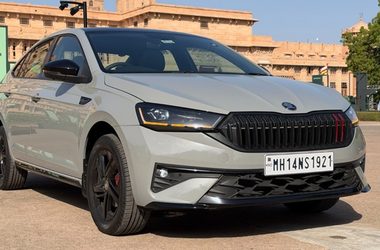
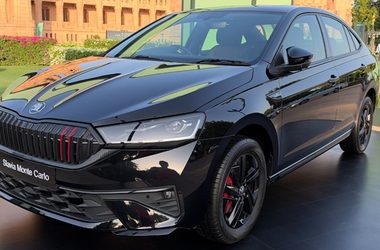
The car you see here is the top-spec Monte Carlo 1.5 TSI, effectively the extrovert of the Slavia family. It takes the fundamentally European-looking sedan, applies blacked-out exterior detailing, red accents and a sportier cabin, then pairs the theatre with the strongest engine offered in the range. The facelift also brings meaningful changes rather than the usual automotive equivalent of changing a shirt and calling yourself a new person: there are new alloy wheels, a revised digital instrument cluster, a 360-degree camera, rear-seat massage functionality and a new 8-speed torque-converter automatic transmission within the updated range.
The original Slavia arrived in India in 2022, replacing the Rapid and becoming one of the principal products developed around Volkswagen Group’s India-specific MQB A0 IN architecture. Four years later, the formula remains recognisable, but Škoda has clearly tried to add technology, convenience and enough cosmetic drama to keep the sedan relevant.
That matters because more than 80,000 Slavias have been sold so far. Evidently, the traditional sedan is not quite ready for retirement.
A name older than the car industry
The Slavia name has considerably more history than the car itself. It is derived from the Slavia bicycle built by Škoda’s founders in 1896, linking this thoroughly modern turbocharged sedan to the company’s earliest days.
There is a pleasing symmetry to that. The original Slavia had pedals; this one has aluminium ones.
Underneath the modern bodywork sits Volkswagen Group’s Modular Transverse Toolkit MQB A0 IN platform, an architecture also shared with the Škoda Kushaq and Kylaq and the Volkswagen Virtus and Taigun. It is an important piece of engineering for the Group’s Indian operation because it allows products to retain a recognisably European character while being engineered around local market requirements.
The Slavia is assembled in India as well as Vietnam, and its broader design language remains unmistakably European. There are relatively clean surfaces, strong horizontal lines and proportions that look like they were drawn as a sedan from the beginning rather than created by attaching a boot to something else.
Pricing: the Monte Carlo sits right at the top
The 2026 Slavia remains petrol-only, with the range starting at approximately ₹11 lakh ex-showroom and extending to ₹18.84 lakh for the top model.
Our car is that flagship proposition: the Monte Carlo with the 1.5-litre TSI petrol engine.
At nearly ₹19 lakh before registration, insurance and everything else involved in turning an ex-showroom figure into the amount that actually leaves your bank account, expectations are understandably high. The Monte Carlo therefore has to offer more than some red stitching and a badge on the fender.
Fortunately, Škoda has made the visual differentiation fairly comprehensive.
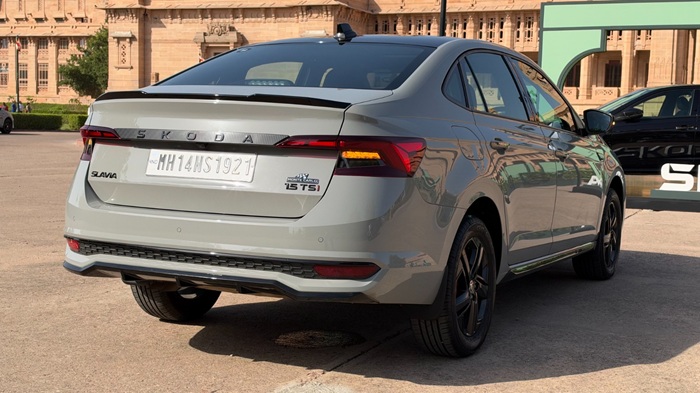
The Monte Carlo wears sporty red stripes and blacked-out exterior elements, immediately giving it a more aggressive character than the ordinary Slavia. It is still an elegant sedan beneath the decoration, but one that appears to have spent some time browsing the sporting-goods aisle.
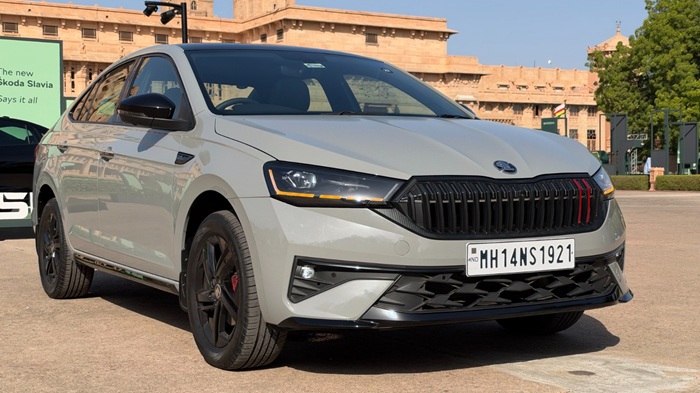
The Cappuccino Beige paintwork of this example provides an interesting contrast to those darker details. Other available colours include green, white, silver, grey, blue, red and black, while dual-tone versions are offered with a black roof.
Familiar Slavia proportions, sharper details
At the front sits Škoda’s familiar hexagonal grille, surrounded here by new automatic LED headlamps. L-shaped LED daytime running lamps give the nose a recognisable light signature, while the lighting package also incorporates coming/leaving-home functionality and Light Assistant.
LED fog lamps sit lower down, while the bumper incorporates a diffuser-style treatment. There is another diffuser element at the rear, helping the Monte Carlo look more assertive without transforming what remains an essentially restrained sedan into a touring car impersonator.
Rain-sensing wipers add convenience, and the Slavia receives infrared-cut glass, a useful feature in a country where summer sunlight occasionally behaves as though it has a personal grudge against car interiors.
The electrically adjustable and folding outside mirrors incorporate anti-glare functionality, LED indicators and cameras. Those cameras now contribute to the facelift’s 360-degree camera system, a far more meaningful addition in everyday Indian traffic than another decorative badge ever could be.
Though there is, naturally, a Monte Carlo badge on the fender too.
At the rear, new LED tail-lamps incorporate sequential indicators. Together with the black accents and sportier detailing, they give the facelift enough visual distinction to be noticed without throwing away the underlying simplicity that has always suited the Slavia.
Big enough to be useful, low enough to remain a sedan
The Slavia measures roughly 4.5 metres long, 1.7 metres wide and 1.5 metres tall. Ground clearance is 145 mm, while kerb weight is approximately 1,300 kg and gross weight around 1,700 kg.
That 145 mm figure immediately tells you something about the Slavia’s priorities. This is not pretending to be an SUV. It sits relatively low, which helps its classic sedan proportions, although owners living in neighbourhoods where speed breakers appear to have been designed by civil engineers specialising in mountain ranges will naturally need to exercise some mechanical sympathy.
The facelifted Monte Carlo gets new 16-inch Savio black alloy wheels, with 15-inch steel wheels also mentioned within the wider range. This car runs 205/55 R16 91H CEAT SecuraDrive radial tubeless tyres at both ends.
More interestingly, there are disc brakes at the front and rear, with red brake calipers providing another small flash of Monte Carlo theatre behind those dark wheels.
The boot is one of the Slavia’s strongest practical assets. Capacity stands at a substantial 521 litres with the rear seats in place, expanding to 1,050 litres when the 60:40 split rear backrests are folded.
That is proper family-holiday territory. The sedan shape may have fallen out of fashion in some corners of the market, but a 521-litre boot remains a convincing argument when four people suddenly decide they each need luggage roughly the size of a domestic refrigerator.
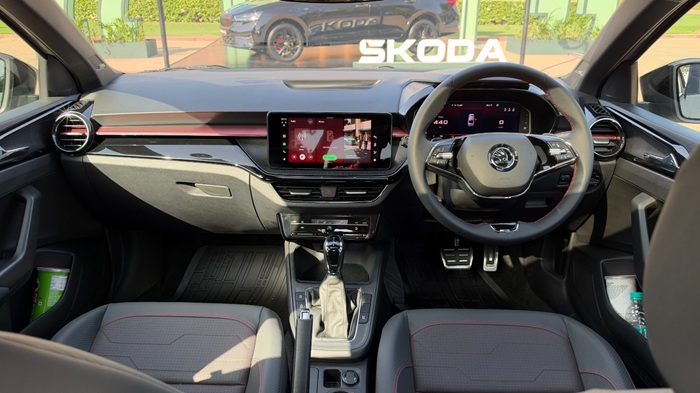
The Monte Carlo cabin turns up the red
Inside, the Monte Carlo treatment becomes much more obvious.
Black leatherette upholstery is paired with red stitching and red ambient lighting, giving the cabin a sportier atmosphere than the standard car. Beige upholstery and fabric upholstery are also available elsewhere in the range, but this darker combination suits the Monte Carlo’s character better.
There are aluminium pedals, a leatherette gear selector and a two-spoke leatherette-wrapped multifunction steering wheel. The steering column offers adjustment for both height and reach, helping the driver establish a more natural position.
Controls on the wheel manage volume, infotainment, voice functions and the instrument cluster. The facelift introduces a new 10.25-inch Škoda Virtual Cockpit with a red-themed interface and navigation display, while lower variants receive either an 8-inch cluster or analogue instruments depending on specification.
It gives the flagship a suitably digital environment without removing conventional driving information from directly in front of the driver.
The centrepiece of the dashboard is a 10.1-inch touchscreen infotainment system, again receiving a red theme in the Monte Carlo. Its feature set is broad: wireless SmartLink, Apple CarPlay, Android Auto, MyŠkoda Connect, USB connectivity, Sygic offline navigation and SIM-based internet connectivity are all included.
Škoda also specifies Google Cloud automotive AI voice assistance, Škoda Play applications, audiobooks, Gaana, BBC World News, weather, news, music and video functions, valet mode and more than 12 applications.
Whether anyone desperately needed their sedan to contain this much digital entertainment is another discussion. But wireless phone integration and built-in connectivity are the sort of things owners genuinely notice every day, whereas some connected-car functions inevitably spend more time demonstrating what is technically possible than what anyone remembers to use.
Lower variants make do with a 7-inch infotainment screen.
Comfort gets increasingly ambitious
The front seats are electrically adjustable and ventilated, two features that make considerably more sense in the Indian climate than many fashionable pieces of automotive technology.
And then there are the rear seats.
For the facelift, Škoda has added rear-seat massage functionality. That is not something normally associated with this class of sedan, and it gives the updated Slavia an unusual talking point for owners who regularly travel with family or a chauffeur.
There is also a phone pocket, LED reading lights, footwell illumination and four-door reflective tape. The latter may sound like a remarkably minor detail until you’ve opened a door at night on an inadequately lit road.
An eight-speaker Škoda sound system includes a subwoofer and amplifier, while wireless phone charging handles modern-device duties. The glovebox is cooled, the interior mirror is auto-dimming and the electric sunroof includes anti-pinch protection.
The automatic climate-control system uses a touch-operated panel and incorporates an Air Care function. Touch-sensitive climate controls remain one of those ideas that always look wonderfully clean in photographs; whether they are as intuitive as physical buttons while travelling over an imperfect road is another matter. Sometimes a knob really does know best.
There is also Škoda’s SmartClip ticket holder and the brand’s so-called smart-grip bottle holder, small touches that suggest somebody involved in cabin development has actually attempted to live with a car rather than merely photograph it for a brochure.
Connected technology without forgetting the basics
The MyŠkoda Plus application comes with a three-year complimentary subscription and allows numerous connected functions to be accessed via smartphone.
These include vehicle tracking, geofencing, real-time speed tracking, roadside-assistance access, emergency SMS messages with location information, route tracking, driving-behaviour information, vehicle status, trip data, tow alerts and device-tampering alerts.
A connected app can rapidly become a technological junk drawer if overloaded with functions, but vehicle status, tracking and emergency-related services are genuinely useful. Parents may also find real-time speed tracking and geofencing considerably more interesting once a newly licensed member of the family asks for the keys.
The Slavia also retains straightforward conveniences such as keyless entry, the driver’s one-touch power window with bounce-back protection and an electric sunroof.
The 1.5 TSI is the engine enthusiasts will notice
The centrepiece of this Monte Carlo is Volkswagen Group’s EA211 Evo TSI petrol engine.
It displaces 1,500 cc, uses four cylinders arranged in-line and employs direct fuel injection together with a variable oil pump. Output is 147 horsepower with 250 Nm of torque.
TSI stands for Turbo Stratified Injection, and in this application the engine additionally incorporates Active Cylinder Technology, or ACT. Under suitable conditions, two cylinders can temporarily deactivate to reduce fuel consumption.
There is also Start Stop Recuperation, or SSR, intended to help reduce CO2 emissions and improve efficiency.
Škoda additionally describes the engine as using plasma-coated technology.
The supplied specifications quote 0–100 km/h in 8.1 seconds and a top speed of 203 km/h. Claimed average fuel consumption is approximately 18 km/l, with petrol stored in a 45-litre fuel tank.
For a family sedan, those performance figures are properly brisk. Eight-point-one seconds to 100 km/h puts the Slavia 1.5 TSI firmly beyond the territory of merely adequate transport. More importantly, 250 Nm gives the engine the sort of mid-range strength that should matter during highway overtakes, where accessible torque is far more useful than a dramatic horsepower figure printed at the end of a brochure.
The car remains front-wheel drive.
The supplied material identifies the 1.5-litre setup with a dry dual-clutch transmission and also specifies a 7-speed DSG within the range. Separately, the facelift information refers to a new 8-speed torque-converter automatic, alongside a 6-speed manual, particularly in connection with the 1.0-litre powertrain options. Since the source notes overlap on this point, the safest conclusion is that transmission availability depends on engine and variant rather than treating the gearbox information as interchangeable across the range.
And it is worth distinguishing the two personalities.
The 1.5-litre’s 147 hp and 250 Nm figures make it the performance-oriented choice, while the smaller engine is positioned more towards efficiency and everyday usability.
The 1.0 TSI alternative
The second petrol engine is Volkswagen Group’s EA211 1.0-litre TSI.
This unit displaces 1,000 cc, uses three cylinders and features direct injection, Dual VVT and a variable oil pump. It produces 114 horsepower and 178 Nm.
According to the supplied figures, the 1.0 TSI reaches 100 km/h in 9.7 seconds and has a top speed of 189 km/h, while claimed fuel economy is approximately 19 km/l.
That makes the smaller engine only about one second slower to 100 km/h on paper while returning slightly better claimed economy. For buyers primarily navigating cities, paying fuel bills and occasionally tackling longer journeys, the 1.0-litre therefore makes a convincing rational case.
But the 1.5 exists for people who occasionally look at an empty stretch of road and think, “perhaps we should use all of it.”
Chassis: conventional ingredients, useful electronics
Up front, the Slavia uses a MacPherson suspension arrangement with lower triangular links and a stabiliser bar. The rear employs a twist-beam axle.
That is a conventional configuration for this class rather than anything exotic, but exotic suspension is hardly mandatory for producing a competent road car. Good tuning matters more than an impressive diagram.
The steering uses electro-mechanical power assistance.
Škoda also fits XDS Electronic Differential Lock, designed to improve stability by managing wheel behaviour electronically rather than employing a traditional mechanical limited-slip differential. It should be particularly useful when putting power down through the front wheels during cornering or on inconsistent surfaces.
There is also brake-disc wiping. In wet conditions the system helps remove water from the brake discs, intended to provide a quicker and more consistent braking response when the driver subsequently presses the pedal.
Those are the sort of invisible engineering details that rarely attract buyers inside a showroom but often distinguish a thoroughly developed car from one that simply has a long equipment list.
The body uses high-strength steel, while the suspension, electronic differential assistance and four-wheel disc brakes collectively suggest that the Slavia continues to take the dynamic side of the sedan brief seriously.
Safety remains one of the major arguments
The Slavia has received a five-star Global NCAP rating according to the supplied material, giving it an important safety credential.
The equipment list itself is extensive.
There are six airbags, ABS, EBD, electronic stability control, traction control, Multi Collision Braking and Motor Slip Regulation. Hill-hold control is included, along with front seat-belt reminders.
Tyre-pressure monitoring, ISOFIX child-seat mountings, rear door and window child locks and three-point front seat belts are provided.
Parking assistance is equally comprehensive on the facelift, with front and rear parking sensors, Park Pilot and the newly added 360-degree camera. The latter should be particularly welcome in crowded urban spaces, because no amount of European chassis tuning can defeat a badly parked scooter.
Security features include an engine immobiliser, anti-theft alarm and speed-sensing central locking. There is also a door-open warning and an emergency triangle.
Together, the package gives the Slavia a more substantial safety story than simply counting airbags.
Ownership: Škoda makes the proposition clearer
Škoda supplies the Slavia with a four-year/1 lakh km warranty. This is accompanied by four years of roadside assistance and four labour-free services.
There is also a six-year corrosion warranty and a three-year paint warranty.
That is a useful ownership package, particularly for buyers who may still associate European cars with complicated long-term maintenance. The supplied material does not specify servicing intervals or extended-warranty pricing, so those are best checked separately when purchasing.
E20 fuel compatibility provides a degree of future-readiness as India’s petrol supply increasingly incorporates ethanol blends.
So, where does the facelift leave the Slavia?
The most important thing about the 2026 facelift is that Škoda has not attempted to reinvent the car.
The Slavia remains recognisably a Slavia: a low-slung, front-wheel-drive petrol sedan with a large boot, European styling and a choice between a sensible 1.0-litre engine and a considerably more interesting 1.5.
Instead, Škoda has concentrated on the areas where the car could become more competitive in everyday life. The 360-degree camera is useful. The revised digital cockpit modernises the driver’s environment. Rear-seat massagers are unexpectedly luxurious. New LED lighting and alloys freshen the appearance, and the connected technology package is extensive enough to satisfy anyone who believes a car should communicate with their phone almost as often as their family does.
The Monte Carlo then adds personality.
Its red accents, black wheels, dark detailing, red cabin illumination and aluminium pedals will not appeal to everyone. Some buyers will prefer the visual restraint of a more conventional Slavia. But the Monte Carlo is not supposed to disappear quietly into an office car park. It is the version for somebody who wants the practical sedan without looking as though practicality was the only item on the shopping list.
The 1.5 TSI remains its defining mechanical attraction. With 147 hp, 250 Nm, a quoted 8.1-second 0–100 km/h time and 203 km/h top speed, it gives the Slavia genuine performance credibility. Active Cylinder Technology and Start Stop Recuperation then attempt to ensure that enthusiasm does not automatically turn every fuel-station attendant into a close personal friend.
There are compromises. The 145 mm ground clearance means the Slavia demands greater care over poorly designed speed breakers than a raised crossover would. A touch-sensitive climate panel will not please everyone. And once the Monte Carlo reaches ₹18.84 lakh ex-showroom, buyers are entitled to be demanding about every plastic surface, every software response and every piece of equipment.
But there is also something refreshing about the Slavia’s priorities.
It has a 521-litre boot without needing SUV proportions. It offers serious performance without pretending to be a sports car. It provides modern connected features without abandoning the basic virtues of a useful cabin. And its five-star Global NCAP result, extensive active-safety systems and substantial warranty package give the sensible side of your brain plenty of material with which to justify the purchase.
Perhaps that is the 2026 Škoda Slavia Monte Carlo 1.5 TSI’s greatest trick.
It is fundamentally a rational family sedan dressed as though rationality occasionally takes Friday evening off.
And in a market increasingly crowded with high-riding vehicles trying very hard to look adventurous, a fast, spacious, slightly mischievous European-style sedan suddenly feels rather distinctive again.