



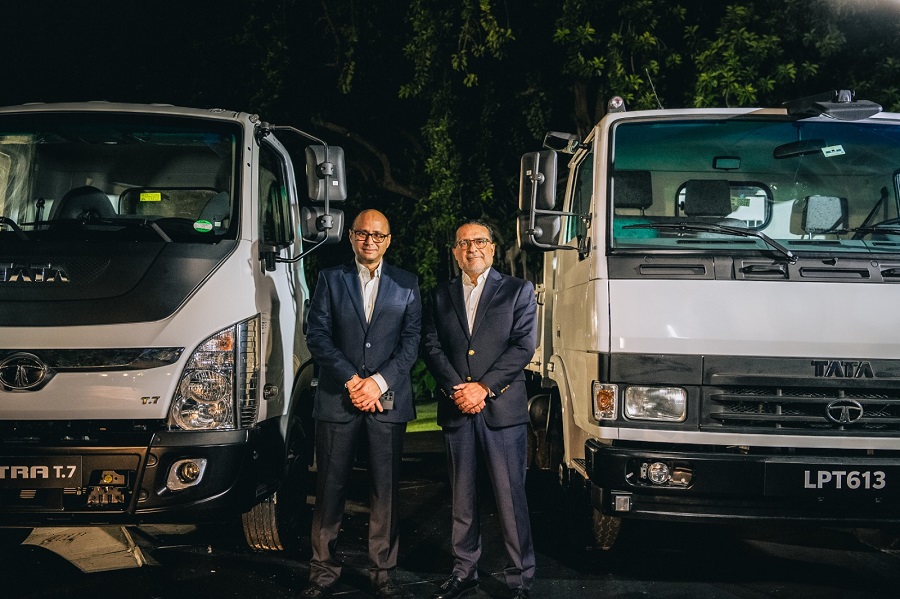
India’s commercial vehicle giant Tata Motors has wrapped up FY26 with a financial performance strong enough to make even its trucks honk in celebration. The company reported record quarterly and annual numbers for its standalone commercial vehicle business, driven by rising infrastructure activity, improved operational efficiency, and a sharper focus on profitability rather than just chasing volumes.
Tata Motors Ltd. announced that its standalone commercial vehicle business delivered Q4 FY26 revenue of ₹24.5K crore, up 22% year-on-year, while EBITDA surged 35% to ₹3.4K crore. Most notably, EBITDA margin touched 13.9%, officially entering what corporate presentations lovingly call the “teens zone.” EBIT margin climbed to 12.1%, helped by better realizations, higher volumes, and tighter cost controls.
Profit before tax for the quarter rose 58% to ₹3.0K crore, while profit after tax jumped 70% to ₹2.4K crore. Clearly, Tata’s trucks were not just carrying cargo this year — they were carrying balance sheets too.
For the full financial year FY26, Tata Motors’ standalone CV revenue stood at ₹77.4K crore, up 11%, with EBITDA rising 22% to ₹10.2K crore. EBIT margin improved to 11%, while profit before tax climbed 46% to ₹8.7K crore.
The company’s annual profit after tax came in at ₹3.4K crore, though this included the impact of exceptional items such as mark-to-market losses related to Tata Capital investments, demerger-related costs, and provisions linked to the New Labor Code. Even with those headwinds, Tata Motors managed to strengthen its financial foundation significantly.
Free cash flow for the year stood at a robust ₹9.2K crore, improving by ₹2.2K crore over FY25. Net cash for the domestic business reached ₹7.5K crore by March 31, 2026, while the company’s Auto ROCE touched an industry-leading 72%.
On the consolidated front, Tata Motors posted Q4 FY26 revenue of ₹26.1K crore, up 19%, with EBITDA margin improving to 13.1%. Quarterly consolidated PAT rose 35% to ₹1.8K crore. For the full year, consolidated revenues stood at ₹83.9K crore.
The company also recommended a final dividend of ₹4 per share, giving shareholders another reason to smile besides reading financial tables full of upward arrows.
Operationally, FY26 proved equally eventful. Tata Motors Commercial Vehicles recorded wholesales of 428K units during the year, up 14%, while exports surged an impressive 54%. Domestic and export demand remained strong across multiple segments.
The company maintained its dominant position in India’s CV market with an overall VAHAN market share of 35.7%, including a commanding 55% share in heavy commercial vehicles.
Tata Motors also used FY26 to aggressively refresh its product portfolio. The company launched 17 next-generation trucks aimed at improving safety, profitability, and operational efficiency. It also introduced the Ace Pro range, positioned as India’s most affordable four-wheel mini-truck, targeting small entrepreneurs and last-mile logistics operators.
One of the biggest highlights of the year came from overseas markets, where Tata Motors secured a massive order for 70,000 Yodha and Ultra T.7 vehicles for deployment in Indonesia. In India, the company also bagged over 5,000 bus orders from multiple State Transport Undertakings.
Meanwhile, the proposed Iveco acquisition continues to move forward, with Tata Motors stating that most regulatory approvals are already in place. The company expects to complete the transaction by Q2 FY27.
Commenting on the results, Girish Wagh, MD & CEO of Tata Motors Ltd., said FY26 marked a clear inflection point for the commercial vehicle industry, with overall industry volumes surpassing pre-FY19 levels thanks to GST 2.0 reforms and sustained infrastructure spending.
He added that despite geopolitical uncertainties and near-term moderation risks, Tata Motors remains well-positioned through proactive risk management, customer-centric solutions, and digitally enabled products offering strong total cost of ownership.
GV Ramanan, CFO of Tata Motors Ltd., highlighted that Q4 EBITDA margins crossing the “teens” milestone and free cash flow translating to nearly 12% of revenue were key achievements, placing the company ahead of its FY2027 targets.
The company also reported a sharp reduction in finance costs, which dropped to ₹166 crore in Q4 FY26 compared to ₹319 crore a year earlier — proof that sometimes the best way to reduce weight isn’t lighter trucks, but lighter interest bills.
With infrastructure spending continuing, fleet replacement cycles strengthening, and exports accelerating, Tata Motors Commercial Vehicles appears to be entering FY27 with strong momentum. And if FY26 was about shifting gears, FY27 may just be about cruising comfortably in the fast lane.
STANDALONE INCLUDING JOINT OPERATIONS TATA CUMMINS – Key financials
| Q4 FY25 | Q4 FY26 | FY25* | FY26 | Q4 vs Q4 | FY26 vs FY25 | |
| YoY | YoY | |||||
| Revenue (Rs. Cr.) | 19,999 | 24,452 | 69,419 | 77,399 | 4,453 (+22%) | 7,980 (+11%) |
| EBITDA % | 12.60% | 13.90% | 12.0% | 13.20% | 130 bps | 120 bps |
| EBIT % | 9.90% | 12.10% | 9.20% | 11.00% | 220 bps | 180 bps |
| PBT (bei) (Rs. Cr.) | 1,883 | 2,972 | 5,961 | 8,682 | 1,089 (+58%) | 2,721 (+46%) |
| FCF (Rs. Cr.) | 5,352 | 4,016 | 7,007 | 9,186 | (1,336) | 2,179 |
*Q1 FY25 numbers included within FY25 numbers are derived