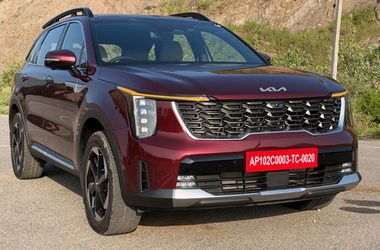
For years, the Indian SUV market followed a fairly straightforward recipe: tall roof, upright tailgate, enough black cladding to suggest an adventurous weekend lifestyle and, preferably, a silhouette that looked capable of frightening a medium-sized pothole into submission. Then Tata Motors decided Indian buyers might also fancy something a little more theatrical.
Enter the Tata Curvv.
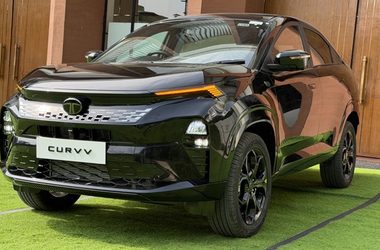
Launched in 2024, the Curvv brought the coupe-SUV shape into a considerably more accessible part of the Indian market. What you are looking at here is the 2026 version of the first-generation Curvv, specifically the Accomplished Dark Series X, priced at ₹15.54 lakh ex-showroom. The wider internal-combustion range starts at around ₹10 lakh and rises to approximately ₹19 lakh, while the electric Curvv starts at about ₹17 lakh.
It is an interesting proposition because the Curvv is trying to do several jobs simultaneously. It wants the visual drama of a coupe, the ground clearance and practicality of an SUV, the technology expected from a modern Tata and enough mechanical variety to appeal to both petrol and diesel buyers. That is quite a collection of hats for one car to wear, especially when one of them involves a dramatically sloping roof.
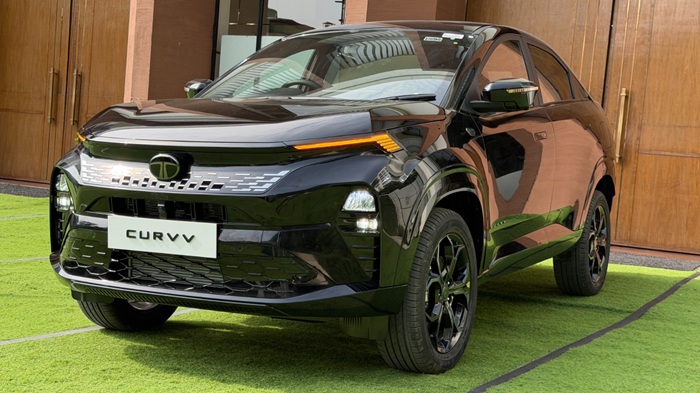
A new shape, but recognisably Tata
The Curvv rides on Tata’s Adaptive Tech-Forward Lifestyle Architecture, or ATLAS, platform, and was designed by Martin Uhlarik. Assembly takes place in Gujarat and Maharashtra.
More importantly, the Curvv represents Tata attempting to move the visual conversation beyond conventional compact and midsize SUVs. Its defining feature is obviously that fastback-style roofline. From the side, the roof begins its descent much earlier than it would on a traditional SUV, sweeping towards the rear in classic coupe-SUV fashion.
Calling anything with four doors and 208 mm of ground clearance a coupe may upset automotive traditionalists, but that semantic battle was lost years ago. BMW, Mercedes-Benz and plenty of others have already ensured that. Tata is merely bringing the argument to a considerably more affordable price point.
And visually, it works.
The Curvv measures approximately 4.3 metres long, 1.8 metres wide and 1.6 metres tall, with 208 mm of ground clearance. Those proportions give it enough road presence without turning urban parking into a surveying exercise.
The front has the now-familiar modern Tata appearance, with slim LED DRLs and sequential indicators sitting high up and the main lighting elements positioned lower down. The car uses automatic LED projector headlamps with High Beam Assist, accompanied by LED fog lamps with a cornering function.
There is a silver-finished skid plate lower down, giving the nose a touch more visual toughness. Whether most Curvv owners will ever actually scrape that skid plate across anything more threatening than an ambitious shopping-mall ramp is another matter.
Front parking sensors are fitted too, which are useful considering that contemporary cars increasingly seem determined to hide their extremities beneath styling.
The rain-sensing aero-blade wipers sit beneath a relatively clean windscreen area, while the exterior mirrors are electrically adjustable and auto-folding, and incorporate both turn indicators and cameras.
Move around the sides and the details become more interesting.
The wheel arches are squared-off rather than conventionally rounded, adding some visual muscle, while piano-black cladding runs around the lower areas. The test car’s Carbon Black paint works especially well with the Dark Series treatment, giving the Curvv a fairly sinister appearance without requiring fake vents or fluorescent trim to announce itself.
Other supplied colours include white, grey, red and blue, while dual-tone versions are offered with a black roof.
The Accomplished version seen here runs on 18-inch dark diamond-cut alloy wheels. Depending on specification, the Curvv can also be had with 17-inch alloys or steel wheels. On this car, the tyres are 215/55 R18 95H Goodyear EfficientGrip Performance radial tubeless tyres front and rear.
Behind them sit front disc brakes and rear drums; notably, even the top version uses rear drum brakes. It is not inherently problematic in everyday use, but at this price point and with the Curvv’s performance-oriented styling, visible rear discs would certainly have looked more appropriate through those large alloy wheels.
The suspension setup is relatively conventional. At the front are independent lower wishbones with McPherson struts, coil springs and associated hardware, while the rear uses a semi-independent open-profile twist beam with stabiliser bar, coil springs and shock absorbers.
There are also illuminated flush door handles, which help keep the side profile uncluttered. They look sophisticated at night, though flush handles remain one of those modern-car solutions to a problem most of us were unaware existed.
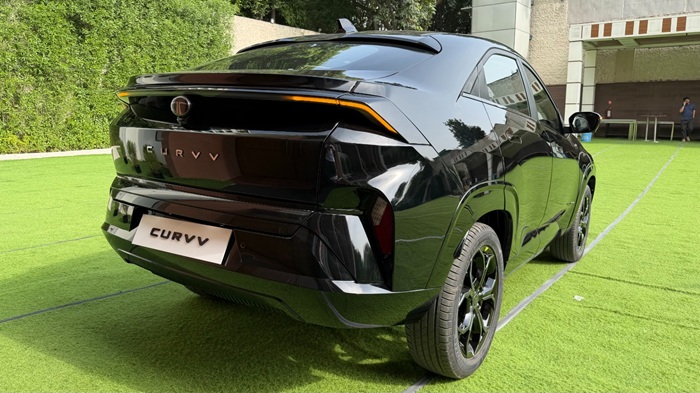
The rear is where the Curvv earns its name
Walk towards the back and the design becomes much more dramatic.
The roofline drops sharply into the tail, giving the Curvv its fastback character, while a gloss piano-black spoiler visually extends the roof. The rear receives LED tail lamps, and higher specifications add welcome and goodbye animations.
These lighting ceremonies serve no essential transport function whatsoever, of course, but that has never stopped them being satisfying in a dark basement car park.
The Curvv also features an automatic rear defogger, while the top variant introduces a gesture-controlled powered tailgate.
Crucially, the coupe styling has not completely destroyed practicality. Tata quotes 500 litres of boot capacity, increasing to 973 litres when the rear seats are folded. That is substantial enough for family luggage and gives the Curvv a real practical advantage over style-led vehicles that look good until somebody attempts to bring a suitcase.
There are also hooks rated for 1 kg, small details that tend to become surprisingly useful when you have groceries attempting to recreate a motorsport slalom event inside the boot.
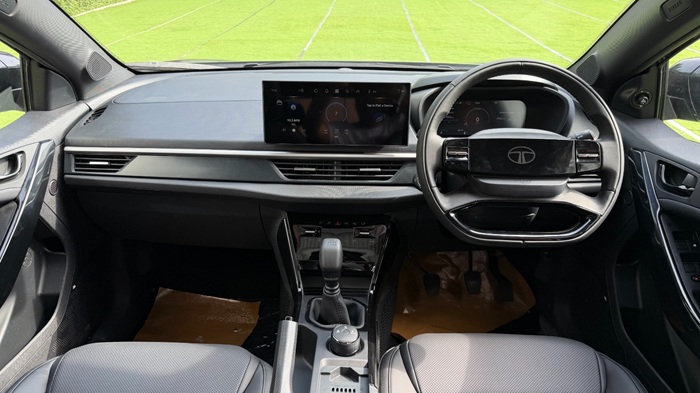
Inside: technology takes centre stage
Climb aboard and the Curvv immediately feels more modern Tata than old-school Tata. The dashboard is dominated by screens and gloss surfaces rather than acres of traditional switchgear.
Our car uses black leatherette upholstery, although fabric upholstery is also available depending on version. The Dark Series treatment creates a suitably moody cabin, assisted by ambient lighting.
The driver’s seat is a six-way electrically adjustable Ergo Lux seat, while the front passenger gets six-way adjustment. The front seats also feature ventilation with shell foam, something Indian buyers will probably appreciate more than another decorative dashboard animation during May.
Front occupants also get height-adjustable seatbelts, while the driver’s window offers one-shot up/down operation.
The steering wheel deserves a mention because it has become one of Tata’s defining interior details. It is a leatherette-wrapped four-spoke illuminated digital steering wheel, with controls for phone functions, volume, infotainment and voice commands.
Steering assistance is electric, and the wheel offers tilt adjustment.
Ahead sits a 10.25-inch digital cockpit instrument cluster, providing information including speed and navigation. Lower variants receive a smaller 4-inch instrument display.
The main infotainment screen measures a generous 12.3 inches and comes from Harman. It supports wireless Apple CarPlay and Android Auto, navigation, multiple voice assistants, JBL sound modes, over-the-air updates, what3words, Wi-Fi connectivity, USB, Bluetooth, air-purifier information, AQI display, FM and radio.
Lower Curvv variants make do with either a 10.25-inch or 7-inch infotainment display, depending on specification.
The system is paired here with a nine-speaker, 320-watt JBL Cinematic Sound system with subwoofer. That should provide enough audio output to compete with the average Delhi wedding procession, although the objective is hopefully fidelity rather than merely volume.
Higher versions also offer Alexa voice commands.
Below the screen sits Tata’s Phygital control panel, blending touch-sensitive and physical-style controls. The Curvv also includes fully automatic climate control with Xpress Cooling and an air purifier, while the top version upgrades to dual-zone climate control.
There is a cooled illuminated glovebox, a wireless phone charger and a voice-assisted panoramic sunroof. The top trim adds mood lighting around the sunroof too, because apparently opening a giant piece of glass above your head was no longer dramatic enough by itself.
Still, a panoramic roof remains a big attraction in this market, especially for rear passengers.
Rear-seat life
This is where coupe-SUVs usually have to answer uncomfortable questions.
The Curvv’s sloping roofline inevitably creates concern about rear headroom, yet Tata has attempted to preserve everyday usability rather than sacrificing the entire second row on the altar of styling.
The rear bench offers a 60:40 split-folding layout and, importantly, two-stage reclining backrests. That ability to alter the seat angle should improve comfort on longer journeys and partly compensate for the more rakish roof.
There is also a sunshade, useful in India’s climate and particularly welcome when the design includes large glass areas.
As supplied, the Curvv seats five and balances its coupe profile with genuine luggage capacity. It is not pretending to be a seven-seat family transporter, nor should it. The point is to offer something with a more interesting silhouette without requiring owners to pack as though they are boarding a low-cost airline.
The connected-car question
Top variants feature Tata’s iRA 2.0 connected-car application, through which owners can access vehicle health monitoring, remote commands, geofencing, immobilisation, valet mode, alerts, driving scores, service booking, live vehicle tracking, location services and other functions.
Connected-service pricing starts at around ₹2,000 per year.
Some people will use these functions constantly. Others will discover them during the first week of ownership, remotely flash the lights twice to impress somebody and then forget their password for six months. Either way, the underlying technology is now becoming an expected part of this segment.
Three engines, two gearboxes
One of the Curvv’s strongest advantages is powertrain choice.
The diesel uses a 1.5-litre, inline-four KryoJet engine, producing 116 hp and 260 Nm. It can be paired with a six-speed manual transmission or seven-speed DCA automatic.
The automatic deserves particular mention because Tata uses a wet-clutch DCA with active cooling technology. Wet-clutch dual-clutch systems are generally better suited to dealing with heat than comparable dry-clutch arrangements, an important consideration in Indian traffic where transmissions can spend considerable time crawling through congestion.
There are two petrol options.
The first is the familiar 1.2-litre inline-three E20-compliant Revotron engine, developing 118 hp and 170 Nm.
Above it sits the newer 1.2-litre inline-three E20-compliant Hyperion Gasoline Direct Injection engine, producing 123 hp and a significantly stronger 225 Nm.
Petrol versions also come with the choice of six-speed manual or seven-speed DCA automatic transmissions.
The Curvv offers three selectable drive modes: Eco, City and Sport. The names are self-explanatory. Eco aims to reduce enthusiasm in the interest of efficiency, City is intended as the everyday setting and Sport sharpens things when the road — and traffic conditions — allow.
The diesel’s 260 Nm figure should make it particularly suited to relaxed overtaking and loaded highway use. Rather than needing repeated downshifts, that torque should give the Curvv the useful mid-range shove buyers traditionally associate with turbo-diesel SUVs.
The Hyperion petrol, meanwhile, is the more interesting option on paper for those wanting stronger performance without switching to diesel. Its 225 Nm is substantial for a 1.2-litre three-cylinder engine and should give it a much healthier mid-range than the 170 Nm Revotron.
No official acceleration or top-speed figures were supplied here, so it would be wrong to manufacture them simply because a coupe silhouette encourages stopwatch talk.
What should it feel like on the road?
The Curvv’s engineering brief appears to prioritise stability and everyday usability rather than chasing sports-car responses beneath an SUV body.
Its 208 mm ground clearance is generous enough for broken roads, oversized speed breakers and the various geological formations that occasionally appear without warning in Indian cities.
At low speeds, the combination of 18-inch wheels and 215/55 tyres means the car may not possess the pillow-soft ride of a smaller-wheel version, but the suspension architecture is conventional and well suited to the vehicle’s purpose.
The electrically assisted steering should keep urban manoeuvring relatively easy, while the broader stance and long body should contribute to highway stability.
There is no suggestion here that the Curvv is attempting to behave like a genuine performance coupe. Nor should it. A high-riding, five-door crossover carrying five people and nearly 1,000 litres of potential cargo volume with its seats folded is playing a very different game.
The objective is to provide enough composure that the dramatic body shape does not feel like false advertising.
Braking comes from discs at the front and drums at the rear. Again, rear drums are perfectly capable of performing the required job, though enthusiasts may question their presence on a vehicle wearing 18-inch wheels and premium positioning.
Efficiency
According to the figures supplied, the 1.5-litre diesel is capable of around 17 km/l, paired with a 44-litre fuel tank.
The 1.2 Revotron petrol is also quoted at around 17 km/l, while the more powerful Hyperion direct-injection petrol is listed at approximately 14 km/l.
These figures should be treated as stated or approximate economy numbers rather than guaranteed real-world consumption. Actual efficiency will inevitably depend on gearbox, traffic, driving style, load and climate-control use.
And in a turbo-petrol car with a Sport button, one’s right foot occasionally develops opinions of its own.
Safety is one of the Curvv’s strongest arguments
Tata has made safety a major part of its brand identity, and the Curvv has the credentials to support that positioning.
The vehicle has received a five-star Bharat NCAP safety rating.
Its safety equipment includes six airbags, ABS, EBD, Electronic Stability Program, traction-related electronic assistance, seatbelt reminders, a Tyre Pressure Monitoring System, hill-hold assist, hill-descent control, ISOFIX child-seat mounts, three-point ELR seatbelts, keyless entry, brake-disc wiping, park assist, remote central locking, a puncture-repair kit and rear-door child locks, among other equipment.
Higher specifications expand the electronic safety package considerably.
The Accomplished X+ adds Level 2 ADAS, incorporating Lane Departure Warning, Lane Keep Assist, Blind Spot Detection, Blind Spot View Monitor, 360-degree 3D Surround View Camera, Lane Change Alert, Forward Collision Warning, Automatic Emergency Braking, Traffic Sign Recognition, Over Speed Alert, Rear Cross Traffic Alert, Rear Collision Warning, Driver Doze-off Alert, Adaptive Cruise Control and Door Open Alert.
That is a lengthy list, but several of these features can be genuinely useful rather than merely brochure decoration.
A blind-spot view monitor and 360-degree camera make everyday urban driving easier, while rear cross-traffic alert can be valuable when reversing out of spaces with poor visibility. Automatic emergency braking and forward-collision warning add another layer of protection.
Adaptive cruise control, particularly with stop-and-go functionality, should also reduce fatigue in suitable traffic conditions, though as with any ADAS-equipped car in India, the driver remains responsible for supervising the system.
Ownership
Tata provides a three-year/1 lakh km warranty on the Curvv.
That is useful coverage for buyers expecting significant annual mileage, particularly diesel customers who may choose the Curvv specifically for long-distance highway use.
The broader Tata dealer and service footprint also makes the Curvv a less adventurous ownership proposition than an unfamiliar niche model might be. That matters because the design may look relatively exotic, but the car underneath still needs to function as an everyday family vehicle.
Where does the Curvv fit?
The Curvv occupies an unusual place in India because its biggest selling point is not simply equipment, horsepower or cabin space. It is the combination.
Conventional SUVs may offer a more traditional upright rear profile. Some rivals may feel more spacious in the back, others may have more polished petrol engines, softer suspension tuning or simpler cabin controls. But relatively few offer the Curvv’s combination of coupe-inspired styling, diesel availability, dual-clutch automatic gearbox, substantial boot space, high ground clearance, connected technology and five-star Bharat NCAP credentials at this price.
And that is why the car makes sense.
A buyer choosing a Curvv probably wants something noticeably different from the anonymous rectangular SUV parked next door, but cannot afford to sacrifice practicality simply for design.
This Accomplished Dark Series X at ₹15.54 lakh sits in an especially interesting part of the range. It delivers much of the visual drama and premium atmosphere associated with the Curvv without necessarily pushing towards the roughly ₹19 lakh upper end of the combustion-engine line-up.
Buyers who want the full ADAS suite, gesture-operated tailgate, additional climate features and the most extensive technology package will naturally look further up the range.
Verdict
The Tata Curvv is not simply a conventional SUV with its roof chopped diagonally and a new badge attached. There is enough substance underneath the styling to make the concept work.
It has 208 mm of ground clearance, a useful 500-litre boot, multiple turbocharged petrol and diesel choices, manual and dual-clutch automatic gearboxes, sophisticated connected-car technology and a strong collection of safety equipment. The five-star Bharat NCAP rating gives the Curvv credibility beyond the fashion statement suggested by its silhouette.
There are compromises. The dramatic rear roofline may not suit buyers who prioritise maximum rear-seat airiness. Rear drum brakes feel slightly unglamorous behind those handsome 18-inch wheels. Some people will also prefer the simplicity of fewer screens, fewer touch controls and door handles that do not feel the need to make an entrance.
But those are relatively minor criticisms of a car with a very clear identity.
The diesel remains appealing for buyers covering serious highway mileage, while the Hyperion direct-injection petrol looks like the more interesting choice for drivers wanting stronger petrol performance. The Revotron provides the more familiar middle ground.
And then there is the styling.
Park a Curvv beside a conventional SUV and the Tata immediately looks less ordinary. It has the slightly extravagant quality that coupe-SUV buyers usually have to pay considerably more money to obtain.
That ultimately defines the Curvv. It is not trying to be the most hardcore SUV, nor the sharpest sports car, nor merely the cheapest route into a long equipment list. Instead, it tries to make everyday family transport feel a little more special.
The Tata Curvv Accomplished Dark Series X succeeds because underneath the dramatic roofline, illuminated steering wheel and nightclub-friendly black paint is something refreshingly sensible: a practical, safety-conscious Indian family car that simply refuses to dress like one.