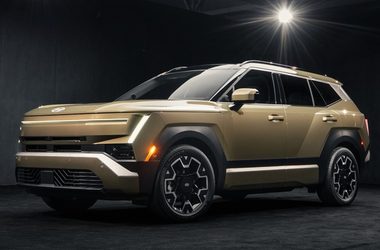
NEW YORK: Hyundai Motor Company has unveiled the all-new Tucson, giving its best-selling global SUV a major overhaul with a larger body, a new hybrid system targeting up to 42 mpg, Pleos Connect infotainment with Gleo AI, and an adventure-focused XRT Pro variant equipped with dedicated off-road technology.
The new-generation Tucson made its global debut against the Manhattan skyline in New York City and introduces Hyundai’s latest “Art of Steel” design philosophy. It will first go on sale in Korea later in 2026, followed by North America, Europe and other global markets in 2027.
The redesign comes at an important point for one of Hyundai’s most successful nameplates. Since its debut in 2004, the Tucson has recorded cumulative global sales of more than 11.1 million units, making it Hyundai Motor’s best-selling SUV worldwide.
“Millions of families around the world count on the Hyundai Tucson, and this is the best one we have ever built. Its combination of bold design, generous cabin space, seamless infotainment, and available hybrid efficiency sets a new standard for what customers should expect in this segment. Tucson opens the most ambitious product offensive in our history, including more than 100 new and refreshed vehicles globally by 2030 — 58 in North America alone,” said José Muñoz, President and CEO, Hyundai Motor Company.
Bigger dimensions, bolder design
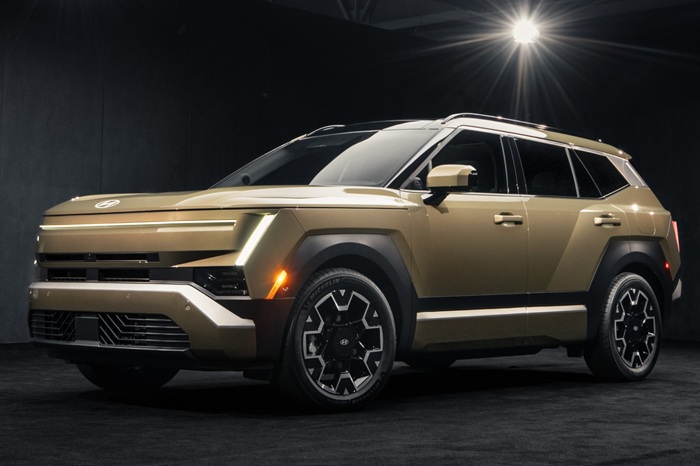
Hyundai has substantially changed the Tucson’s proportions as part of the new “Art of Steel” design direction.
The long-wheelbase version measures 4,700 mm in length, 1,905 mm in width and 1,685 mm in height. Compared with the previous model, that represents increases of 60 mm, 40 mm and 20 mm respectively.
Pronounced wheel arches and muscular fenders give the SUV a stronger visual stance, while comparatively restrained door surfaces and sharper body lines prevent things from becoming too visually busy — an increasingly valuable skill in the modern SUV world.
Hyundai says the front-end structure has also been designed to improve pedestrian safety and forward protection in a collision.
Door opening angles have increased from 73 degrees to 83 degrees, improving access to the cabin.
The new Tucson introduces several nature-inspired exterior colours, including Ranger Green Pearl/Matte, Kodiak Blue Pearl, Driftwood Gray Metallic/Matte and Red Rock Orange Pearl/Matte.
Lighting also plays a major part in the redesign. Hyundai’s new H-Edge front lighting uses indirect central illumination combined with edge lighting to visually widen the SUV.
At the rear, Prism Rear Lamps create a new lighting signature, while an available Micro Pixel Lighting system uses 25,600 individual LED pixels. Hyundai says the technology can generate precision beam patterns, a rain guide and dynamic welcome and farewell animations.
LED headlamps use a two-in-one module arrangement, while LED tail lamps are standard across the range.
More spacious, more conventional where it matters
Inside, Hyundai has taken a relatively minimalist approach while retaining physical controls for frequently used functions.
The dashboard follows a two-layer layout. A horizontal upper section houses the principal displays, while a deep open tray underneath provides additional storage.
A 9.9-inch slim driver display sits above the steering column behind a Double D-Cut steering wheel.
Importantly for drivers who would rather not negotiate a touchscreen simply to adjust the temperature, Hyundai has retained tactile controls below the centre display for commonly used climate-control and audio functions.
Dual 15-watt wireless charging pads are available, while a hidden storage tray is integrated into the centre console.
The new Tucson provides 1,036 mm of front headroom, 1,064 mm of rear legroom and 1,470 mm of front shoulder room.
An available Ergo Motion Seat uses a seven-cell pneumatic lumbar and bolster massage system with both manual and automatic modes. Hyundai will also offer a four-link Relaxation Comfort Seat that can recline by 10 degrees at the touch of a button while the vehicle is parked.
Gear selection moves to a steering-column-mounted Shift-By-Wire lever, freeing additional space in the centre console.
The climate-control system includes Hyundai’s Multi-Air Mode, which distributes conditioned air through several outlets to reduce concentrated airflow. An optional three-zone HVAC system allows separate climate settings for front and rear occupants.
One of the more unusual options is 13.5V Metal-Coated Heated Glass. Hyundai claims it can fully de-ice the glass in 15 minutes during winter, while rejecting 60 percent of solar energy and keeping the cabin approximately 2 degrees cooler in summer.
Hybrid targets up to 42 mpg
Electrification plays a central role in the new Tucson line-up.
Hyundai’s Next-generation Hybrid System has been developed around what the company calls “Intelligent Efficiency”, with the hybrid targeting fuel economy of up to 42 mpg while achieving 0–60 mph acceleration in 8.5 seconds.
Hybrid models also receive an E-Traction system that adjusts driving torque to reduce wheel slip during cornering and improve stability.
A new HEV Stay Mode allows occupants to operate features such as the air-conditioning, heating, audio system and device charging while the petrol engine is switched off, providing an EV-like stationary cabin experience.
For buyers choosing a conventional engine, Hyundai lists a 1.6-litre turbocharged GDI unit producing 184 hp and 27.0 kgf·m of torque, paired with an eight-speed automatic transmission.
Both conventional and electrified powertrains use an integrated electric water pump system designed to consolidate cooling circuits and reduce weight.
Plug-in hybrid offers 292 PS and 81 km EV range
The Tucson Plug-in Hybrid combines a 1.6-litre turbocharged petrol engine with an electric drive system.
Total output is rated at 292 PS, with 38.7 kgf·m of torque.
Hyundai estimates an all-electric driving range of 81 km, potentially allowing many shorter daily journeys to be completed without starting the combustion engine.
A 7.2 kW onboard charger is included for AC charging.
The specification indicates Hyundai is attempting to position the Tucson’s electrified versions not merely as economy-focused alternatives, but as mainstream powertrains intended to balance efficiency and usable performance.
Pleos Connect brings Gleo AI into the Tucson
The technological centrepiece of the new cabin is Hyundai’s Pleos Connect infotainment system.
Based on Android Automotive OS, Pleos Connect can be configured with either a 17-inch or 12.9-inch primary touchscreen, paired with the 9.9-inch driver display.
The interface supports three-finger gesture controls and a single-screen viewing mode.
Its headline feature is Gleo AI, Hyundai’s in-car agentic AI system designed to understand conversational requests and their context.
Hyundai gives the example of a driver asking: “Find a hiking trailhead with parking within 30 minutes,” after which the system can identify relevant destinations without requiring the user to manually work through several menus.
Pleos Connect can also integrate third-party entertainment, productivity and gaming services directly through its Android Automotive architecture without relying on smartphone mirroring.
Over-the-air software updates will allow Hyundai to add or modify functionality after the vehicle has been sold.
Greater focus on driver monitoring and safety
The Tucson’s redesigned structure makes extensive use of hot-stamped steel, including reinforcement around critical sections of the body and centre pillars.
Hyundai says the structure has been engineered to distribute collision loads through multiple paths while improving overall body rigidity.
Inside, an In-Cabin Monitoring Unit monitors the driver’s eye activity and signs of drowsiness, issuing fatigue alerts when necessary.
Child Presence Detection and Rear Occupant Alert systems can warn the driver when a child or pet may have been left inside the vehicle.
Intelligent Speed Limit Assist can recognise posted speed limits and adjust the set vehicle speed, while Navigation-Linked Smart Cruise Control uses map information to anticipate curves, roundabouts, intersections and speed bumps.
Tucson gets Hyundai’s first Smart Terrain Assist
Hyundai is also pushing the Tucson further into off-road territory with a collection of new electronic driver-assistance systems.
The SUV debuts the company’s first Smart Terrain Assist, which continuously assesses traction and wheel-slip conditions.
The system displays what Hyundai calls a “stuck score”, using green, orange and red indicators to tell the driver how difficult the terrain is becoming.
Target Speed Control works between 2 and 25 km/h and can automatically regulate acceleration and braking over difficult surfaces, leaving the driver to concentrate primarily on steering.
An available Memory Reversing Assist can record a vehicle’s path at speeds of up to 30 km/h and assist with steering when reversing along narrow sections.
Ground View Monitor provides a digital view of the terrain directly ahead of and underneath the vehicle.
For drivers towing trailers, Trailer Reverse Assist can semi-automatically control steering alignment while reversing.
North American Tucson Hybrid models will have a maximum towing capacity of 3,000 lb, or 1,361 kg — an increase of 1,000 lb compared with the previous model.
European towing capacities have also increased, according to Hyundai, by as much as 350 kg for the internal-combustion version, 260 kg for the hybrid and 450 kg for the plug-in hybrid compared with their predecessors.
XRT Pro gets 210 mm ground clearance
The new Tucson will also be available in XRT and more extreme XRT Pro versions.
The regular XRT uses wider exterior cladding, enlarged wheel-arch protection and a forged-carbon-inspired visual treatment around the lower sections of the vehicle.
More substantial changes arrive with the Tucson XRT Pro.
It comes with all-wheel drive, all-terrain tyres, redesigned approach and departure angles and front recovery hooks.
Ground clearance rises to 210 mm, which is 30 mm more than the standard Tucson.
The model receives additional lower-body cladding for protection as well as unique wheel designs and XRT-specific interior detailing.
The combination of electronic terrain management and genuine hardware changes suggests Hyundai wants the XRT Pro to offer more than just the appearance of an off-road package.
Tucson remains a major global model for Hyundai
The Tucson has grown into one of Hyundai’s most important products since the first generation was introduced in 2004.
Cumulative worldwide sales have now passed 11.1 million vehicles.
The United States alone accounts for roughly 20 percent of the Tucson’s cumulative global sales.
Electrified versions are also becoming increasingly important. Hybrid models represented 31 percent of all Tucson sales in the U.S. during 2025, according to Hyundai.
The company has separately confirmed that a new sport-inspired Tucson variant will make its debut at the 2026 Paris Motor Show on October 12.
The all-new Tucson will reach Korea later in 2026, followed by North America, Europe and other markets during 2027.
With a larger cabin, more sophisticated electrified powertrains, AI-driven infotainment and an XRT Pro that appears willing to get its tyres dirty rather than merely look the part, the new Tucson reflects how broad the modern family-SUV brief has become. For Hyundai, the challenge will now be translating all that technology and versatility into another successful chapter for a nameplate that has already sold more than 11 million examples worldwide.