
The Toyota Hilux is one of those vehicles whose reputation arrived long before the marketing department did. Ask people in cities and they’ll tell you it is a large, intimidating pickup truck. Ask farmers, miners, expedition drivers or people living in places where roads are more of a government proposal than a physical object, and they’ll probably describe it as equipment.
That distinction matters.
The Hilux was first launched in 1968, and what you are looking at here is the 2026 ninth-generation Toyota Hilux. Nearly six decades have passed since the original arrived, yet the basic philosophy remains beautifully uncomplicated: make something strong, make it dependable, and make sure it still works after its owner has done something that would make the warranty department nervous.
The latest generation carries the AN220 codename, and although this is recognisably a Hilux, Toyota has given it a considerably more modern personality. It looks sharper, the cabin is far more digital, the safety package has grown, and the overall design now has enough futuristic detailing to stop it looking like something permanently assigned to a construction site.
But underneath all the new technology, this remains a body-on-frame pickup with serious four-wheel-drive hardware, a one-tonne-class payload and a 2.8-litre diesel producing 500 Nm.
In other words, the smartphone has been upgraded. The hammer underneath remains very much a hammer.
Price and Positioning
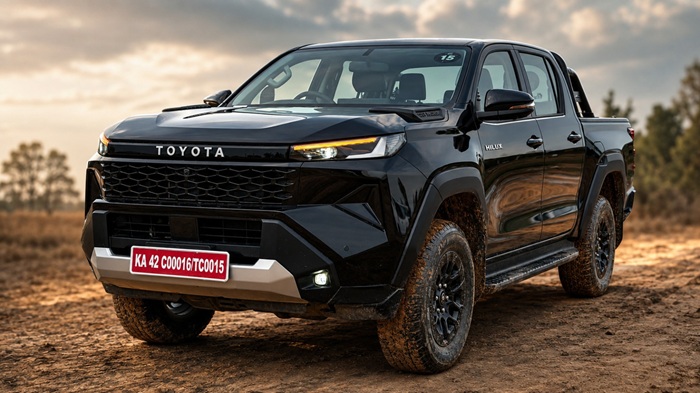
In India, the 2026 Toyota Hilux is currently available only with the diesel engine, and the range starts at roughly ₹32 lakh ex-showroom. The version you are looking at here is the flagship VX 4×4 AT, sitting at around ₹36.7 lakh ex-showroom.
Which means, once registration and insurance have entered the conversation, you are very firmly in premium-SUV money.
That inevitably raises the question: why would anyone spend Fortuner money on a vehicle with an open cargo bed at the back? The answer is simple. Because a Hilux can do things a conventional premium SUV simply cannot.
You can fill the rear bed with muddy equipment, motorcycles, camping gear, construction material or almost a tonne of cargo without spending the journey worrying about the beige carpet in your boot.
And if your weekend involves towing a large trailer, crossing a river and then carrying several hundred kilograms of equipment into the wilderness, suddenly a panoramic sunroof begins to feel rather less important.
Four Doors Here, Many More Hiluxes Elsewhere
The Indian Hilux is the four-door double-cab version, giving you proper rear seats as well as the cargo bed.
Globally, however, the Hilux family is much larger. Toyota sells two-door versions, single cabs, cab-chassis versions and various work-focused derivatives depending on the market. There are even petrol and electric versions internationally, although India currently sticks with the diesel.
The same applies to trims. Around the world you’ll find names such as WorkMate, Rogue, Rugged, PreRunner, Overland and other market-specific derivatives, each aimed at a slightly different job.
Some are lifestyle pickups. Some are genuinely luxurious. And some look as though their entire existence revolves around being covered in dust before breakfast. India gets a comparatively focused line-up.
The New Fortuner Connection
If you are wondering why certain elements of this new Hilux appear important beyond the pickup itself, there is a good reason.
The upcoming next-generation Toyota Fortuner is expected to share plenty of design, engineering and technology themes with the new Hilux.
So in many ways, this truck gives us a fairly good preview of where Toyota’s next big ladder-frame SUV is heading.
That connection is hardly surprising because the Hilux and Fortuner have always been closely related mechanically. Both belong to Toyota’s utility-vehicle family and use rugged architecture intended for markets where durability matters more than fashionable engineering terminology.
The Hilux uses Toyota’s IMV — Innovative International Multi-purpose Vehicle — architecture, a platform family that has underpinned products including the Fortuner and various other utility vehicles.
Its biggest selling point isn’t sophistication. It is the ability to take punishment.
Cyber Sumo: Yes, That’s Really the Design Philosophy
Toyota describes the design language of the new Hilux as “Cyber Sumo.” Which sounds like the name of either a futuristic wrestling championship or an arcade game from 1997. But visually, it makes sense.
The idea combines the planted, muscular stance of a sumo wrestler with futuristic, technical surfaces. The front is broad and upright, the shoulders are heavily sculpted and the entire truck looks as if it has spent several years lifting weights while studying industrial design.
Toyota also talks about a “Tough & Agile” philosophy. That is probably the better way of describing it. The previous Hilux always looked strong, but it sometimes looked strong in the way a generator looks strong. The new one has considerably more visual drama. The design work is associated with Toyota’s global design teams, including designer Nicolas Hogios, whose work has been closely connected with Hilux development in Australia.
And Australia is exactly the sort of place where you want your pickup truck being evaluated. They take “utes” rather seriously over there.
Front End: Maximum Intimidation
The front is dominated by a large honeycomb grille, and the entire nose now feels wider and more assertive.
The slim LED headlamps come with LED daytime running lamps and a welcome function, while LED fog lamps sit lower down.
The bonnet itself is high and muscular, which gives the driver a wonderful command-the-road feeling from behind the wheel. It also creates a very specific sensation when you pull up behind a small hatchback at a traffic light.
From the Hilux, the hatchback appears less like another vehicle and more like an item you accidentally forgot to put in the load bed.
The new lights and sharper surfaces help make the Hilux look more premium, but Toyota has wisely avoided making it delicate. It still looks like it would be entirely comfortable wearing several layers of mud.
The Side Profile Is Where the Size Hits You
Walk around the side and the sheer scale becomes obvious. The Hilux is approximately 5.3 metres long, around 1.8 metres wide and roughly 1.8 metres tall. That makes it considerably longer than most SUVs on Indian roads.
It is the sort of vehicle where you don’t simply enter a multi-level car park. You study the height clearance first, inspect the turning ramps and perhaps draw a small architectural plan.
The turning radius is around 6.3 metres, so tight U-turns require a little planning. You don’t flick this thing around casually like a hatchback. You prepare.
Kerb weight sits at roughly 2,100 kg, depending on specification, while gross vehicle weight can approach 3.5 tonnes. And yet, despite those numbers, the Hilux doesn’t look clumsy.
Toyota has managed to give it enough muscle around the arches and enough horizontal definition along the body to disguise some of its considerable length.
Attitude Black Suits It Perfectly
The colour you see here is Attitude Black, and frankly, the Hilux suits dark paint extremely well. It makes the body look tighter, the arches more aggressive and the grille even more imposing.
Other shades are available, including white, red, gold-toned and ash-type finishes depending on the specification. But in black, the Hilux has a particular presence. It doesn’t look parked. It looks like it has been assigned somewhere.
17-Inch Wheels: Sensible Beats Flashy
This Indian version runs on 17-inch alloy wheels with 265/65 R17 Bridgestone Dueler all-terrain radial tubeless tyres.
Some overseas Hilux versions get 18-inch wheels, but they are not part of the Indian specification. And that is probably a good thing. A pickup like this actually benefits from having proper tyre sidewalls.
Twenty-inch wheels may look fantastic outside a luxury hotel, but off-road, tyre sidewall is your friend. It helps absorb impacts and gives you a much better chance of surviving sharp rocks without turning an alloy wheel into modern art.
The Hilux gets disc brakes at the front and drum brakes at the rear. Yes, rear drums on a vehicle costing this much will attract comments.
But remember, this is still engineered fundamentally as a workhorse. Drum brakes are durable, simple and perfectly suited to heavy-duty commercial applications. Would four-wheel discs look better on the specification sheet?
Absolutely. Will the Hilux care? Probably not.
Proper Ladder-Frame Hardware
The Hilux uses a body-on-frame chassis, which is one of the biggest reasons it behaves so differently from a crossover SUV. A monocoque SUV integrates the body and structural shell.
The Hilux places the body on top of a separate heavy-duty frame. This construction gives it enormous strength for towing, payload work and repeated off-road use.
It also explains why Hiluxes have spent decades working in mines, farms, deserts, forests and remote regions where vehicle breakdowns can be considerably more serious than missing dinner reservations.
The downside is additional weight and a ride quality that will never feel as polished as a road-focused monocoque SUV.
The upside is that you can attach a large trailer, fill the bed with cargo and then drive somewhere where the road disappears.
Suspension: Built for Work First
At the front you get double-wishbone suspension, while the rear uses a rigid axle with leaf springs.
Toyota says the suspension is comfort tuned, and compared with older pickups, this generation is certainly much more civilised. But there is no hiding what is happening underneath.
Leaf springs are brilliant when you’re carrying serious weight. When the bed is empty, however, the rear suspension can feel firmer and busier over broken roads.
That isn’t a flaw so much as a consequence of designing one vehicle to carry four passengers today and close to a tonne of material tomorrow.
Toyota has worked on pitch and bounce control, and it also uses features such as hydraulic engine mounts and shear-type body mounts to reduce unwanted vibration entering the cabin.
So while it may still feel like a pickup, it no longer feels like the driver is directly connected to the chassis using agricultural equipment.
4TREX Four-Wheel Drive
The Hilux is equipped with Toyota’s part-time 4TREX four-wheel-drive system, controlled through an electronic transfer switch.
In normal road use, you can operate it in rear-wheel drive.
When the surface becomes loose or slippery, you can engage H4 high-range four-wheel drive.
And when the terrain becomes properly serious, you have L4 low range.
Low range is where a proper off-roader separates itself from lifestyle SUVs.
It allows the vehicle to crawl at very low speeds while multiplying usable torque, which is exactly what you need on steep climbs, deep mud, rocks or technical terrain.
There is also an electronic rear differential lock.
Activate it and both rear wheels are mechanically encouraged to rotate together, helping when one wheel loses traction.
Because when you’re halfway up a slippery incline, the last thing you want is one wheel spinning enthusiastically while the other has apparently decided to take the afternoon off.
Auto LSD and Traction Systems
The Hilux also uses an automatic limited-slip differential function to improve mobility when wheelspin is detected.
Combined with traction control, low-range gearing, downhill assist and the locking differential, it gives the Hilux a proper off-road toolkit.
And this is where the difference between a real pickup and a fashion SUV becomes obvious.
Some SUVs have an animated graphic of mountains on the touchscreen.
The Hilux has hardware.
Ground Clearance and Water Wading
Ground clearance is substantial, and the Hilux has been designed with serious rough-road ability in mind.
Depending on the exact specification and measurement standard, figures of around 300 mm-plus are associated with the new truck, while the vehicle can handle water depths of approximately 700 mm under suitable conditions.
Now, that does not mean you should drive into every flooded road because Toyota printed a wading figure.
Moving water, hidden potholes and poor judgment remain perfectly capable of defeating even a very capable pickup.
But it does give you an indication of how seriously this thing has been engineered for bad conditions.
It Can Tow 3.5 Tonnes
Properly configured, the Hilux can tow up to around 3,500 kg.
That is serious towing ability.
Caravan?
Fine.
Boat?
Fine.
Trailer full of equipment?
Fine.
A small moon?
Toyota hasn’t officially rated it.
The combination of the ladder-frame chassis, 500 Nm diesel engine and low-range transfer case gives the Hilux the sort of pulling ability you actually want when towing heavy loads.
The Rear Bed Is the Point
Then we arrive at the part that separates the Hilux from the Fortuner.
The cargo bed.
Payload can approach 1,000 kg, depending on the exact version and market configuration.
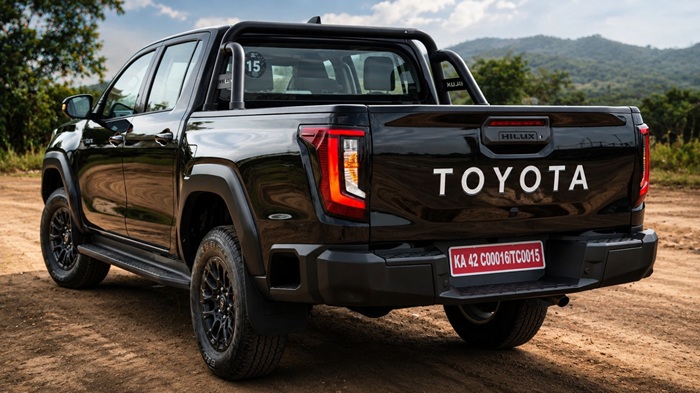
There are tie-down points, integrated steps and a tailgate assist system to make opening and closing the large tailgate easier.
Toyota has also included an integrated rear bed step, which sounds like a minor detail until you’ve tried climbing into the back of a tall pickup while carrying something heavy.
There is around 470 litres of quoted cargo volume depending on how the space is measured, although conventional boot-volume figures are slightly meaningless here.
Because unlike a closed SUV boot, the load doesn’t have to stop when it reaches the roof.
There is no roof. Want to carry a large appliance?
Fine. Camping gear?
Fine. A dirty mountain bike?
Throw it in. A conventional SUV owner would be looking for protective covers. A Hilux owner would be looking for another ratchet strap.
Rear Styling
At the rear, the truck gets LED combination tail lamps, an LED high-mounted stop lamp and a rear defogger.
The styling is modern but restrained. Toyota could easily have overdesigned the tailgate in an effort to make it look expensive. Instead, it still looks like a proper pickup bed. Exactly as it should.
2.8-Litre 1GD-FTV Diesel
Under the bonnet sits Toyota’s familiar 2.8-litre 1GD-FTV turbo-diesel engine.
It is an inline-four, 16-valve, DOHC common-rail direct-injection diesel complying with the latest BS6 requirements for India.
Output is roughly 204 PS, while peak torque is a substantial 500 Nm. And it is the torque figure that matters most.
Pickup trucks do not need to scream to 7,500 rpm. They need to pull.
This engine produces a big, muscular wave of torque through the mid-range, which makes the Hilux feel effortless during overtaking, climbing and load carrying. Put your foot down and it doesn’t snap forward like a sports sedan.
Instead, it develops momentum with the confidence of something that knows the object attached behind it probably weighs more than your first car.
The 1GD Engine Family Is Everywhere
Toyota’s GD-series diesel family has been used across a remarkable variety of vehicles.
Depending on market and application, engines from this family appear in products related to the Fortuner, Innova, Land Cruiser Prado, Land Cruiser 70 Series, HiAce, Coaster and various commercial Toyota and associated industrial applications. That tells you a lot about the basic engineering philosophy.
This is not an engine designed primarily to deliver an exciting exhaust note. It is designed to produce useful torque repeatedly, in heat, under load and across enormous distances. Which, for a Hilux, is precisely what you want.
Six-Speed Automatic Only for India
The Indian Hilux gets Toyota’s six-speed automatic transmission.
A six-speed manual exists in other markets, but India currently does not get it. Purists may complain, but the automatic actually suits this truck extremely well.
Five hundred Newton-metres is a lot of torque to manage in stop-start traffic, and the automatic makes the Hilux significantly easier to drive every day.
It also helps off-road because you can concentrate on throttle control, steering and wheel placement rather than worrying about clutch modulation halfway up a rocky climb.
Eco, Normal and Sport
There are three drive modes: Eco, Normal and Sport.
Eco softens the throttle and gearbox behaviour to favour efficiency. Normal is the everyday setting. Sport sharpens responses and makes the transmission more eager to hold gears. Sport mode in a Hilux is rather amusing.
You are still sitting in a large ladder-frame pickup on all-terrain tyres with a leaf-sprung rear axle. It doesn’t suddenly become a GR86. But it does make overtaking noticeably more responsive.
Think of it less as “sports car mode” and more as “please wake up, we’re overtaking a truck” mode.
Fuel Tank and Economy
The Hilux carries a large 80-litre fuel tank, which makes sense for a vehicle designed for long-distance travel and remote-area work.
Depending on driving conditions, around 13 km/l is possible territory, although actual mileage will vary enormously with speed, load, tyre pressure, terrain and four-wheel-drive usage.
Drive gently on the highway and the range can be impressive.
Drive quickly with a loaded bed and aerodynamic drag will remind you that you are pushing something shaped broadly like a two-tonne office building through the atmosphere.
Mild Hybrid Exists Globally
Toyota has also introduced a 48V mild-hybrid system on selected Hilux variants internationally.
The system uses a motor-generator and small 48V battery to improve response, smooth stop-start operation and assist the diesel engine under acceleration.
It is a useful development for reducing fuel consumption without fundamentally changing the Hilux character.
However, the mild-hybrid setup should be regarded as a global-market feature rather than something currently fitted to the Indian VX shown here.
India sticks with the conventional 2.8-litre diesel setup.
The Interior Has Finally Joined the Modern World
Open the door and the biggest transformation becomes obvious.
The new Hilux cabin looks far more sophisticated than before.
Previous generations were functional, durable and occasionally looked as though every surface had been designed to survive being cleaned with a hose.
The new one is properly contemporary.
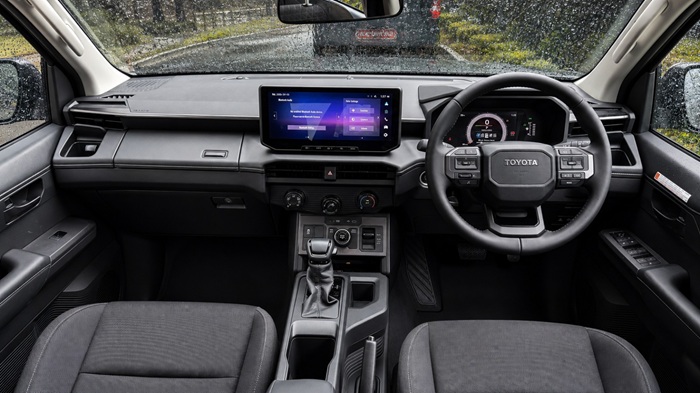
There is a broad dashboard, improved materials and much more digital technology.
But Toyota has wisely retained physical controls for important functions.
This matters enormously in an off-road vehicle.
When you are bouncing across a trail, you don’t want to swipe three times through a glass screen to activate low range.
You want a switch.
Toyota understands this.
12.3-Inch Infotainment
The centre of the dashboard carries a 12.3-inch touchscreen infotainment system.
It supports wireless Android Auto and Apple CarPlay, along with Bluetooth, USB connectivity, FM radio and voice recognition.
Lower variants in various markets can receive a smaller 8-inch display.
The new system immediately makes the Hilux feel more expensive and far less utilitarian.
It is responsive, properly sized and positioned high enough to glance at without looking too far away from the road.
And because Android Auto and CarPlay work wirelessly, you don’t have to spend the first five minutes of every drive searching for a cable that has disappeared between the seats.
Eight-Speaker Audio
There is an eight-speaker audio system as well.
It is not trying to compete with some 28-speaker, 1,500-watt luxury-car system named after a Danish audio engineer.
But eight speakers in a pickup truck are entirely adequate.
Besides, if you’re driving through deep mud in low range, the entertainment is probably happening outside.
Instrument Cluster
The Indian Hilux receives a 7-inch combimeter/information display, while a larger 12-inch-class fully digital cluster is available in some overseas markets.
That larger display is not currently offered in India.
Again, this is an area where the Indian Hilux feels slightly less lavish than its price suggests.
The existing cluster is clear and functional, but when the centre screen is 12.3 inches, a larger driver display would have made the dashboard feel even more cohesive.
Steering and Controls
The Hilux gets a three-spoke power steering wheel with controls for the instrument display, volume, phone and voice functions.
The steering column offers tilt and telescopic adjustment, so finding a comfortable driving position is straightforward.
Toyota also uses variable flow control for the power steering system, helping reduce effort at lower speeds.
And believe me, low-speed assistance matters when you’re manoeuvring 5.3 metres of pickup through a crowded Indian market.
Cruise Control
Cruise control is available too, and it suits the Hilux particularly well.
Long highway journeys are where this truck starts to make real sense.
The seating position is high, the diesel engine barely needs to work hard, the gearbox settles into top gear and the large fuel tank gives it excellent touring potential.
Once you’re out of the city, the Hilux feels like the kind of vehicle in which you could simply keep driving until somebody runs out of continent.
Fabric Seats—Yes, Fabric
The Indian Hilux gets fabric upholstery.
Leather is available in some overseas versions but not here.
Considering the price, this may surprise people.
So will the manual front seats.
The driver gets six-way manual adjustment, while the passenger gets four-way manual adjustment.
Yes.
You can spend nearly ₹37 lakh before taxes and still adjust the seat using your arm.
But somehow it fits the Hilux philosophy.
Toyota seems to be saying: “We gave you a low-range transfer case, rear differential lock and one-tonne payload capacity. Surely you can pull a lever.”
Rear Seat Flexibility
The rear bench uses a 60:40 split folding and tie-up arrangement, allowing the cushions to be moved when you need additional secure storage inside the cabin.
This is genuinely useful.
A pickup bed is brilliant for dirty and bulky objects, but laptops, cameras and expensive equipment are better kept inside.
The rear bench itself is reasonably practical for adults, though the backrest remains more upright than you’d find in a large SUV because there is a pickup bed immediately behind it.
You cannot cheat packaging.
Practical Touches
Front seatbelts are height adjustable, and you get an illuminated scuff plate to add a small dash of premium theatre.
There are also cargo hooks and useful storage spaces around the cabin.
The Hilux has clearly been designed by people who expect owners to actually carry things.
This may sound obvious, but plenty of lifestyle vehicles seem designed primarily around carrying coffee.
Air Conditioning
The Indian Hilux gets manual air conditioning with a PM2.5 filter. Some global versions get dual-zone automatic climate control, but India does not. And this is probably one of the biggest specification omissions. Manual AC at nearly ₹37 lakh will inevitably create internet comments. Of course it will cool the cabin perfectly well.
But buyers at this price point are conditioned to expect automatic climate control. The Hilux simply has different priorities. It gives you a differential lock instead. Choose your luxury.
Wireless Charging and 220V Power
You get a wireless smartphone charger, which pairs nicely with wireless phone connectivity.
More interestingly, there is also a 220V power outlet.
That is exactly the sort of thing you want in a pickup.
You can charge laptops, camera equipment, tools and various accessories while travelling.
It is a small feature that perfectly matches the Hilux’s working personality.
Rear-View Mirror
The Indian version uses a conventional day/night rear-view mirror.
An auto-dimming mirror is offered internationally on higher trims, but isn’t available here.
Again, not a deal-breaker.
But another reminder that Toyota India has spent the money on mechanical engineering rather than loading the cabin with every premium convenience feature available globally.
Safety
Safety equipment is comprehensive.
The Hilux has earned strong international crash-test results, including five-star ANCAP performance for relevant tested versions.
The Indian version gets seven SRS airbags, rather than the eight-airbag configuration seen on certain overseas specifications.
Other equipment includes ABS with EBD, Brake Assist, Vehicle Stability Control, traction control, Downhill Assist Control, tyre-pressure monitoring, ISOFIX child-seat mounts, seatbelt reminders, anti-theft protection and impact-sensitive door-unlocking technology.
You also get parking assistance and a 360-degree camera.
That last feature is not optional psychologically.
Once you have driven something this large in a crowded parking area, the 360-degree camera quickly goes from “nice feature” to “trusted colleague”.
Toyota GOA Body
The Hilux also follows Toyota’s GOA — Global Outstanding Assessment — body engineering philosophy.
The basic idea is controlled impact absorption while protecting the passenger cell.
That means the Hilux isn’t simply relying on being large and heavy to protect occupants.
The structure itself is engineered to manage crash energy.
Which is reassuring because “don’t worry, the other car is smaller” isn’t really a safety strategy.
No Full ADAS Package in India
One noticeable omission is a full ADAS package.
Several overseas Hilux versions are available with more sophisticated Toyota Safety Sense-type technologies, including features such as adaptive cruise control and autonomous emergency braking depending on the market.
India currently misses out on that comprehensive suite.
At this price, it would have been welcome.
The Hilux is a fundamentally old-school machine in its chassis philosophy, but that doesn’t mean it cannot benefit from modern driver assistance.
i-Connect Connected Features
Toyota’s i-Connect app brings plenty of connected-car functionality.
Depending on the activated services, owners can access features such as Find My Car, vehicle tracking, geofencing, vehicle information, service reminders, theft alerts, trip information, driving insights and stolen-vehicle location assistance.
It is quite funny when you think about it.
The Hilux is mechanically designed to take you somewhere with no mobile phone signal.
But once the signal returns, it can tell your smartphone where you’ve parked.
Accessories
Toyota also offers a substantial range of accessories.
Depending on availability, these include roof tents, 3D floor mats, body mouldings, door visors, logo projection lamps, bonnet garnishes, fuel-lid garnishes, over-fenders, headlamp garnishes, bumper garnishes and various utility accessories.
The roof tent deserves particular mention.
A lot of SUVs are advertised using photographs of mountains.
With a Hilux, you can simply carry your bedroom to the mountain.
Global Production
The Hilux is one of Toyota’s most globally established utility vehicles.
Production and assembly takes place across important markets including Thailand, India, South Africa and other regional manufacturing centres.
Thailand is particularly significant because it is one of the world’s biggest pickup-truck markets and has long been a major production hub for the Hilux.
India’s Hilux is locally assembled, giving Toyota a presence in one of the most specialised niches of the premium lifestyle-vehicle segment.
Hilux Means High Luxury
The name Hilux is derived from the words “High” and “Luxury.”
Which is charming.
Because when the original Hilux appeared in 1968, “high luxury” meant something slightly different from today’s 30-colour ambient lighting, massage seats and active fragrance systems.
But the principle was sound.
Take a commercial pickup and make it more comfortable and refined.
That philosophy has gradually evolved for nearly six decades.
Today’s Hilux is far more technologically sophisticated, but its basic mission hasn’t really changed.
Electric Hilux and Hydrogen Future
The Hilux story is also moving beyond diesel.
Toyota has introduced battery-electric versions in selected international markets, while petrol Hiluxes remain available in certain regions.
The company is also developing hydrogen fuel-cell Hilux technology, with further production and deployment targeted later in the decade, including plans around 2028.
This demonstrates Toyota’s familiar multi-pathway approach.
Rather than betting everything on one propulsion technology, it is experimenting with diesel, mild hybrid, battery electric and hydrogen depending on the market and application.
And the Hilux is a particularly interesting test bed because commercial users care enormously about range, payload, towing and downtime.
On the Road
The first thing you notice from behind the wheel is the size. There is no escaping it.
The Hilux is long. The bonnet is high. The mirrors are large. The seating position is commanding.
The moment you pull into traffic, everything smaller than a compact SUV appears to be operating one floor below you. Yet after a few kilometres, it becomes surprisingly easy to place.
The large mirrors help enormously, the steering is manageable and the 360-degree camera makes parking significantly less intimidating. The engine is the real star.
The 2.8-litre diesel produces its 500 Nm with the sort of relaxed authority that suits this vehicle perfectly.
There is no need to rev it hard. You simply squeeze the accelerator and allow the torque to do the work.
Acceleration isn’t sports-car dramatic, but it is strong enough that the Hilux never feels underpowered. Even when overtaking, there is a reassuring reserve of shove.
Highway Manners
On the highway, the Hilux settles down beautifully. The engine becomes quieter, the automatic gearbox finds a relaxed cruising ratio and the enormous wheelbase contributes to good straight-line stability. This is the environment where the truck begins to feel almost effortless.
You sit high above traffic with 500 Nm available, an 80-litre tank beneath you and a cargo bed capable of swallowing holiday equipment for people who apparently plan holidays as military expeditions. Long-distance touring suits it. Very well.
City Driving
Cities are a different matter. The Hilux is still more than five metres long, and no amount of camera technology changes basic geometry.
Narrow lanes require patience. Basement ramps require attention. Small parking spaces require optimism. Parallel parking requires a supportive family.
But once you understand its dimensions, it is manageable. And the commanding driving position means visibility ahead is excellent.
Ride Quality
Ride quality is probably the biggest difference between the Hilux and something like a Fortuner.
Because of the rear leaf springs, the Hilux can feel noticeably firmer and more active when the cargo bed is empty. Sharp bumps can send a little movement through the rear axle.
Load the bed, however, and the whole truck settles down. That is exactly what leaf springs are designed for.
This is a vehicle designed to carry weight, so judging it completely empty is a little like criticising a cargo aircraft because the suspension feels odd without cargo.
Still, anyone moving from a monocoque luxury SUV will immediately notice the difference.
Off-Road
Take the Hilux off-road and suddenly all those compromises begin making sense. Switch into four-wheel drive. Engage low range if necessary. Use the rear differential lock. Let those 265-section all-terrain tyres find grip. The Hilux feels completely at home.
Long suspension travel, good ground clearance, proper transfer gearing and a robust chassis mean you can drive over terrain that would make the owner of a crossover immediately start checking Google Maps for another route.
The best thing isn’t merely that the Hilux can tackle difficult terrain. Plenty of modern SUVs can complete controlled off-road courses.
The Hilux gives the impression it could do it every day. For years. While carrying something heavy. That is the real difference.
Hilux or Fortuner?
So why buy this instead of a Fortuner? If you want seven seats, a fully enclosed luggage compartment and more family-oriented comfort, the Fortuner makes much more sense. But the Hilux offers something different.
You can carry filthy equipment without caring. You can transport tall objects. You can tow serious trailers.
You can build it into an overlanding truck. You can throw camping gear into the back and head somewhere remote. It is also far rarer on Indian roads, which gives it enormous visual presence. A Fortuner is imposing.
A Hilux looks like the Fortuner joined a gym, bought outdoor clothing and stopped caring where the road ends.
What Could Be Better?
There are areas where the Indian specification feels surprisingly basic for the money. The lack of leather upholstery will bother some buyers. Manual front seats feel unusual at nearly ₹37 lakh. Manual climate control is difficult to ignore.
An auto-dimming rear-view mirror should ideally be standard. The larger international digital instrument cluster would have improved the cabin. And a comprehensive ADAS suite would make the package feel more complete.
Then there is the physical size. For buyers living in dense urban areas, owning a Hilux requires planning. Your parking space matters. Your office basement matters.
Your turning radius matters. Your neighbour’s badly parked scooter suddenly matters far more than it used to.
But none of this will matter much to the buyer who genuinely needs the capabilities.
Warranty and Ownership
Toyota provides a standard three-year/100,000 km warranty for the Hilux in India, with extension options available depending on the programme. Toyota’s extensive dealer network is another important advantage.
And for a vehicle like this, reliability isn’t just about avoiding inconvenience. A lifestyle hatchback breaking down near your home is annoying.
A workhorse breaking down while towing equipment somewhere remote is a genuine problem. That is why the Hilux’s reputation for durability carries so much weight.
Final Verdict
The 2026 Toyota Hilux is not the sort of vehicle that makes complete sense on a conventional feature-per-rupee spreadsheet.
At nearly ₹37 lakh for the flagship VX 4×4 AT, you can buy SUVs with softer dashboards, leather seats, powered chairs, automatic climate control and considerably more luxury equipment. But they cannot do what the Hilux can.
This gives you a proper body-on-frame chassis, a serious part-time four-wheel-drive system, low range, an electronic locking rear differential, strong all-terrain tyres, roughly one-tonne payload ability and up to 3.5-tonne towing capacity. Then there is the engine.
A 2.8-litre turbo-diesel producing around 204 PS and 500 Nm is exactly the kind of powertrain this truck needs: strong, unstressed and full of low-end pulling power.
The cabin is now modern enough for everyday use, with a large touchscreen, wireless smartphone integration, eight-speaker audio, connected-car technology and a 360-degree camera.
Yet Toyota hasn’t allowed any of that to dilute what the Hilux fundamentally is.
A tool. A very expensive, very large and surprisingly sophisticated tool. It is not trying to imitate a luxury SUV. It is not pretending that a selectable drive mode makes it an off-roader.
And it certainly isn’t a crossover wearing plastic wheel-arch cladding and posting inspirational quotes about adventure. The Hilux has real four-wheel-drive hardware.
It has real load-carrying ability. It can tow properly. It can wade through deep water. It can spend hours crawling over rough terrain.
And once you’re finished, you can drive it home with wireless Apple CarPlay running and your phone charging on the centre console. That combination is what makes it so appealing.
A Toyota Hilux can take you to a five-star hotel on Friday night, carry camping equipment into the mountains on Saturday morning, tow a trailer on Sunday and report for work on Monday carrying a load that would give most lifestyle SUVs anxiety. There are more luxurious vehicles.
There are faster vehicles. There are easier vehicles to park.
But very few vehicles give you the same sense that, whatever happens next, the machine underneath you probably has the situation covered.
And perhaps that is the greatest compliment you can give a Hilux.
It doesn’t merely look tough. It has spent nearly sixty years proving it.