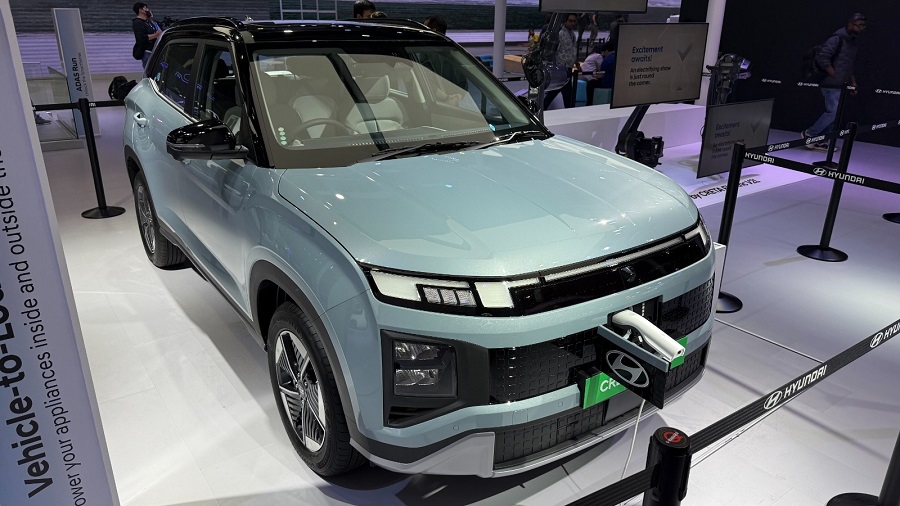
Gurugram: Hyundai Motor India Limited has inaugurated 120 kW DC fast public EV charging stations across key locations in New Delhi on World EV Day, strengthening charging access in the National Capital Region as the company prepares for a broader electric vehicle push in India.
The new fast-charging stations, set up in partnership with Statiq, are designed to reduce charging time and improve public charging convenience for EV users. They can be accessed through the myHyundai app as well as other major charging-management applications.
As part of its World EV Day initiative, Hyundai is also offering complimentary charging to Hyundai EV owners from September 09 to September 11, 2026, across HMIL-owned public charging stations when booked through the myHyundai app. For EV owners, that is one small break from range anxiety and one slightly larger break from the monthly running-cost spreadsheet.
The company said the expansion forms part of its larger plan to build an electric mobility ecosystem that goes beyond vehicle launches. HMIL currently operates 185 DC fast-charging stations across 105 cities and plans to scale its proprietary charging network to 600 stations by 2030 across key cities, highways and Hyundai dealerships.
Its DC fast-charging solutions range from 60 kW to 240 kW. Through the myHyundai app, the company also provides access to more than 38,000 charging points via partnerships with multiple Charge Point Operators. The app supports charging-station discovery, navigation, advance booking and digital payments, and is open to EV customers across brands.
Commenting on HMIL’s EV ecosystem readiness, Tarun Garg, MD & CEO, HMIL, said “Electric mobility represents an important pillar of India’s journey towards sustainable and future-ready transportation. At Hyundai Motor India Limited, our focus is not limited to introducing advanced electric vehicles. We are working to create a complete ecosystem that gives customers confidence at every stage, from product discovery and purchase to charging, maintenance and long-term ownership. By expanding our network of EV chargers, EV-ready sales and service touchpoints, investing in specialised infrastructure and systematically training our dealership teams, we aim to make the transition to electric mobility convenient, dependable and rewarding. On World EV Day, we reiterate our commitment to driving meaningful EV adoption while keeping customers at the heart of every initiative.”
HMIL’s current EV portfolio in India includes the Ioniq 5 in the premium segment and the Creta Electric. The company also plans to soon launch a localised, mass-market SUV EV built on a dedicated EV platform, a move that could widen its reach in India’s increasingly competitive electric passenger vehicle market.
Alongside charging infrastructure, Hyundai is also investing in dealership and service readiness. The company said it has trained more than 10,000 sales personnel to date to support customers through the EV purchase and ownership process. It plans to train an additional 7,000 sales personnel by the end of FY26-27, taking the total target to over 17,000 trained sales personnel.
The training is aimed at helping dealership teams explain EV technology, charging requirements, vehicle capabilities, ownership considerations and the broader benefits of electric mobility to customers during the consideration and purchase phase.
On the service side, HMIL said it has more than 2,600 trained dealership service personnel available for EV maintenance and repair across its EV service touchpoints. It plans to train an additional 5,000 service personnel by the end of FY26-27, including technicians, service staff, service managers and other dealership employees involved in the EV customer journey.
The company has delivered approximately 16,000 person-days of EV service training so far and invested around ₹2 crore in making its training centres EV-ready. The programmes include certification-based learning, model-specific modules and practical instruction covering high-voltage safety, EV diagnostics, battery handling and specialised repair procedures.
Hyundai said its EV-ready workshops are supported by specialised equipment and safety infrastructure, including Personal Protective Equipment kits, insulated tools, EV chargers, EV battery-handling trolleys and relevant Special Service Tools.
By the end of FY26-27, HMIL plans to expand its EV-ready sales and service network to 820 touchpoints and 650 workshops, giving customers wider access to trained personnel as electric vehicles move gradually from early-adopter enthusiasm to everyday family-car consideration.
The company’s latest steps in Delhi underline a key reality of India’s EV transition: selling electric cars is only one part of the journey. Building reliable chargers, trained dealership teams and specialised service support may prove just as important in convincing more customers that the shift to electric mobility is not only cleaner, but also practical.