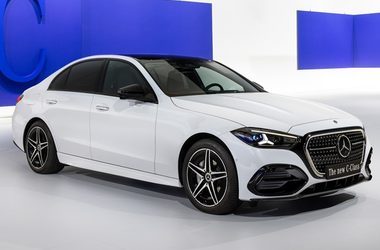

Mercedes-Benz has unveiled an extensively updated C-Class sedan and estate, describing the overhaul as the most comprehensive technical upgrade in the model’s history. The revised C-Class brings a sharper exterior, a new MB.OS-based digital architecture, artificial intelligence-powered MBUX features, upgraded electrified petrol and diesel engines, and plug-in hybrids capable of travelling up to 100 kilometres on electric power under the WLTP cycle.
Orders for all powertrain versions opened in Germany on August 18, 2026. Prices start at €41,045 before VAT, or €48,844 including VAT, for the C 200 sedan.
The update arrives alongside the European market introduction of the electric C-Class and is intended to keep Mercedes-Benz’s conventional and plug-in-hybrid midsize models technologically aligned with the company’s latest generation of vehicles.
“The new C-Class proves that continuity and innovation are not mutually exclusive. With its sporty elegance, electrified powertrains and intelligent support through MB.OS, it offers what drivers really need: proven reliability and innovative technology that creates genuine added value in everyday life. In this way, a familiar classic becomes a modern companion,” said Mathias Geisen, Member of the Board of Management of Mercedes-Benz Group AG, Sales & Customer.
Familiar C-Class shape, considerably brighter personality
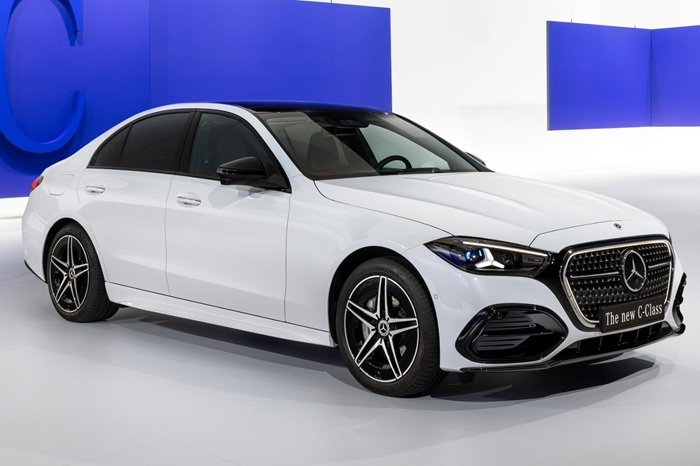
Mercedes-Benz has avoided reinventing the C-Class visually, instead concentrating on making an already familiar shape more distinctive.
The front receives a more upright grille surrounded by a chrome frame with an illuminated contour. A Mercedes star pattern is incorporated into the grille, while the central three-pointed star can also be illuminated in selected markets.
New headlights feature a double-star daytime-running-light signature, while the sedan also receives star-inspired rear lamps. Revised bumpers, gloss-black trim and chrome detailing complete the exterior changes.
For anyone concerned that modern luxury cars were becoming insufficiently illuminated, Mercedes has also incorporated light projectors into the side sills. Opening the doors can project an animated Mercedes-Benz pattern onto the ground, while the exterior mirrors project the brand’s star beside the vehicle.
Wheel choices range from 17 to 19 inches, including two new 19-inch AMG designs.
Mercedes-Benz has added two exterior colours — Lavender Silver metallic and Moody Sky Grey metallic — while an AMG Line Plus specification joins the range for the first time. It adds elements including gloss-black exhaust trim, a black rear spoiler lip, the Night Package, sports seats with red stitching and red seatbelts.
MB.OS becomes the digital backbone
A major part of the update sits beneath the surfaces rather than on them.
The new C-Class adopts Mercedes-Benz Operating System, or MB.OS, as its central software platform. It enables over-the-air updates for numerous vehicle systems and allows customers to add or activate selected digital functions after buying the car.
The cabin retains the vertically oriented central display layout. Drivers get a 12.3-inch digital instrument cluster, accompanied by an 11.9-inch portrait-format media display.
Mercedes-Benz has also revised the multifunction steering wheel, bringing back more conventional physical controls for frequently used functions. Rocker switches operate the speed limiter and Distronic adaptive cruise control, while a roller handles audio volume.
It is a relatively small change, but one likely to be welcomed by drivers who prefer operating a car without first completing a touchscreen treasure hunt.
ChatGPT, Google Gemini and Microsoft Bing join MBUX
The fourth-generation MBUX system is among the most significant additions.
Mercedes-Benz says its new MBUX Virtual Assistant combines artificial intelligence technologies from ChatGPT, Microsoft Bing and Google Gemini through what the company calls a “multi-agent approach”.
Activated using “Hey Mercedes”, the assistant can conduct multi-stage conversations, retain short-term conversational context and answer questions involving navigation, general information and points of interest.
Mercedes says it can also provide information on subjects including current share prices, currency conversion, weather and even ski conditions.
Entertainment functions have also been integrated into conversational commands. Drivers can describe a song when they cannot remember its name or artist, with the assistant attempting to identify and play it.
Three virtual assistant avatars are currently available.
Google Maps powers navigation
Navigation in the new C-Class is based on Google Maps and incorporates Google’s Automotive AI Agent through the partnership between Mercedes-Benz and Google.
Drivers can use conversational commands to search for destinations, charging stations and parking facilities, including information about available parking spaces where supported.
MBUX Surround Navigation uses sensor and camera information to generate a three-dimensional representation of the vehicle’s surroundings. Cars, motorcycles, bicycles and pedestrians can be displayed alongside route guidance and information from the assistance systems.
Augmented-reality navigation technology previously offered in models such as the S-Class and EQS also becomes available in the C-Class.
Updated petrol engines get electric compressor
The conventional engine range consists of electrified four-cylinder petrol and diesel engines equipped with second-generation integrated starter-generators.
The 48-volt ISG 2.0 system can provide up to 17 kW of additional output and 205 Nm of supplementary torque. It also enables functions including energy recuperation and engine-off coasting.
The updated 2.0-litre M 254 EVO petrol engine gains a newly developed electrically powered auxiliary compressor designed to improve response at low engine speeds and reduce turbo lag.
Three states of tune are offered.
The C 200 develops 130 kW, or 177 hp, and 270 Nm. The C 250 produces 160 kW, or 218 hp, with 320 Nm, while the C 300 delivers 190 kW, or 258 hp, and 400 Nm.
Mercedes quotes combined fuel consumption of between 6.2 and 7.1 litres per 100 kilometres across the petrol sedan and estate variants, depending on the specification.
Plug-in hybrid offers up to 395hp and 100km electric range
Plug-in hybrids remain an important part of the C-Class range.
The C 400 e 4Matic sedan and estate combine a four-cylinder petrol engine with an electric motor to produce system output of up to 290 kW, equivalent to 395 hp, and maximum system torque of 650 Nm.
A high-voltage battery with 19.53 kWh of usable capacity provides up to 100 kilometres of electric driving range under the WLTP test cycle.
The plug-in hybrids support charging at up to 11 kW using AC power and up to 55 kW at a compatible DC fast charger.
Mercedes-Benz says the range should allow many routine urban journeys and commuting trips to be completed using electricity alone.
Diesel stays — and can run on HVO100
Mercedes-Benz has not abandoned diesel power in the C-Class.
The revised OM 654 EVO four-cylinder diesel is available with outputs of 120 kW, or 163 hp, and 147 kW, or 200 hp.
It uses variable turbine geometry and common-rail direct injection operating at pressures of up to 2,200 bar.
The engine is also compatible with HVO100 as well as B10 and B20 fuels.
Mercedes-Benz says its petrol and diesel engines have been engineered with upcoming Euro 7 requirements in mind.
Rear-wheel steering reduces turning circle
The chassis has also been revised to improve body control and agility without compromising the C-Class’s traditional long-distance comfort.
Optional rear-wheel steering can turn the rear wheels by up to 2.5 degrees and reduces the turning circle by 43 centimetres to 10.64 metres.
Below 100 km/h, the rear wheels turn in the opposite direction to the fronts to improve manoeuvrability. At higher speeds, they turn in the same direction, effectively increasing stability during lane changes and sudden evasive manoeuvres.
Mercedes-Benz has also retuned the adjustable damping and suspension connections to reduce body movement and provide more precise responses.
MB.DRIVE expands driver assistance
The updated C-Class can be equipped with as many as 10 cameras, five radar sensors and 12 ultrasonic sensors.
Depending on the selected MB.Drive package, the system can assist with steering, maintaining distance, lane positioning, braking and acceleration.
MB.Drive Assist offers assisted lane changing after the driver taps the indicator stalk, while MB.Drive Assist Plus adds functions including automatically slowing the vehicle for stop signs and red traffic lights where the system and local regulations permit.
MB.Drive Assist Pro is intended to provide more extensive point-to-point assistance, including in dense urban traffic. Mercedes-Benz says this system will initially be introduced in China.
Parking technology includes assisted parking and exiting, a 360-degree camera option, reversing collision assistance and trailer manoeuvring support.
A new digital reversing function can also automatically retrace part of a route the vehicle has recently travelled forwards under certain conditions — useful when a narrow road abruptly reminds the driver that optimism is not a substitute for turning space.
Digital Light becomes brighter and more efficient
The optional Digital Light system has also been upgraded.
Mercedes-Benz says new micro-LED technology and a more powerful processing chip increase the high-resolution illumination field by around 40%, while cutting energy consumption by as much as 50% compared with the previous system.
The Ultra Range high beam can dynamically adjust its direction, while partial high-beam and adaptive cornering-light functions are designed to improve visibility without dazzling other road users.
More comfort and a 710-watt Burmester system
Interior upgrades include new upholstery options, decorative finishes and an enhanced Burmester 3D Surround Sound System.
The optional Burmester setup uses 15 speakers and a 710-watt amplifier with Dolby Atmos. Occupants can adjust the spatial sound effect across 10 levels or focus the audio on different seating areas.
An automatic function uses seatbelt-buckle detection to determine where passengers are seated and adjusts the sound distribution accordingly.
Optional multicontour seats provide massage functions, adjustable lumbar support and inflatable side bolsters.
The Air-Balance package combines fragrance, ionisation and filtration, while ambient lighting offers 64 colours, 10 preset colour themes and four separately adjustable dimming zones.
Two new upholstery colours — Beechbrown and Cherry Red — join the selection, accompanied by three new trim choices including open-pore light birch wood, anthracite birch and a glossy silver metal-mixed textile finish.
Estate retains 1,510-litre maximum luggage capacity
The C-Class estate continues to target buyers requiring additional practicality.
Its luggage compartment provides 490 litres of capacity with the rear seats upright and up to 1,510 litres with them folded.
The second-row backrests are divided 40:20:40 and can be folded individually, while an Easy-Pack powered tailgate is fitted as standard.
A major update for Mercedes-Benz’s 12-million-car nameplate
The C-Class traces its history to 1982, and Mercedes-Benz says more than 12 million examples have been sold since its introduction.
Rather than replacing the established formula, the 2026 update attempts to stretch it across two increasingly important areas of the market: highly electrified combustion vehicles and software-defined cars.
The result is a C-Class that remains recognisably conventional in its proportions and purpose while adopting technology that would have been associated with Mercedes’ flagship models only a few years ago.
As Mercedes-Benz marks what it calls “140 Years of Innovation” since Carl Benz patented his first automobile in 1886, the new C-Class illustrates how the company’s midsize mainstay is evolving for a period in which combustion engines, plug-in hybrids, artificial intelligence and increasingly sophisticated driver assistance must all coexist — sometimes on the same driveway.