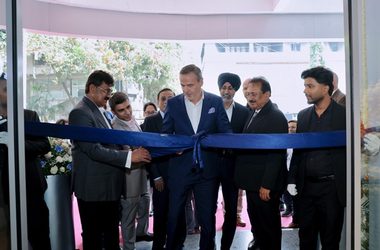



Mumbai: Blue Energy Motors (BEM), in partnership with Hindustan Petroleum Corporation Limited (HPCL), has inaugurated Bhiwandi’s first battery-swapping station for electric heavy-duty trucks, expanding the Mumbai–Pune Electric Freight Corridor and strengthening charging infrastructure in one of Maharashtra’s busiest logistics hubs.
The newly operational facility allows Blue Energy Motors’ electric heavy-duty trucks to exchange depleted batteries for charged ones in less than five minutes, potentially reducing vehicle downtime and improving fleet productivity. The development marks a significant step in the strategic partnership between BEM and HPCL, announced in January 2026.
Located in Bhiwandi, a major warehousing and logistics centre within the Mumbai Metropolitan Region, the station extends the Mumbai–Pune Electric Freight Corridor launched by Blue Energy Motors in October 2025.
Battery Swapping in Under Five Minutes
Unlike conventional electric vehicle charging, which requires vehicles to remain stationary while batteries recharge, battery swapping enables trucks to resume operations with a charged battery within minutes.
For logistics companies operating on tight delivery schedules, the difference could be significant. After all, in the freight business, time spent waiting is rarely time well spent.
The facility is designed specifically for BEM’s electric heavy-duty trucks, offering an alternative to lengthy charging stops while potentially improving vehicle availability and operational efficiency.
However, the station’s usefulness extends beyond commercial trucking.
Public EV Charging for Two-Wheelers, Cars and Commercial Vehicles
Alongside its heavy-duty battery-swapping infrastructure, the Bhiwandi facility also incorporates a public EV charging station.
The charging infrastructure will cater to electric two-wheelers, four-wheelers and commercial vehicles, creating a multi-segment EV energy facility within HPCL’s existing retail network.
This combination allows the location to serve different categories of electric vehicles while making use of established fuel retail infrastructure.
The development also highlights how conventional petroleum retailers are increasingly participating in India’s transition towards electric mobility.
Blue Energy Motors Plans Further Expansion
Commenting on the development, Anand Mimani, CEO – EV & New Energy Business, Blue Energy Motors, said, “Our focus at Blue Energy Motors is on making electric freight a practical and scalable reality in India. Our partnership with HPCL brings together our strengths to build the energy infrastructure needed to support this transition. Bhiwandi, with its strong freight and logistics activity, is an important market for us. This first facility is a meaningful step forward, and we look forward to expanding our network of battery-swapping and charging facilities across key markets, supporting electric trucking and serving the wider EV ecosystem.”
The company intends to expand its battery-swapping and charging network across important markets as part of its strategy to support electric freight operations.
For heavy-duty commercial vehicles, access to reliable energy infrastructure remains an important consideration, particularly on routes where delivery schedules, vehicle utilisation and operating costs directly influence business decisions.
Over 1,400 Green Trucks Operating Across India
Blue Energy Motors operates in the alternative-fuel commercial vehicle segment, offering both electric and liquefied natural gas (LNG)-powered heavy-duty trucks.
According to the company, more than 1,400 of its green heavy-duty trucks are operating across major freight routes in India.
BEM also reports that its vehicles have collectively covered more than 150 million green kilometres, contributing to a reduction of over 44,000 tonnes of CO₂ emissions. The company estimates that this reduction is equivalent to the carbon absorption of approximately 1.8 million trees.
These figures cover the company’s broader green-truck operations, including its electric and LNG-powered vehicles.
Why the Bhiwandi Facility Matters for Electric Freight
The opening of the Bhiwandi station reflects a broader shift in India’s commercial transportation sector, where vehicle electrification increasingly depends on the availability of supporting energy infrastructure.
While electric passenger vehicles can often be charged at homes, offices or public charging points, heavy-duty freight operations have different requirements, including predictable turnaround times and dependable access to energy along major transport routes.
By combining rapid battery swapping with public EV charging, the Blue Energy Motors–HPCL partnership offers one approach to addressing these challenges.
The longer-term significance of the initiative will depend on how extensively such facilities are deployed and how effectively they meet the operational needs of transport companies. For India’s electric freight sector, the development reinforces a fundamental point: putting cleaner trucks on the road is only part of the transition; keeping them moving is equally important.