
Audi has revealed the third generation of its flagship Q7 SUV, giving the long-running luxury family hauler a major update in design, technology, comfort and powertrain efficiency. The new Q7 will be available to order in Germany from June 2026, with deliveries scheduled to begin in September 2026. Prices start from €87,900 for the 180 kW diesel variant, while the more powerful 220 kW version starts from €90,500.
First launched in 2005, the Audi Q7 has spent over two decades trying to answer one very German question: can an SUV be luxurious, practical, powerful, high-tech and still look like it means business outside a five-star hotel? With the third-generation model, Audi clearly believes the answer is yes — preferably with digital lights, quattro all-wheel drive and enough seating flexibility to carry a boardroom, a family, or both.
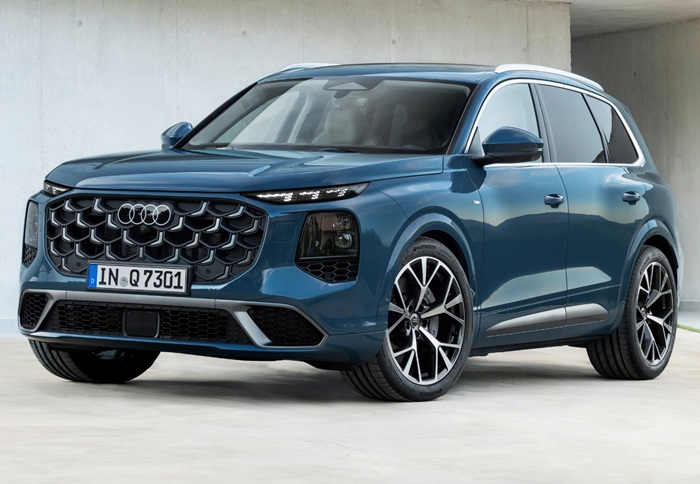
Audi CEO Gernot Döllner said the Q7 has represented “the perfect premium SUV” for more than 20 years, adding that the new generation carries the mission forward with a sporty design, versatile cabin, premium materials and a wide range of technologies. The SUV will be offered with five seats as standard, while six- and seven-seat configurations will also be available. The six-seat layout gets two individual second-row seats, adding a business-class flavour for those who like their SUV with a touch of executive lounge.
The cabin receives a major push in luxury and usability. Audi has added a new panoramic sunroof with switchable transparency, which can turn opaque in nine segments. It also gets illumination that adapts to the ambient lighting. In simple words, the roof no longer merely lets in light; it now behaves like it has attended a luxury hospitality course.
Practicality remains a key Q7 strength. The five-seat version offers up to 806 litres of boot space, expanding to 2,075 litres with the rear seats folded. The seven-seater offers up to 722 litres behind the second row and up to 1,980 litres behind the first row. The second-row bench can accommodate three child seats side by side, which should make family buyers very happy and airport cab operators deeply emotional.
Technology is a major focus area. The new Q7 features an Audi MMI panoramic display with OLED technology, a standard passenger display, optional head-up display, Audi Application Store support and an AI-backed Audi assistant. If the system cannot answer a general question, it can forward the query to ChatGPT. So yes, even the Q7 now has someone to ask when the driver says, “Why is the luggage still not fitting?”
Audi has also gone big on lighting. The SUV gets optional digital Matrix LED headlights with micro-LED technology, third-generation digital OLED rear lights and up to eight digital light signatures. A new projection light in the doors creates a rhombus pattern on the ground when passengers enter or exit. More importantly, Audi says the lights are now more closely integrated with driver assistance systems, displaying lane guidance and warning information directly in the driver’s field of view.
One of the headline innovations is the advanced turn signal system, which projects a stylised turn signal onto the ground at night, in sync with the front and rear indicators. Audi says this is intended to improve visibility for other road users, especially cyclists and pedestrians. It is the kind of feature that makes regular indicators suddenly feel like they are still using dial-up internet.
At launch, the new Q7 will be offered with a 3.0-litre V6 diesel engine in two states of tune: 220 kW or 299 PS with 630 Nm, and 180 kW or 245 PS with 500 Nm. Both versions use MHEV plus technology and an electric-powered compressor. The mild-hybrid system can temporarily add up to 18 kW or 24 PS, while also supporting partially electric driving in low-speed scenarios such as parking, manoeuvring and city driving.
Power is sent through an eight-speed tiptronic transmission, with quattro permanent all-wheel drive standard. Audi has also equipped the SUV with a new limited-slip centre differential with preload, aimed at improving traction, steering response and stability. Suspension options include standard steel springs, adaptive air suspension and adaptive air suspension sport. The latter lowers the SUV by 30 mm, because apparently even a large luxury SUV occasionally wants to pretend it is late for a track day.
The new Q7 also gets several advanced safety and assistance systems, including adaptive driving assistant plus, trained parking, reverse assist, rear cross-traffic alert, 360-degree camera system, park assist, trailer manoeuvring assist and emergency assist. A new shoulder-steering function can move the SUV to the highway shoulder and bring it to a stop if the driver becomes inactive, provided system conditions allow.
The third-generation Audi Q7 will continue to be manufactured in Bratislava, like its predecessors. With its mix of diesel power, quattro grip, luxury seating options, digital lighting drama and a cabin that seems designed for both families and frequent flyers, the new Q7 is clearly not trying to reinvent Audi’s big SUV formula. It is simply polishing it, powering it up, and giving it enough technology to make your living room feel slightly under-equipped.