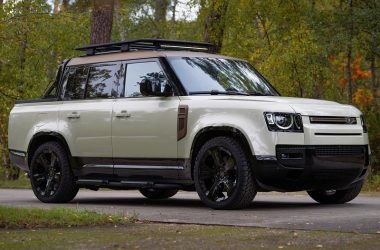



There are SUVs, there are off-roaders, there are lifestyle vehicles, and then there is the Land Rover One Ten Defender — a machine that looks less like it was designed and more like it was issued by a government department with a ruler, a hammer and absolutely no time for nonsense.
This is a British SUV, but not in the modern “ambient lighting, perfume diffuser, digital key and vegan leather” sense. This is British in the “rain, mud, army boots, sheep, tea flask and please don’t ask about refinement” sense. The model you see here is a 1989 first-generation Land Rover One Ten, launched originally in 1983. Today we know this shape as the Defender, but back then it was called the Land Rover One Ten, because Land Rover apparently believed names should be functional rather than fashionable. One Ten simply meant 110-inch wheelbase. Straightforward. Honest. Very British. No marketing yoga involved.
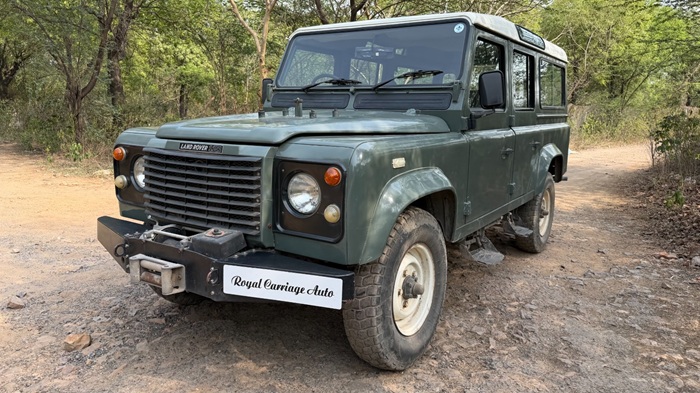
In 1990, after the Land Rover Discovery arrived and created the possibility of showroom confusion, the One Ten was renamed Defender. Because when your vehicle has been used by farmers, armies, police forces, explorers, NGOs, hotels, rescue teams and probably one uncle who thinks roads are optional, “Defender” is not just a name. It is a job description.
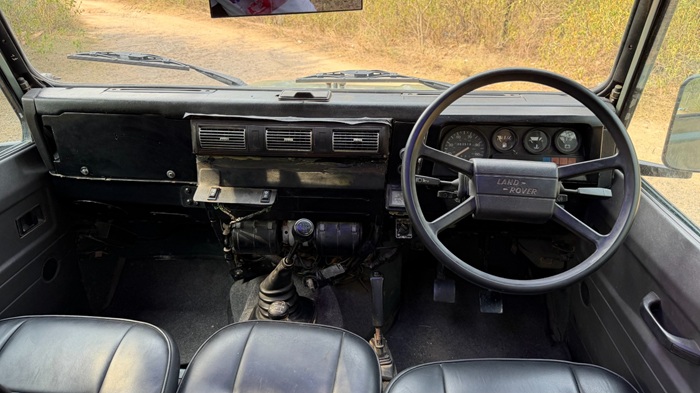
This particular vehicle is currently a restoration project and is expected to be completed in about a month. And that is where the charm begins. It is not trying to hide its age; it is wearing history like a military jacket. Classic machines like this can be bought and restored through Royal Carriage Auto, and frankly, that is exactly the kind of environment this Land Rover belongs in — somewhere between a workshop, a museum and an adventure novel.
Back in 1990, the Defender range in India reportedly started around ₹13 lakh ex-showroom and went up to around ₹26 lakh for the top variant. Today, a classic 110 Defender like this could cost somewhere around ₹37 lakh in India, depending on condition, originality, restoration quality and how emotionally vulnerable the buyer becomes after seeing it parked under good lighting. The modern third-generation Defender now starts from around ₹1 crore, which means the family has moved from farm gate to five-star hotel valet parking without losing the family surname.
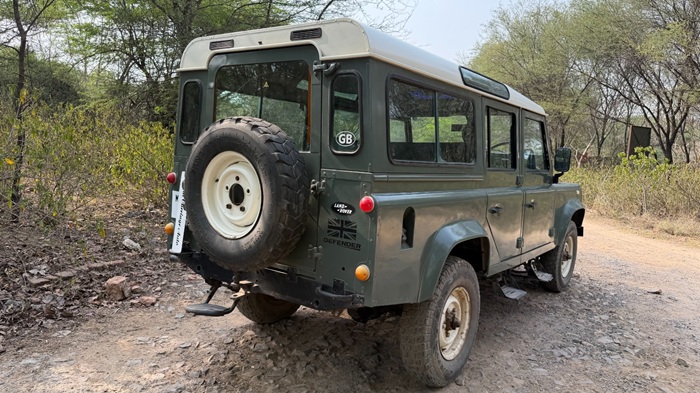
The Land Rover One Ten was built at Solihull in the United Kingdom, a place that has given the world some of the most iconic British 4x4s and probably a few oil leaks with emotional value. Its roots go back to the 1978 Land Rover Series models, and the philosophy was simple: make something that can go almost anywhere, carry almost anything and survive people who consider maintenance a suggestion.
The design is wonderfully honest. There are round headlamps, a tall one-piece windscreen, two-speed wipers and the kind of flat body panels that make you feel like the vehicle was assembled using mathematics and determination. The bonnet can carry a spare wheel, which is not just practical but also makes the Land Rover look like it is ready to invade a muddy hill at short notice. The laminated windscreen, wide-opening doors and upright body are all reminders that this SUV was not shaped by a wind tunnel. It was shaped by purpose.
This green example has the correct old-school personality, though colours like red, white, beige, blue and grey were also available. But green suits it best. A green Defender looks like it has already crossed a forest, attended a military briefing and frightened a hatchback.
Dimensionally, the 110 is not small, but it is not unnecessarily huge either. It measures around 4.5 metres in length, 1.8 metres in width and 2 metres in height. Kerb weight is around 2,000 kg, gross weight is about 3,050 kg, and towing capacity can go up to 3,500 kg. That means it can pull a trailer, a boat, a broken SUV or possibly the entire ego of a modern crossover owner. Ground clearance stands at around 215 mm, water wading ability is around 500 mm, and the turning radius is about 6.4 metres. So yes, it can cross rivers, climb rocks and still make you work a little in tight parking spaces. That is called character.
The steel ladder-frame chassis gives it serious strength, while the aluminium alloy bodywork helps resist rust — a very clever decision, especially for a vehicle expected to spend its life being attacked by weather, mud and enthusiastic owners. The 16-inch steel wheels are wrapped in 7.50-16 8PR JK Tyre Sand Cum Highway tyres at both ends. Braking is handled by front discs and rear drums, which feels perfectly appropriate. This vehicle was made for control, not drama. Though, naturally, if you drive it like a sports car, it will remind you very quickly that physics was not cancelled in 1989.
The suspension setup is properly old-school and properly serious. At the front, there is a live beam axle with a panhard rod, dual-rate coil springs and telescopic hydraulic dampers. At the rear, you get a live beam axle with an A-frame, single-rate coil springs, telescopic hydraulic dampers and an anti-roll bar. This gave the One Ten better ride quality and axle articulation compared to older leaf-sprung Land Rovers. In simple words, it could keep its wheels on the ground even when the ground itself had completely lost interest in being flat.
Then there is the four-wheel-drive system, and this is where the Defender earns its reputation. It gets a 2-speed transfer case with a lockable centre differential, giving it permanent four-wheel-drive capability. This is not some soft-roader setup that waits for a computer to panic and then send power somewhere. This is mechanical confidence. It is the sort of system that looks at slippery terrain and says, “Fine, we are doing this properly.”
There is also a single dry plate hydraulic clutch and a 5-speed manual transmission. This example is equipped with a high-strength Santana 5-speed manual gearbox. The steering system is worm and roller, with power assistance, which means it has that heavy, mechanical, proper-truck feel. You do not so much steer a Defender as negotiate with it. It listens, but only if you are sincere.
This particular Defender is powered by a 2.5-litre inline-four intercooled Tdi diesel engine with direct injection, Bosch two-stage lift injectors and a Garrett turbocharger. Output is around 107 horsepower and 254 Nm of torque. On paper, those numbers may not scare a modern turbo-petrol compact SUV, but this engine was never about Instagram acceleration reels. It was about torque, endurance and crawling through places where normal cars begin writing their resignation letter.
Fuel efficiency is around 10 km/l, and the fuel tank capacity is about 80 litres. That gives it a useful touring range, provided you are not constantly stuck in low-range doing heroic things for no reason. The engine also gets an alloy aluminium cylinder head. Petrol options included 2.2-litre, 2.5-litre and 3.5-litre V8 engines, while diesel options also included a 2.2-litre engine in some markets. But the Tdi diesel became one of the defining Defender engines because it suited the vehicle’s personality: tough, torquey, agricultural in the best possible way, and always happier working than posing.
Of course, it was not perfect. If maintenance was ignored, these turbo-diesel engines could suffer failures, and Land Rover did work on improving them. But the reputation for demanding care remained. A Defender is like an old royal horse. Treat it properly and it will carry you across kingdoms. Neglect it and it will embarrass you in front of villagers.
Inside, this is a 12-seater version, which immediately makes it more social than most modern SUVs. Other seating layouts included 2, 3, 5, 6, 9, 10 and 11-seater configurations. That tells you everything about the Defender’s flexibility. It was not just aimed at families. It was aimed at farmers, hoteliers, businesses, emergency services, military operators and anyone who needed a vehicle more than they needed cupholders.
The cabin here has fabric upholstery with vinyl seat covers, a fully carpeted interior, seatbelts and reclining front seats. There is also aftermarket air-conditioning, which in a classic Defender is less a feature and more a blessing from above. The doors open wide, entry is easy, and the cabin has that upright, commanding driving position that makes you feel less like a driver and more like a field commander.
Do not expect luxury in the modern sense. There are no giant touchscreens, no mood lighting and no fake exhaust sound through speakers. Instead, you get visibility, simplicity and hardware. The cabin is full of straight lines, exposed practicality and honest materials. Everything feels like it has been designed so it can be repaired by someone with tools, patience and possibly a cup of tea balanced on the wing.
The 1,600-litre space makes it properly usable. Whether you are carrying luggage, tools, equipment, camping gear or a group of people who all suddenly became off-road enthusiasts, the Defender has the capacity. It is a vehicle that understands load-carrying not as a feature, but as a lifestyle.
Variants were also extensive. Apart from the 110, Land Rover offered pickup truck, panel truck, soft-top, crew cab, 2-door 90 and 127 variants. The 127 was later renamed 130. This meant the Defender could be almost anything — family carrier, farm truck, expedition vehicle, utility van, military machine or extremely committed wedding-entry vehicle.
The Special Vehicles Division, or SVD, took this flexibility even further. Created to boost sales and build special conversions, SVD produced all sorts of fascinating versions: six-wheel-drive models, amphibious Land Rover 90s, stretched-wheelbase mobile workshops and military vehicles. There was even a V8-powered Rapier missile launcher Defender for the British Army. That is possibly the most British sentence ever written: tea, rain, V8 and missile launcher.
The Defender was used by armies and police forces in many countries, which only added to its rugged reputation. It was tested in extreme conditions, from the heat of Death Valley to the freezing cold of the Canadian Arctic. This was not a vehicle designed merely for school runs, although it can do those too. It was built to handle climates where lesser vehicles start questioning their life choices.
Globally, the Defender became one of the most famous SUVs ever made. More than 21 lakh Defenders have been sold worldwide, and the model enjoyed a 33-year production run, making it one of the longest-running single-generation vehicle designs in the world. That is not just longevity; that is stubbornness on wheels. Production of this classic design finally ended in 2016, and after a four-year gap, the modern L663 Defender arrived in 2020.
But the old Defender’s journey was not always easy. Toyota Land Cruiser and Nissan Patrol caused serious trouble for Land Rover in many markets. They offered strong reliability and better build consistency at a time when Land Rover was under British Leyland, a company not exactly famous for flawless quality control. British Leyland had a reputation for substandard build quality and unreliability, and that hurt Defender sales. In other words, the Defender was brave enough to cross continents, but sometimes its own factory standards were the biggest obstacle course.
Still, the Defender survived because it had something its rivals could not copy completely: identity. A Land Cruiser was dependable, a Patrol was tough, but a Defender was emotional. It looked like history. It felt like adventure. It made you forgive its faults because it seemed to have earned them honestly.
Special editions only added to the legend. Over the years, Land Rover produced versions like the 90SV, Heritage, Tomb Raider, G4 Edition, Defender Black, Defender Silver, X-Tech, SVX, Paul Smith, Defender Works V8, TD 130 and 147. Some were rugged, some were stylish, some were collectible, and some looked like they had been designed after someone at Land Rover found a new box of colours and got excited.
The One Ten County name also became familiar, offering a more comfortable and lifestyle-oriented version of the utility Land Rover. That mattered because by the 1980s and 1990s, buyers were beginning to expect more than just the ability to carry sheep across Wales. They wanted comfort, trim, seating, paint options and a little bit of civility. The Defender offered just enough civility to be acceptable, without accidentally becoming soft.
Driving the One Ten today is not like driving a modern SUV. A new Defender isolates you. The old One Ten involves you. You feel the steering, the gearbox, the engine vibration, the suspension movement and sometimes possibly the weather. It is mechanical, noisy, upright and alive. It does not flatter lazy driving, and it does not pretend to be something it is not.
At low speeds, it feels tough and deliberate. The diesel engine pulls with patience rather than urgency. The gearbox needs a proper hand. The steering needs commitment. The brakes need respect. The suspension, however, is surprisingly capable over rough ground, and once you leave broken roads behind and enter actual terrain, the Defender begins to make sense. Suddenly, all the things that felt crude in the city feel brilliant in the wild.
That is the secret of the Defender. In a parking lot, it is an old box. On bad roads, it is a legend warming up. In mud, rocks, farms, hills and remote trails, it becomes exactly what it was born to be. It does not need drive modes with names like Snow, Sand, Mud, Rock and Existential Crisis. It has levers, differentials, articulation and confidence.
The exterior design has aged beautifully because it was never chasing fashion. The round headlamps, flat sides, exposed hinges, high roofline and utilitarian stance are all functional, but together they create an unmistakable silhouette. You can identify a classic Defender from a kilometre away. Even children who do not know cars understand that this thing means business.
And that is why it still has value today. It is not just a used SUV. It is a piece of automotive history. Restored properly, it becomes a collector’s vehicle, an off-road toy, a lifestyle statement and a rolling reminder of how simple, robust engineering once ruled the world before everything needed a software update.
The modern Defender is faster, safer, more luxurious and far more technologically advanced. It starts from around ₹1 crore and offers the kind of comfort old Defender owners could only dream of while wiping condensation from the inside of the windscreen. But the old One Ten has something the new one must respectfully inherit rather than invent: authenticity.
This 1989 Land Rover One Ten Defender is not perfect. It is not refined. It is not quick. It is not aerodynamic. It does not whisper. It does not massage. It does not care about your playlist. But it has presence, heritage, mechanical honesty and a kind of rugged charm that modern SUVs spend crores trying to simulate.
It was built for farmers and forces, businesses and borders, deserts and snowfields, families and field engineers. It competed with the toughest Japanese off-roaders, survived British Leyland’s reputation, inspired generations of enthusiasts and continued long enough to become an icon.
In the end, the Land Rover One Ten Defender is not just a vehicle. It is a British institution on steel wheels. A machine that says: roads are useful, but not compulsory.
And when this restoration is complete, it will not merely return to the road. It will return to duty.