
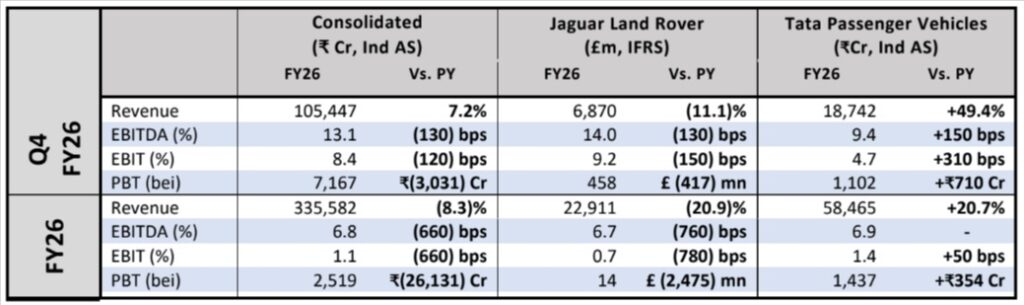
Mumbai: Tata Motors Passenger Vehicles Limited, formerly Tata Motors Limited, closed FY26 with a performance that can best be described as “bruised but still in the fast lane.” The company reported consolidated Q4 FY26 revenue of ₹105,447 crore, up 7.2% year-on-year, while EBITDA stood at ₹13,851 crore and PBT before exceptional items came in at ₹7,167 crore. The quarter also delivered healthy free cash flow of ₹11.4K crore, helped by normalised Jaguar Land Rover production and record domestic volumes.
For the full FY26, consolidated revenue stood at ₹335,582 crore, down 8.3% year-on-year, with EBITDA margin at 6.8% and EBIT margin at 1.1%. PBT before exceptional items was ₹2,519 crore. After exceptional items of ₹4.1K crore, PBT from continuing operations was negative ₹1.6K crore. In simpler garage language: the engine kept running, but the year threw in more potholes than a forgotten service road.
The Board has recommended a final dividend of ₹3 per share, subject to shareholder approval, adding a small but welcome garnish to what was otherwise a year of heavy-duty financial digestion.
JLR: A Difficult Year, but Q4 Brought the Recovery Tow Truck
Jaguar Land Rover reported Q4 FY26 revenue of £6.9 billion, down 11.1% year-on-year, with EBITDA margin at 14.0% and EBIT margin at 9.2%. PBT before exceptional items stood at £458 million. For the full year, JLR revenue fell 20.9% to £22.9 billion, while EBITDA margin stood at 6.7% and EBIT margin at 0.7%. Full-year PBT before exceptional items was just £14 million, compared with £2.5 billion a year ago.
The luxury carmaker’s FY26 performance was hit by several headwinds, including a cyber incident, US tariffs, China luxury tax impact, higher variable marketing expenses, commodity pressure, and planned winding down of outgoing Jaguar models ahead of the brand’s next chapter. Basically, JLR had the kind of year where even the spare wheel needed emotional support.
Still, Q4 showed clear signs of recovery as production returned to normal levels. Free cash flow for the quarter was £829 million, though full-year free cash flow remained negative at £2.2 billion. JLR ended March 2026 with cash of £2.8 billion, net debt of £2.6 billion and total liquidity of £6.9 billion.
On the product and brand front, Defender OCTA saw a fourfold year-on-year sales uplift in Q4. Range Rover showcased its Bespoke personalisation credentials at Milan Design Week, while Jaguar’s first all-electric model, called Type 01, gained attention after media drives on frozen Arctic lakes and UK test tracks. The Jaguar TCS Racing Formula E team also celebrated wins in Miami, Jeddah and Madrid, proving that even in a tough financial year, someone in the family was still collecting trophies.
PB Balaji, Chief Executive Officer, JLR, said the company recovered well in Q4 after the production pause caused by the cyber incident. He added that JLR will focus on growth through its House of Brands strategy, reducing breakeven volumes and launching key new products, including the Range Rover Electric and the first EMA products.
Tata Passenger Vehicles: Domestic Business Becomes the Star Student
While JLR battled global turbulence, Tata Passenger Vehicles had a strong year at home. Q4 FY26 revenue jumped 49% year-on-year to ₹18,742 crore, supported by PV and EV volumes of 201,800 units, up 37%. EBITDA margin rose to 9.4%, while EBIT margin improved sharply to 4.7%. PBT before exceptional items stood at ₹1,102 crore.
For FY26, Tata PV revenue grew 20.7% to ₹58,465 crore. EBITDA margin remained steady at 6.9%, while EBIT margin improved to 1.4%. PBT before exceptional items stood at ₹1,436 crore. Domestic PV and EV business generated free cash flow of ₹1.7K crore in Q4 FY26, while the domestic business closed the year with net cash of ₹6.7K crore.
The company’s Vahan market share rose to 14.2% in Q4 FY26, helping Tata secure the number two position in H2 FY26. Overall FY26 Vahan market share stood at 13.6%, while EV market share remained strong at 40.2%. Alternative powertrains continued to play a major role, with EV penetration at 14% and CNG at 27% during the year.
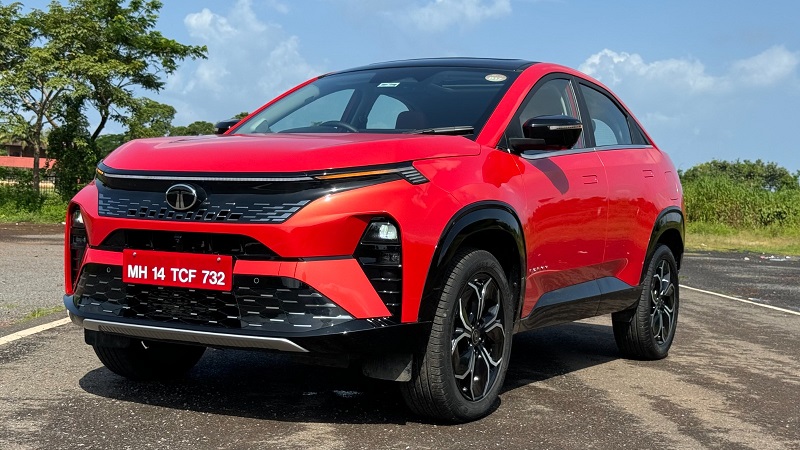
Tata.ev crossed 250,000 cumulative EV sales, reinforcing its leadership in India’s electric vehicle market. The company also highlighted its new manufacturing facility at Panapakkam, which will support long-term growth. In H2 FY26, the Nexon and Punch emerged as the number one and number three selling passenger vehicle models respectively, underlining the strength of Tata’s SUV portfolio. The SUVs clearly did not just bring ground clearance; they brought balance-sheet clearance too.
FY26 was also packed with product action. Tata launched the all-new Sierra, introduced petrol versions of the Harrier and Safari with the new 1.5-litre Hyperion Turbo-GDi engine, launched the new Punch and Punch.ev, expanded its EV portfolio with the Harrier.ev, and re-entered the South African market with a bold new passenger vehicle range.
Shailesh Chandra, Managing Director and CEO, Tata Motors Passenger Vehicles Limited, called FY26 a landmark year. He said the company achieved its highest-ever annual sales of over 6.4 lakh units, delivered 15% year-on-year growth and emerged as the number two player in H2 FY26. He also noted that Tata’s EV volumes grew 43% year-on-year to over 92,000 units, the company’s highest-ever annual EV performance.
Management View: Two Halves, One Recovery Story
Dhiman Gupta, Chief Financial Officer, TMPVL, described FY26 as a “tale of two halves.” According to him, the domestic business gained strong momentum after GST 2.0, while JLR faced multiple headwinds including tariffs and the cyber incident. He said Q4 FY26 saw significant improvement across consolidated financial metrics as JLR operations recovered and the domestic business continued its positive trajectory.
Looking ahead, TMPVL expects global geopolitical and regulatory challenges to remain key watchpoints, especially for supply-chain risks and cost pressures. The company plans to focus on profitable domestic growth, structural cost reductions and JLR’s upcoming launches over the next 18 months.
In short, FY26 was not a smooth expressway for Tata Motors Passenger Vehicles Group. JLR hit international speed breakers, cyber trouble and tariff traffic, while Tata PV in India drove past with SUVs, EVs, CNG and record volumes. The final result: not a perfect year, but definitely a resilient one — the kind where the car comes back to the pits with scratches, heat in the brakes, and still enough fuel for the next lap.