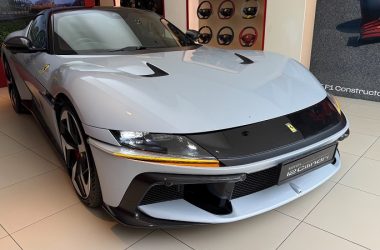


If the Italian Riviera ever decided to transform itself into a four-wheeled machine, it would probably look a lot like the Ferrari Amalfi. Elegant, dramatic, and unapologetically fast, the Amalfi represents Ferrari’s modern interpretation of the classic Italian Grand Tourer—a car designed not just to break speed limits, but also to break hearts along scenic coastal roads.
Ferrari’s relationship with this segment dates back to 2008, when the brand introduced the Ferrari California, a car that blended performance with everyday usability. That lineage continued with the Portofino and later the Roma. Fast-forward to 2026, and what you see today is the fifth-generation evolution of this concept: the Ferrari Amalfi, a machine that replaces the Roma while raising the bar in terms of design, technology and performance.
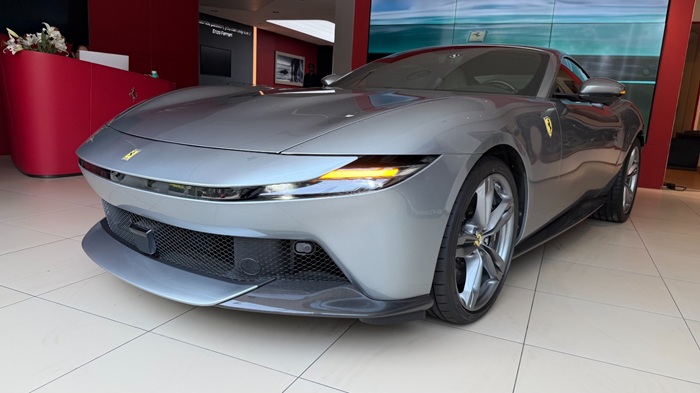
The name itself is borrowed from the picturesque city of Amalfi in Italy, a place famous for winding coastal roads, Mediterranean charm and the sort of scenery that practically begs for a Ferrari soundtrack. Fittingly, this car feels as though it was designed specifically for such roads—preferably with the windows down and a V8 orchestra playing behind you.
Ferrari internally calls this project F169M, and for now it comes in a single petrol-powered coupe variant, priced at approximately ₹5.50 crore ex-showroom in India. A convertible version is expected to arrive soon, which should make those Amalfi Coast daydreams even more realistic.
The Amalfi is the work of Flavio Manzoni, Ferrari’s legendary design chief. If the name rings a bell, it should—he’s the creative mind behind masterpieces such as the Ferrari Purosangue, Monza SP1, 296 GTB, and several other iconic designs. Interestingly, his earlier career also involved projects like the Volkswagen Golf, Fiat 500 and SEAT Tango, proving that great design can flourish anywhere—from compact hatchbacks to exotic supercars.
As with every modern Ferrari, the Amalfi is assembled in Maranello, Italy, the spiritual home of the Prancing Horse.
Visually, the Amalfi follows Ferrari’s philosophy of “modern elegance with performance DNA.” The car adopts what Ferrari calls a monolithic speedform design, where the body appears sculpted from a single flowing surface. The result is minimalistic yet extremely dramatic—almost like a sculpture that accidentally learned how to do 320 km/h.
At the front, the Amalfi features a carbon fibre front spoiler, an integrated bypass duct for improved aerodynamics, and active matrix LED adaptive headlights with automatic high-beam functionality. Even the thermo-insulating windscreen contributes to cabin comfort during long drives. The electrically adjustable electrochromic mirrors can optionally be finished in carbon fibre, while the classic Scuderia Ferrari shield proudly sits on the front fenders.
Moving along the side profile, you’ll notice carbon side skirts and perfectly balanced proportions. The car measures 4.6 metres in length, 2 metres in width, and just 1.3 metres in height, with a dry weight of 1,470 kg and an ideal 50:50 weight distribution between the front and rear.
The wheels are 20-inch alloys, available in five different designs, with options for carbon or black centre caps. Behind them sit massive carbon-ceramic brakes, with standard black brake calipers and optional colours including red, orange, silver, yellow, grey and blue—because even brake calipers deserve a personality.
Tyre duties are handled by Bridgestone Potenza Sport tyres made in Italy, sized 245/35 ZR20 at the front and 285/35 ZR20 at the rear, although customers can opt for Goodyear, Pirelli or even run-flat tyres depending on preference.
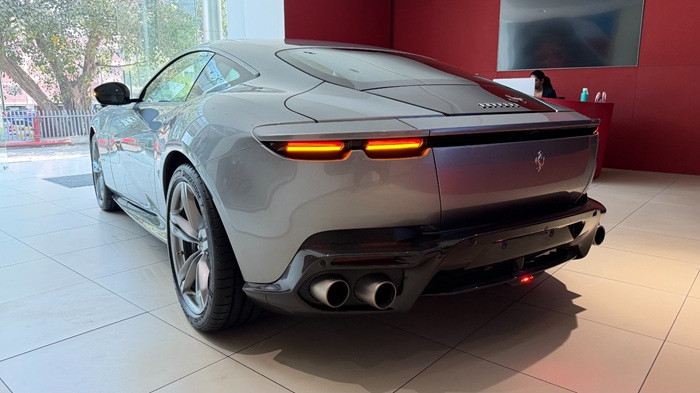
Ferrari offers an astonishing 35 exterior colour options, including silver, grey, black, white, yellow, orange, red, green, blue, violet and multiple matte finishes. The car shown here wears silver, which suits the Amalfi like a tailored Italian suit—clean, classy and subtly intimidating.
At the rear, the design remains aerodynamic yet aggressive. A carbon fibre diffuser improves airflow efficiency, while the active rear spoiler operates in three configurations, doubling as an air brake during heavy braking. Even the underbody has been carefully sculpted to maximize aerodynamic efficiency.
Customers can also customize the tailpipe tips, choosing between standard finishes, titanium, black ceramic or sporty variants.
Underneath all this beauty lies a heavily refined chassis. The Amalfi features a 6D sensor system that monitors vehicle dynamics and distributes braking force accordingly for improved stability. Ferrari has also introduced recalibrated magnetorheological dampers, a new brake-by-wire system, and an updated engine control unit.
The power steering is now 10% quicker and more precise, making urban driving smoother and high-speed cornering sharper. For those unfortunate moments when your driveway ramp feels like Mount Everest, Ferrari offers a 40 mm suspension lifter option.
Handling is further enhanced by Ferrari’s electronic differential, which distributes torque between the rear wheels for improved traction and cornering performance. The Ferrari Dynamic Enhancer (FDE 2.0) uses subtle braking inputs to refine stability during spirited driving.
Meanwhile, the SCM-E Frs magnetorheological suspension system constantly adjusts shock absorber stiffness in real time, balancing comfort and razor-sharp handling. In simpler words, the car reads the road faster than your brain can say “Ferrari”.
Ferrari has also carefully engineered the signature engine sound, ensuring that even though the engine is turbocharged, it still sings like an Italian opera.
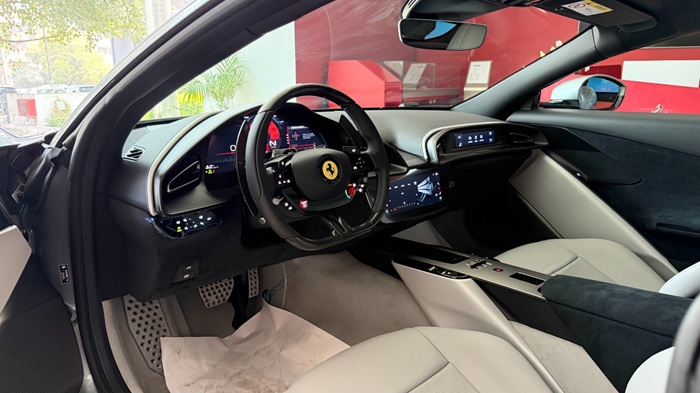
Inside, the Amalfi transforms from supercar to luxury lounge. Ferrari calls the cabin layout monolithic, with a driver-centric dashboard that integrates digital displays seamlessly.
The car offers fully electric front seats with ventilation and massage functions, with numerous customization options including seat colour, stitching patterns and headrest logo embroidery. Standard seats are available, but special performance seats can also be specified.
Interior materials include beige leather upholstery as standard, with optional colours such as black, brown, red, maroon and blue. The headliner comes in leather, with Alcantara available as an option.
Ferrari allows extensive customization for almost every interior element, including door trims, dashboard colours, seat backrests, carpets and even seatbelt colours—available in red or yellow.
The steering wheel is a work of art itself, finished in carbon fibre and leather, with multiple colour options. It houses controls for lights, indicators, voice commands, adaptive cruise control, wipers and drive modes.
The driver faces a 15.6-inch digital instrument cluster displaying vehicle dynamics and performance data. In the centre sits a 10.25-inch touchscreen infotainment system, supporting Apple CarPlay, Android Auto, radio, phone connectivity, vehicle settings and seat controls.
There’s also an 8-inch passenger display, allowing the co-driver to monitor G-forces, RPM and performance data, which is Ferrari’s polite way of saying “everyone gets to enjoy the drama.”
Sound is handled by a high-fidelity audio system, with an optional Burmester premium sound system for audiophiles who occasionally prefer music over V8 symphonies.
Practicality hasn’t been ignored either. The Amalfi offers 273 litres of boot space, enough for weekend luggage, and Ferrari even offers a dedicated custom luggage set.
Technology features include MyFerrari Connect, allowing owners to control and monitor several vehicle functions via smartphone.
Safety is equally comprehensive. The Amalfi includes Adaptive Cruise Control, Automatic Emergency Braking, Blind Spot Detection, Lane Departure Warning, Lane Keeping Assist, Traffic Sign Recognition, Driver Drowsiness Detection and Rear Cross Traffic Alert.
Additional safety features include four airbags, ABS Evo, EBD, F1 traction control, surround-view camera, front and rear parking sensors, Vehicle Dynamic Control, side slip control SSC 6.1, emergency call system, privacy windows and an anti-theft satellite alarm system.
Ferrari also offers a 7-year free maintenance package, with servicing required every 20,000 km or once a year.
Now let’s talk about the real star of the show.
Under the bonnet lies Ferrari’s legendary F154 BH engine. This is a 3.9-litre V8 twin-turbo petrol engine, featuring DOHC, 32 valves, direct fuel injection, dry-sump lubrication and water cooling.
The engine produces 631 horsepower and 760 Nm of torque, enabling the Amalfi to sprint from 0-100 km/h in just 3.3 seconds, reach 200 km/h in 9 seconds, and continue all the way to a top speed of 320 km/h.
Fuel efficiency stands at roughly 8 km/l, with an 80-litre fuel tank, which means the Amalfi is as comfortable devouring highways as it is devouring petrol.
This engine has appeared in several Ferrari and Maserati models—including the Roma, Portofino M, GTC4Lusso T, 488, F8 Tributo, and even the Maserati Quattroporte, Ghibli and Levante—though Ferrari engineers have continuously refined it.
It features a flat-plane crankshaft, low-inertia turbines, twin-scroll turbo technology, and separate exhaust gas management for progressive power delivery. The Amalfi also introduces low-viscosity engine oil, improving warm-up efficiency, along with a lightweight camshaft and redesigned engine block, reducing weight by another kilogram.
The turbochargers themselves spin at an astonishing 171,000 rpm, which is roughly the same speed your heart will reach the first time you floor the throttle.
The engine was designed by Gianluca Pivetti and has won multiple International Engine of the Year awards, further cementing its reputation as one of the finest V8 engines ever built.
And perhaps the most amusing part of the Amalfi is Ferrari’s claim that it’s designed for everyday usability. Technically they’re correct. You can drive it daily.
Of course, your “daily commute” might suddenly start including unnecessary detours, scenic routes, and suspiciously frequent coffee breaks—because when you’re driving something as spectacular as the Ferrari Amalfi, reaching your destination quickly becomes the least interesting part of the journey.