
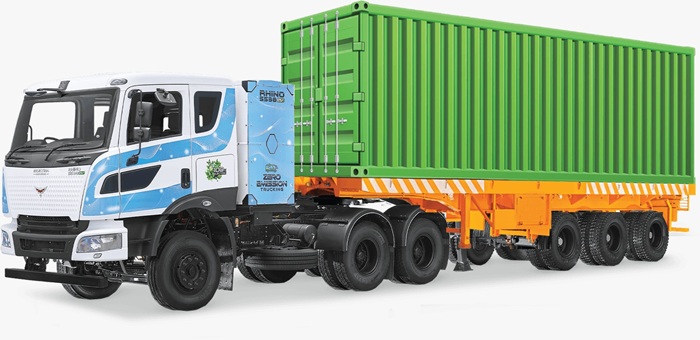
New Delhi: Montra Electric has rolled out its 1,000th Rhino electric heavy-duty truck from its manufacturing facility in Manesar, becoming the first Indian brand to reach the milestone, according to the company. The achievement marks a significant development in India’s electric commercial vehicle industry, where battery-powered heavy trucks are gradually moving from experimental deployments to mainstream freight operations.
The company said its Rhino electric truck fleet has collectively travelled more than 36 million kilometres, avoided over 6.5 million kilograms of carbon dioxide (CO₂) emissions and delivered operating cost savings exceeding ₹70 crore to fleet operators.
According to Montra Electric, the emissions reduction is equivalent to the amount of CO₂ absorbed by approximately 14 lakh trees in a year. The figures highlight the potential environmental and financial benefits of electrifying India’s heavy-duty transportation sector, although the estimates have not been independently verified.
The milestone is being commemorated under the theme “1,000 Rhinos & Beyond. Charge the Change.”
PM E-DRIVE Scheme Provides Additional Momentum
Government incentives have also played a role in supporting the adoption of electric heavy-duty trucks.
In January 2026, the Montra Rhino 5538 EV became India’s first heavy-duty electric truck to receive certification under the PM E-DRIVE scheme, according to the company.
The scheme provides eligible buyers with incentives of up to ₹9.6 lakh per vehicle, potentially reducing the initial acquisition cost of electric trucks, which remains a major consideration for commercial fleet operators.
While electric heavy-duty vehicles generally require higher upfront investment than conventional diesel-powered trucks, lower energy and maintenance expenses can help improve their overall operating economics, depending on utilisation, charging infrastructure and operating conditions.
Customer Confidence Drives Electric Truck Adoption
Reflecting on the company’s progress, Jalaj Gupta, Managing Director, Montra Electric, (TI Clean Mobility Pvt. Ltd.) said, “When we started, there was no electric heavy truck market in India to build on. We had to prove, load after load, that these trucks could do the job and pay for themselves. With policy support such as PM E-DRIVE, and customers coming back to expand their fleets, electric heavy trucking in India has reached a tipping point. Our first 1,000 Rhinos belong as much to our customers and partners as they do to us. They backed electric trucks early, and the next 1,000 will be built on that trust.”
Montra Electric entered the heavy-duty electric vehicle segment when the market was still in its infancy. Charging infrastructure was limited, while fleet operators remained cautious about the ability of electric trucks to transport heavy loads over long distances without compromising productivity or commercial viability.
Unlike passenger electric vehicles, where range and charging convenience often dominate purchasing decisions, heavy-duty trucks must also meet demanding requirements related to payload, operational uptime, energy consumption and cost per kilometre.
For logistics companies, environmental benefits are welcome, but the balance sheet still has the final word.
Montra Electric said it addressed these concerns through customer deployments across demanding transport applications, with repeat purchases becoming an important indicator of growing confidence in the technology.
Performance, Range and Operating Costs Remain Key Priorities
Navneet Sethi, CEO-eM&HCV, Montra Electric, (IPL Tech Pvt. Ltd.) said, “The 1,000th Rhino roll-out marks an important milestone in demonstrating the commercial viability of electric heavy-duty trucking in India. Our trucks have demonstrated their ability to deliver on the parameters that matter the most to fleet operators – performance under load, operational uptime, range and cost efficiency, across demanding applications and long-haul routes. The growing number of repeat orders reflects customer confidence in the product and its ability to deliver tangible business value. Our next priority is to build on this momentum, deepen customer partnerships and expand the footprint of electric heavy-duty trucks across key applications and markets in India.”
The company’s emphasis on repeat orders reflects an important shift in how commercial electric vehicles are being evaluated. Rather than relying solely on environmental considerations or government incentives, fleet operators increasingly need measurable improvements in operating costs and vehicle productivity to justify investing in electric trucks.
For manufacturers, demonstrating reliable performance under commercial operating conditions will be essential to securing larger fleet orders and accelerating adoption.
Montra Electric Targets Wider Heavy-Duty EV Deployment
Following the production milestone, Montra Electric plans to expand its electric truck deployments, strengthen relationships with existing customers and increase its presence across key transportation applications and markets in India.
The company’s next phase will focus on scaling operations while building on the experience gained from its first 1,000 Rhino trucks.
The achievement comes as India’s commercial transportation sector faces growing pressure to reduce emissions while maintaining cost competitiveness. Heavy-duty trucks are particularly important to this transition because of their substantial energy requirements and intensive operating schedules.
Although challenges involving charging infrastructure, initial vehicle costs and long-distance operations remain, Montra Electric’s milestone suggests that electric heavy-duty trucking is beginning to establish a measurable commercial presence in India.
The broader test, however, will be whether manufacturers can translate these early achievements into sustained, large-scale adoption. For India’s freight industry, the transition to cleaner transportation will ultimately depend not simply on how many electric trucks are manufactured, but on how reliably and economically they perform on the road.