

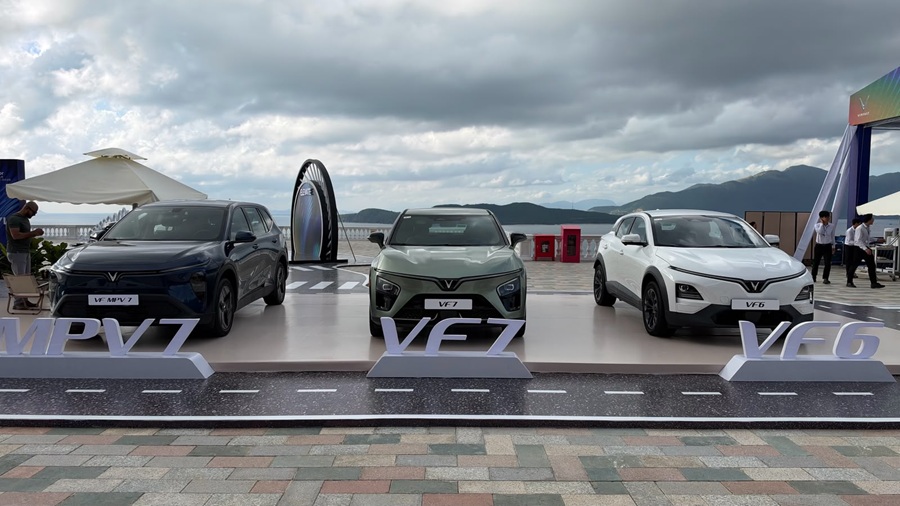
Nha Trang, Vietnam: Vietnamese electric vehicle manufacturer VinFast brought together more than 500 international participants for the V-Creator All Star Summit 2026, a five-day gathering focused on artificial intelligence, autonomous driving, electric mobility and Asia’s growing influence on the global automotive industry. Hosted at Vinpearl Resort Nha Trang, the event featured technology executives, researchers, business leaders and automotive media representatives from India, Indonesia and the Philippines.
Held under the theme “Building the Future of Asia,” the summit’s international conference on November 17 featured speakers from Qualcomm, the University of New South Wales and VinFast, with discussions examining how emerging technologies are transforming vehicle development, consumer expectations and the economics of electric mobility.
Unlike traditional automotive media events dominated by vehicle launches, engine specifications and ambitious performance claims, the summit placed greater emphasis on the technologies and business decisions shaping the industry’s future. Horsepower figures, for once, were not the centre of attention.
Organised by VinFast and its parent group, Vingroup, the conference also reflected the Vietnamese conglomerate’s efforts to establish a broader international platform for exchanges between the automotive, technology and media industries.
Qualcomm and Global AI Researchers Examine the Future of Intelligent Vehicles
Among the prominent speakers was Professor Toby Walsh, a Scientia Professor at the University of New South Wales in Australia and a leading researcher in artificial intelligence.
His presentation, “From AI to the Future of Mobility: How Intelligence Is Reshaping Industries,” examined the growing influence of artificial intelligence across sectors, including its potential to create new business opportunities and competitive advantages.
The discussion explored how organisations can move beyond experimenting with AI technologies and translate them into commercially viable applications.
Representing the automotive technology sector, Abhay Rai, Vice President of ADAS Product Management at Qualcomm, discussed developments in advanced driver assistance systems (ADAS), automated driving and software-defined vehicle architectures.
His presentation examined the increasing role of artificial intelligence, high-performance computing and advanced software in developing intelligent driving systems.
A central theme was the challenge of making these technologies reliable, safe and commercially accessible across different vehicle categories.
As manufacturers introduce increasingly sophisticated driver assistance systems, their ability to balance technological capabilities with affordability and real-world performance is becoming an important consideration.
VinFast Outlines Electric Vehicle Expansion and Autonomous Driving Strategy
VinFast’s leadership provided an industry perspective on the practical challenges associated with expanding electric mobility across international markets.
Tapan Ghosh, CEO of VinFast Asia, discussed the company’s transition from a Vietnamese automotive manufacturer into an international electric vehicle brand.
His presentation focused on the factors influencing mainstream EV adoption, including vehicle affordability, charging infrastructure, customer service and ownership policies.
These considerations are particularly important in emerging automotive markets, where charging networks, consumer purchasing power and infrastructure development vary significantly.
While electric vehicles continue to attract investment and technological innovation, their wider adoption depends on more than improvements in battery technology and driving range.
Consumers must also have access to convenient charging, dependable aftersales services and ownership costs that compare favourably with conventional vehicles.
Meanwhile, Professor Dr. Van Duong Nguyen, a senior VinFast executive specialising in advanced driver assistance and autonomous driving technologies, discussed the company’s development of intelligent vehicle systems.
His presentation covered Level 2 and Level 2+ driver assistance technologies alongside emerging approaches involving end-to-end artificial intelligence, Vision-Language-Action models and Agentic AI.
The discussion also addressed the engineering challenges involved in developing these systems, including computing requirements, data availability, safety, performance and manufacturing costs.
Such technologies represent an increasingly important area of automotive research, although advanced driver assistance capabilities should not be confused with fully autonomous driving.
For VinFast, the development of these systems forms part of its broader efforts to integrate software and artificial intelligence into future vehicle technologies.
India, Indonesia and the Philippines Take Centre Stage in VinFast’s Asian Expansion
The summit also examined opportunities for electric mobility across Asia, particularly in India, Indonesia and the Philippines, which form important parts of VinFast’s international growth strategy.
Tapan Ghosh and Antonio “Toti” Zara, CEO of VinFast Philippines, discussed the commercial opportunities and challenges associated with expanding electric vehicle operations in these markets.
Their presentations highlighted the importance of adapting business strategies to local conditions rather than relying on a single approach across multiple countries.
Although demand for electric mobility is developing throughout the region, individual markets differ considerably in charging infrastructure, government policies, consumer preferences and automotive purchasing patterns.
For manufacturers such as VinFast, successful expansion will therefore depend on building suitable distribution networks, strengthening customer support and developing accessible charging ecosystems.
The conversations also reflected a broader challenge facing the international automotive industry: technological progress may make electric vehicles more capable, but infrastructure and affordability will ultimately influence how quickly consumers adopt them.
Vingroup Seeks a Broader Role in International Technology Discussions
Beyond the individual presentations, the V-Creator All Star Summit illustrated Vingroup’s efforts to strengthen its connections with international technology companies, researchers, automotive executives and media organisations.
The five-day programme combined technology discussions and industry exchanges with opportunities for participants to experience different businesses within the Vingroup ecosystem.
By hosting the gathering in Vietnam, the company also sought to highlight the country’s potential as a venue for international discussions on advanced manufacturing, artificial intelligence and future mobility.
The format marked a departure from conventional automotive press programmes, which typically concentrate on introducing new models, communicating corporate developments and arranging vehicle evaluations.
Instead, the summit provided journalists and content creators with opportunities to engage with specialists whose work extends beyond the automotive industry.
This wider perspective is becoming increasingly relevant as vehicle manufacturing converges with semiconductor development, software engineering, artificial intelligence and energy infrastructure.
The presence of executives from established international technology companies also offered an opportunity to examine how partnerships between industries could influence future vehicle development.
Could V-Creator Become a Recurring Global Automotive Forum?
The V-Creator All Star Summit 2026 could provide a foundation for further international discussions involving automakers, technology companies, researchers, policymakers and media representatives.
However, whether the gathering develops into a recurring industry forum will depend on its ability to maintain participation from independent experts, encourage substantive exchanges and address challenges extending beyond VinFast’s own commercial interests.
The event also highlighted the changing ambitions of Asian businesses seeking greater recognition as technology developers and international brands rather than solely manufacturing centres.
For Vingroup, hosting a conference of this scale provides an opportunity to increase its international visibility while encouraging discussions on issues affecting the wider mobility sector.
As the automotive industry moves towards an era increasingly defined by software, artificial intelligence and electrification, the companies shaping its future may be judged not only by the vehicles they manufacture but also by the technologies, partnerships and ideas they help develop. VinFast’s V-Creator Summit reflects that shift, placing Vietnam within a wider conversation about the next generation of global mobility.