Tesla has unveiled its long-awaited second-generation Roadster electric sports car, featuring rocket-inspired propulsion technology, extraordinary acceleration claims and the ability to perform controlled aerial manoeuvres. Developed with engineering expertise from SpaceX, the new Roadster has also opened for reservations in India, with an initial booking amount of ₹5.01 lakh for the Performance variant. However, the most ambitious Rocket version, capable of limited flight, will be available by invitation only.
Unveiled on October 15 at a SpaceX facility in Texas, the redesigned Roadster represents a significant departure from conventional electric sports cars. During the presentation, Tesla demonstrated the vehicle driving upside down along a specially designed ramp, performing aerial rotations and jumping over other vehicles using a combination of aerodynamic suction and compressed-gas thrusters.
Tesla CEO Elon Musk celebrated the demonstration on X, writing, “Turns out the future does have flying cars.”
In another post, Musk remarked, “Success is not certain, but excitement is.”
The demonstration has drawn considerable attention, although Tesla is targeting production in 2028, and questions remain about regulatory approval, road legality and the feasibility of bringing its most extreme capabilities to customers.
Tesla Roadster India Booking Details
Tesla’s reservation system lists two configurations available for booking in India: Performance and Thrust. The third, Rocket, is restricted to customers who receive an invitation.
For the Performance variant, customers must initially pay ₹5,01,000, followed by ₹45,05,000 within 10 days, bringing the total reservation deposit to ₹50,06,000.
The Thrust variant requires an initial ₹5,01,000 payment, followed by ₹2,45,24,000 within 10 days, amounting to a total reservation deposit of ₹2,50,25,000.
These amounts are reservation deposits rather than the vehicles’ final selling prices. Tesla has not announced definitive retail prices or confirmed an India delivery schedule.
Importantly, accepting reservations in India does not establish that the flight-capable version will be approved for operation in the country.
Three Variants: Performance, Thrust and Rocket
Tesla has outlined three versions of the Roadster, each designed around a different level of performance.
Performance: The entry-level, road-focused configuration offers seating for two and incorporates active aerodynamics and a multi-mode suction system to improve traction and handling. Tesla claims acceleration from 0–60 mph (approximately 97 km/h) in under 1.6 seconds.
Thrust: Developed primarily for track-oriented performance, this two-seater adds rear-mounted cold-gas thrusters to the aerodynamic and suction systems. Tesla claims a 0–60 mph acceleration time of less than 0.9 seconds.
Rocket: The most technically ambitious configuration accommodates only one occupant and combines the multi-mode suction system with cold-gas thrusters positioned around the vehicle. According to Tesla, these systems enable vertical and forward acceleration, lateral movement and controlled aerial rotations. The company claims a 0–60 mph time of under 0.59 seconds.
Unlike the other configurations, the Rocket variant is not approved for public-road use. It is also restricted to invited customers.
Tesla Roadster Performance: Under-One-Second Acceleration and Over 370 km/h Top Speed
Tesla claims that the redesigned Roadster can deliver acceleration and handling capabilities beyond those of conventional high-performance sports cars.
During the reveal, the company demonstrated a 0–60 mph acceleration time of approximately 0.81 seconds, with a figure of 0.67 seconds when rollout was subtracted.
Tesla’s stated targets also include a driving range exceeding 300 miles (approximately 483 kilometres) and a top speed of more than 230 mph (370 km/h) for the Rocket configuration.
These figures remain manufacturer-reported performance claims rather than independently verified production-vehicle results.
The extraordinary acceleration is made possible partly by technology that operates independently of conventional tyre traction. While most sports cars depend on mechanical grip to transfer power to the road, Tesla’s cold-gas propulsion system generates additional thrust directly.
According to the company, the thruster system can generate four to five times the force available from tyre traction alone under certain conditions.
The obvious challenge, of course, is that most roads were designed for cars that prefer to remain firmly attached to them.
How the Roadster’s Flying Technology Works
At the centre of the Roadster’s unconventional engineering is a combination of active aerodynamics, a multi-mode suction system and cold-gas thrusters.
The suction system uses powered fans and ground-sealing technology to extract air from underneath the vehicle, generating downforce even when the car is stationary.
Tesla claims the resulting aerodynamic force is sufficient to hold the Roadster upside down without requiring forward movement.
Active wings further regulate aerodynamic performance by balancing downforce and drag. In Track Mode, the vehicle lowers its ride height and adjusts its suspension characteristics for higher-speed driving.
For the Thrust and Rocket configurations, compressed gas provides additional propulsion.
Developed using expertise associated with SpaceX spacecraft systems, the cold-gas thrusters employ electrically controlled actuators capable of making rapid adjustments to the direction and magnitude of thrust.
On the Rocket configuration, these thrusters are designed to support controlled upward movement and stabilisation during flight.
Tesla says the vehicle incorporates Carbon Fibre Overwrapped Pressure Vessels (COPVs) to store compressed gas, allowing the propulsion system to deliver repeated bursts of thrust.
Although the technology demonstrated controlled airborne manoeuvres, it should not be confused with approval for routine aircraft-style operation or unrestricted flight over public roads.
Exterior Design Inspired by Fighter Jets and Spacecraft
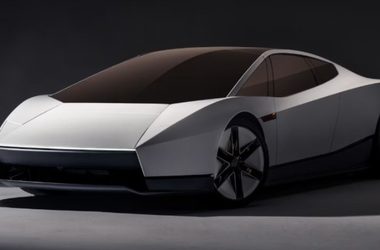
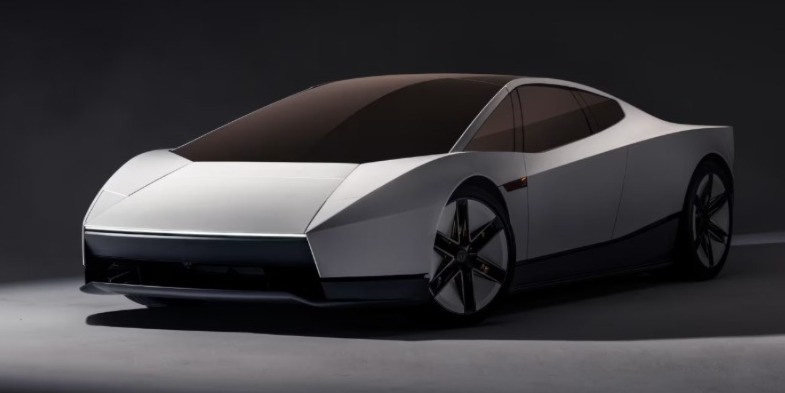
The new Tesla Roadster adopts an angular, minimalist appearance influenced by aerospace engineering.
Tesla says its design takes inspiration from the Lockheed SR-71 reconnaissance aircraft and the F-35 fighter jet, with an emphasis on aerodynamic efficiency, lightweight construction and functional exterior surfaces.
The vehicle features concealed headlights, a full-width rear light signature, flush-mounted aerodynamic elements and lightweight wheels with slender spokes.
An aerospace-inspired Ano White exterior finish is designed with protective properties associated with spacecraft materials, including ultraviolet and cryogenic protection, electrostatic dissipation and corrosion resistance.
The car also features Gold Glazed tinted windows, inspired by the metallic coatings used on astronaut helmet visors, alongside subtle titanium detailing.
Together, these features give the Roadster a distinctive appearance that reflects Tesla’s increasingly futuristic design language.
Minimalist Interior Focused on Weight Reduction
Inside, the Roadster follows Tesla’s minimalist approach, although the emphasis is firmly on performance rather than conventional luxury.
The Ultrawhite cabin features grey microsuede detailing and seats with additional microsuede bolstering to improve occupant grip during aggressive manoeuvres.
A yoke-style steering control works with a next-generation steer-by-wire system, while a central touchscreen is accompanied by two smaller displays providing essential driving information.
Tesla has also prioritised reducing unnecessary weight through manual controls, a fixed seating position and the extensive use of lightweight materials.
Magnesium, titanium and carbon fibre feature prominently in the company’s engineering strategy, helping offset the additional mass associated with the vehicle’s propulsion and aerodynamic systems.
The result is a cockpit designed around the driver, with particularly unconventional demands placed on the occupant in the flight-capable configuration.
A Roadster Legacy That Began in 2008
The Roadster name holds considerable historical importance for Tesla.
Introduced in 2008, the original Roadster was the company’s first production vehicle and helped challenge the perception that electric cars were inherently slow or unexciting.
The second-generation Roadster was initially revealed in November 2017, with deliveries originally expected to begin in 2020.
However, the project experienced repeated delays as Tesla concentrated on expanding its mass-market electric vehicle portfolio and developing autonomous driving technology, artificial intelligence and robotics.
The latest unveiling represents the most substantial update to the Roadster programme in years, although production remains approximately two years away.
It also arrives as Tesla increasingly positions autonomous vehicles and humanoid robotics at the centre of its long-term strategy.
Can the Tesla Roadster Become India’s First Flying Car?
Despite the Roadster’s dramatic airborne demonstration and the opening of Indian reservations, there is currently no confirmation that its Rocket configuration will be introduced for commercial operation in India.
Flying-capable vehicles face substantial regulatory, safety and operational requirements that differ from those governing conventional passenger cars.
Tesla has explicitly stated that the Rocket variant is not approved for public-road use, and its potential operation in India would depend on applicable regulatory approvals.
The company’s planned 2028 production timeline also remains subject to execution, especially given the Roadster programme’s lengthy history of postponements.
For now, the new Roadster is best understood as an ambitious engineering showcase rather than a commercially available flying car.
Tesla’s latest Roadster demonstrates how far electric vehicle engineering could extend when aerospace propulsion, advanced aerodynamics and lightweight materials converge. Yet its ultimate significance will depend less on the spectacle of a car briefly taking flight and more on whether Tesla can translate those capabilities into a safe, reliable and commercially viable production vehicle. After nearly a decade of anticipation, the Roadster has proved it can attract attention. Delivering on its promises will be the considerably harder part.