There are SUVs, there are big SUVs, there are full-size SUVs, and then there is the Nissan Patrol — a machine so large that if you park it outside your house, Google Maps may start marking your driveway as a new district. This is not just a Japanese full-size SUV. This is Nissan’s long-running declaration that comfort, capability, and old-school mechanical confidence can still arrive wearing 18-inch tyres, a V-shaped grille, and the fuel appetite of a small private aircraft.
The Nissan Patrol was first launched in 1951, which means this nameplate has been around longer than most modern countries’ traffic regulations, most automotive trends, and definitely longer than the patience of a parking valet in South Delhi. What you are seeing here is the 2025 sixth-generation facelift model, internally known as the Y62. Internationally, the seventh-generation Patrol has already arrived, but whether that new model will officially come to India remains one of those great mysteries, along with why hotel parking ramps are designed by people who apparently hate cars.
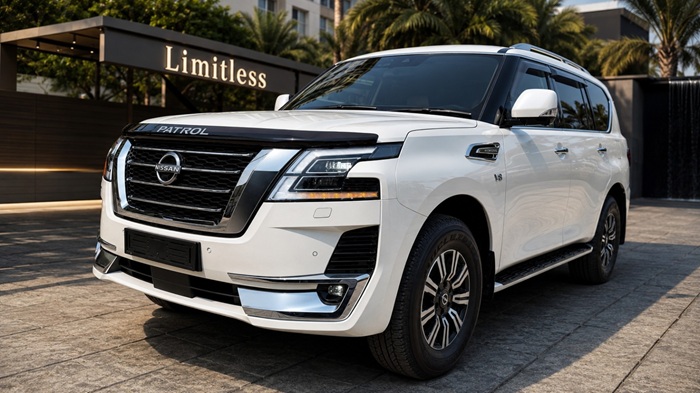
For now, this Y62 Patrol remains a very special sight in India because Nissan does not officially sell the Patrol here. The vehicle you see is a used private import, priced at around ₹2.45 crore, and can be purchased through Limitless Luxuries. In Dubai, the Patrol range starts from around ₹58 lakh ex-showroom and goes up to nearly ₹1 crore for the top variant. But once a vehicle crosses oceans, customs, paperwork, taxes, import rules, and the emotional trauma of Indian registration, it becomes less of a car and more of a financial adventure with headlights.
And yet, the Patrol has always had that charm. Nissan built it originally to compete with the Toyota Land Cruiser, and over decades it has become a serious legend in markets like the Middle East, Australia, Africa, and several grey-import-loving countries where people enjoy their SUVs large, strong, and capable of casually crossing deserts before lunch. In some countries, this SUV is also sold as the Nissan Armada, which sounds less like a family car and more like something that should arrive with naval support.
Design-wise, the Patrol does not whisper. It announces itself. Designed by Taiji Toyota, this generation carries a bold, upright, muscular shape that makes it look like it was carved from a large block of confidence. The V-shaped grille dominates the face, giving the Patrol a proper flagship Nissan identity. The C-shaped LED headlights come with High Beam Assist, washers, daytime running lamps, and auto levelling. Basically, even the headlights have a better support system than most office employees.
The fog lamps add to the front-end character, while the tinted windscreen and large body panels give the Patrol that diplomatic convoy energy. It does not look aggressive in a childish way. It looks serious, established, and slightly uninterested in what compact SUVs are doing on Instagram.
From the side, the Patrol’s sheer size becomes clear. It is around 5.1 metres long, 2 metres wide, and 1.9 metres tall. The turning circle is 12.5 metres, which means tight U-turns require planning, patience, and possibly a written application to local authorities. Ground clearance stands at a massive 273 mm, so bad roads, broken patches, stones, village tracks, and those surprise speed breakers built by emotionally unstable contractors should not trouble it much.
It weighs around 2,800 kg, with a gross weight of 3,450 kg. That is not kerb weight; that is almost a small building with leather seats. It can tow up to 3,500 kg and has a roof loading capacity of 100 kg. So yes, it can pull, carry, climb, and still look expensive while doing it.
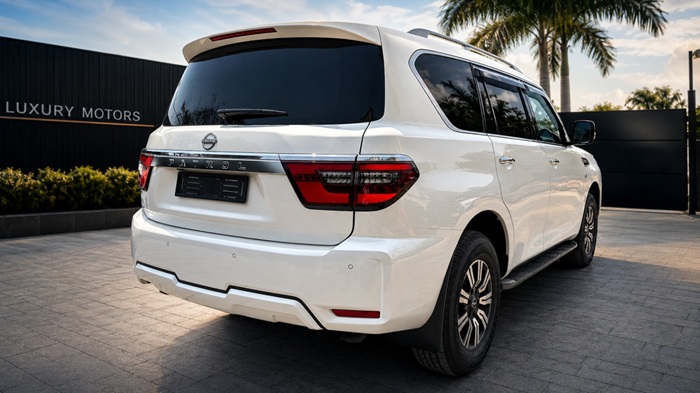
The SUV shown here is finished in Pearl White, a colour that suits the Patrol perfectly. It gives the big body a clean, premium appearance, somewhere between luxury hotel shuttle and Middle Eastern desert commander. Other colour options include gold, black, grey, silver, beige, and blue. Personally, white on a Patrol just feels correct. It looks majestic, authoritative, and also slightly like it has never had to ask for permission at a security gate.
The Patrol rides here on 18-inch alloy wheels, though 20-inch alloys are also available as an option. The tyres are 265/70 R18 116H Bridgestone Dueler A/T 693 II, made in Japan, steel-belted radial tubeless tyres. These are proper all-terrain tyres, not those fashion-focused rubber bands that look good outside cafés but start crying the moment they see gravel. Disc brakes are offered at the front and rear, which is reassuring because when a 2.8-tonne SUV gets moving, stopping it is not a feature — it is a civic responsibility.
At the rear, the LED tail lamps come with sequential turn indicators, because even a vehicle this traditional understands a little bit of theatre. The heated rear screen gets a defogger and timer, useful in cold weather and during those moments when the cabin is full of seven people breathing, talking, and debating which dhaba to stop at.
The Patrol is not just big for the sake of being big. It is built on the Y62 platform, which also underpins models like the Armada, Terra, Navara, and Infiniti QX80. That gives it genuine structural seriousness. This is not a soft crossover wearing boots. This is a proper four-wheel-drive SUV with a Limited Slip Differential and rear differential lock for better traction. It has four drive modes: Sand, On Road, Snow, and Rock. In India, we may not have snow everywhere, but rock, sand, potholes, broken diversions, and random construction debris are available in excellent variety.
One of the Patrol’s biggest engineering highlights is its Hydraulic Body Motion Control, or HBMC. Nissan calls it the world’s first Hydraulic Body Motion Control suspension system, and the idea is simple but clever. During off-road driving, it allows maximum suspension stroke, helping the vehicle keep its tyres in contact with the surface. During cornering, it increases damping force to reduce body roll and improve stability. In normal human language, it tries to make this massive SUV behave less like a boat and more like a very disciplined elephant.
And that is important because the Patrol is enormous. Without clever suspension, a vehicle of this size could easily feel like a sofa thrown down a hillside. But HBMC helps it stay flatter, smoother, and more composed, whether you are cruising on highways or tackling rough terrain. The front and rear both use double wishbone suspension, which adds to the ride comfort and control. This is one of the reasons the Patrol is so loved in the Middle East, where people expect one vehicle to take them to a five-star hotel, a desert camp, and possibly a family wedding with equal dignity.
There is also an Off-Road Monitor system, which shows steering angle, tyre angle, Vehicle Dynamic Control activity, and traction information. This helps the driver understand what the SUV is doing over difficult terrain. It is the kind of feature that makes you feel like an expedition leader, even if your biggest off-road challenge is entering a farmhouse driveway after rain.
The Vehicle Dynamic Control system helps prevent sliding on slippery road surfaces by automatically controlling the vehicle’s behaviour. Add to this hill start assist and hill descent control, and the Patrol feels ready for steep climbs and descents. It is the sort of SUV that looks at bad roads and says, “That’s cute.”
Safety equipment is extensive. The Patrol gets 6 SRS airbags, ABS, EBD, brake assist, electric door locking, Crash Sensitive Door Unlock, Moving Object Detection, a 360-degree camera, corner sensors, ISOFIX child seat mounts, anti-theft devices, immobiliser, alarm, Around View Monitor, central locking, and 3-point ELR seatbelts. The front seatbelts also get pretensioners and load limiters. This is good because in a vehicle this large, safety must be handled with the seriousness of a government file moving through six departments.
ADAS features include Blind Spot Intervention, Blind Spot Warning, Rear Cross Traffic Alert, Lane Intervention, Lane Departure Warning, Intelligent Emergency Braking, Intelligent Forward Collision Warning, and more. In short, the Patrol tries to protect you not only from your mistakes, but also from the mistakes of people around you — which, in Indian traffic, is practically a full-time job.
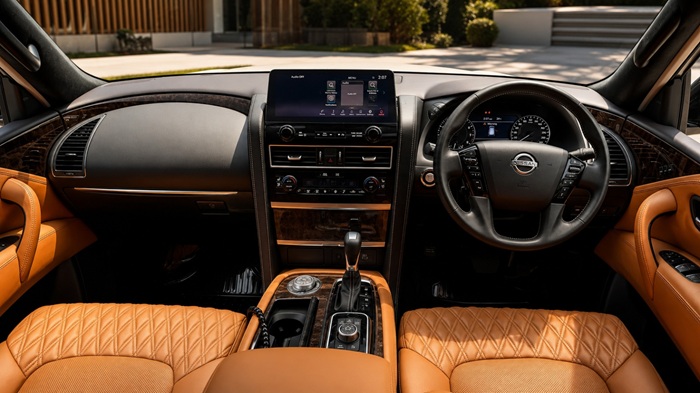
Inside, the Patrol is exactly what you expect from a flagship Japanese SUV: large, comfortable, practical, and slightly old-school in the nicest possible way. It does not try to be a spaceship. It tries to be a luxury lounge that can cross a desert.
The cabin gets leather upholstery, electrically adjustable front seats with ventilation, heating, and memory. This means the front passengers are treated with genuine respect. Seat heating may not be urgently required in most Indian cities, but seat ventilation is a blessing from above, especially when the outside temperature reaches levels where even the steering wheel starts questioning life choices.
The second-row seats are manually reclining and folding, while the third-row seats are 60:40 split folding with manual fold-down and reclining functions. This is a proper large family SUV. You can carry people, luggage, shopping bags, camera equipment, relatives, and still have room for someone’s unrealistic expectations.
Boot space stands at 550 litres with all rows up. Fold the third row and it expands to 1,490 litres. Fold the second row as well and you get a massive 3,170 litres of space. At that point, it is no longer a boot. It is a studio apartment with tail lamps.
Noise insulation is also taken seriously. The door windows get UV and noise insulation, while the front door panels use ultra micro-fibre insulation to reduce noise. The result should be a quieter, more premium cabin experience. This is exactly what a luxury SUV should do: keep the outside world outside, especially when the outside world includes honking, road rage, and someone on a scooter carrying a refrigerator.
There is a 13-speaker Bose audio system, which is perfect because a vehicle this big deserves a sound system that can fill the cabin without sounding like a Bluetooth speaker trapped in a cupboard. Whether it is classic rock, Bollywood, ghazals, or an unnecessarily loud podcast, the Bose system should keep everyone entertained.
The Patrol also gets anti-pinch power windows, footwell lighting, an electric tilt and telescopic steering wheel, a cool box, and a lockable glovebox with light and damper. The cool box is a wonderful feature, especially in hot climates. Keep water, soft drinks, or chocolate inside and feel like a person who has solved one of life’s smaller but very important problems.
The tri-zone air conditioning system comes with a heater, allowing different cabin zones to maintain different temperatures. This is extremely useful in a family car because one passenger will always be cold, another will always be hot, and the third will always complain regardless of temperature.
The infotainment system uses a 12.3-inch advanced touchscreen display with Bluetooth, navigation, 2GB HDD music box, AUX, USB, voice recognition, off-road monitor, Apple CarPlay, Android Auto, FM, and radio. The 2GB HDD music box feels charmingly old-school in today’s world of streaming apps, but honestly, it gives the Patrol character. It is like finding a CD changer in a luxury car — unnecessary, but nostalgically delightful.
There is also an electric anti-dazzle rear-view mirror, a tilt and slide sunroof, hydraulic power steering, steering-mounted controls for the instrument cluster and volume, plus phone, voice, and cruise control buttons. The instrument cluster gets a 7-inch display, offering important information without turning the dashboard into a gaming console.
Now we must talk about the heart of this beast: the mighty 5.6-litre V8 petrol engine. This naturally aspirated VK56VD engine comes with DOHC, spark ignition, and direct fuel injection. It produces 400 horsepower and 560 Nm of torque. No turbocharging drama, no hybrid complexity, no tiny engine pretending to be brave. Just a large, naturally aspirated V8 doing what large naturally aspirated V8s do best — moving heavy things with smooth authority and making fuel pumps feel seen.
This engine is paired with a 7-speed automatic transmission, though a manual transmission option was also available in some markets. The Patrol can reach a top speed of around 200 km/h, which is impressive because at that speed, this SUV is not travelling — it is relocating airspace.
Fuel efficiency is around 6 km/l, and the fuel tank capacity is a massive 140 litres. This tells you everything you need to know about the Patrol’s personality. It does not sip petrol. It hosts a farewell ceremony for every litre. But with a 140-litre tank, the driving range remains useful, especially in places where long-distance touring matters.
The same Nissan VK engine family has also been used in models like the NV, Titan, Armada, Infiniti QX80, M56, and Q70. That gives it a strong background and proven reputation. There was also a 4.0-litre V6 engine option available earlier, but honestly, in a vehicle like the Patrol, the V8 feels like the correct emotional answer. Buying a Patrol with a V8 is like ordering a thali and not skipping the dessert.
On the road, the Patrol is likely to feel majestic rather than sporty. This is not a corner-carving SUV. It is not here to chase lap times or impress hatchbacks at traffic lights. It is here to deliver effortless cruising, commanding visibility, and a feeling of mechanical confidence. The hydraulic power steering should feel sturdy and honest, while the suspension setup gives it that big-SUV comfort.
The Patrol’s 3500 kg towing capacity also adds to its appeal. It can pull trailers, boats, caravans, or anything else that rich people in brochures always seem to tow while smiling near lakes. In India, it could probably tow a broken road roller out of a pothole and still ask for breakfast.
Its off-road ability is a huge part of its identity. Thanks to four-wheel drive, rear differential lock, Limited Slip Differential, drive modes, hill descent control, high ground clearance, and HBMC suspension, the Patrol can tackle terrain that would embarrass many luxury SUVs. It has the physical toughness and mechanical depth that made it popular in harsh environments. This is why in many countries it has a cult following. People do not just buy Patrols. They trust them.
Over the years, Nissan has also created several special editions of the Patrol, including the Desert Edition, Black Special Edition, and the powerful Nismo variant. The Nismo version especially proved that someone at Nissan looked at this giant SUV and thought, “Yes, but what if it was angrier?” That is the kind of thinking the automotive world needs more of.
The Patrol’s biggest strength is its combination of old-school charm and modern convenience. It has ADAS, large screens, leather seats, Bose audio, 360-degree cameras, and premium comfort features. But underneath all that, it still feels like a proper mechanical SUV. It has a big engine, serious suspension, strong drivetrain hardware, real off-road ability, and the presence of a vehicle that does not care about trends.
In India, however, the Patrol is not a practical purchase in the normal sense. It is unavailable officially, comes through private import channels, and costs a serious amount of money. At ₹2.45 crore for this used private import example, it enters the territory of luxury SUVs from German and British brands. But the Patrol offers something different. It is not about badge snobbery in the usual way. It is about rarity, toughness, size, comfort, and that legendary Patrol name.
It also has a certain charm because it is not trying too hard. Many modern luxury SUVs are obsessed with screens, ambient lighting, digital tricks, and performance claims. The Patrol simply arrives with a V8, a massive fuel tank, leather seats, off-road hardware, and the confidence of a vehicle that has been crossing difficult terrain since before most influencers discovered adventure.
Yes, it is huge. Yes, it drinks fuel. Yes, parking it in Indian cities may require courage, patience, and possibly a drone operator. But that is also the point. The Nissan Patrol is not for people who want a sensible compact lifestyle crossover. It is for people who want a full-size Japanese SUV with genuine character, road presence, luxury, and enough mechanical confidence to make rough terrain feel like mild inconvenience.
The Patrol is a proper old-money SUV in a new-money world. It does not shout with flashy gimmicks. It simply stands there, massive and calm, like a heavyweight boxer wearing a tailored suit. It can carry seven people, cross rough ground, tow serious weight, cruise at highway speeds, and make every fuel station employee slightly emotional.
In the end, the Nissan Patrol is a reminder of what big SUVs used to be and, in some ways, still should be: strong, comfortable, dependable, powerful, and slightly excessive. It is not perfect, and it is definitely not economical, but it has presence, heritage, engineering depth, and personality.
The Nissan Patrol is not just a car. It is a moving fortress with Japanese discipline, Middle Eastern popularity, Land Cruiser rivalry, V8 theatre, and enough boot space to make a furniture shop nervous.
And if you buy one in India for ₹2.45 crore, remember one thing: you are not just buying an SUV.
You are buying a postcode with four-wheel drive.