
There was a time when owning a mid-size sedan in India meant something rather different from choosing between three turbo-petrol crossovers differentiated mainly by the shape of their daytime-running lamps. In the 1980s and early 1990s, a proper three-box saloon—with a long bonnet, separate boot and rear-wheel drive—still carried an air of occasion. The Premier 118NE belonged firmly to that world.
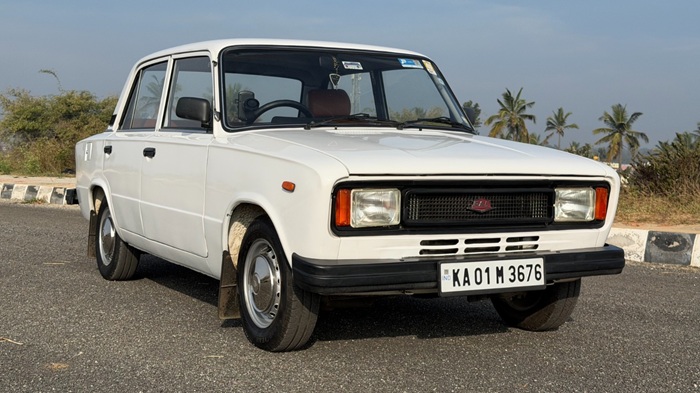
Launched in India in 1985, the 118NE was positioned as a relatively upmarket family sedan, and the white car here is a 1991 first-generation example. It was available with petrol and diesel engines, and the supplied period information places its ex-showroom range between ₹6 lakh and ₹7.20 lakh. This particular car is the petrol version. Production eventually ended in 2001, closing the chapter on one of Premier Automobiles Limited’s most recognisable post-Padmini-era cars.
Calling the 118NE merely an old Premier, however, misses the interesting bit. Underneath its upright Indian-sedan identity sits an international family tree involving Fiat, SEAT, Nissan and enough licensed derivatives to make a family reunion require several translators.
An Italian-Spanish-Indian Family Tree
The roots go back to the Fiat 124 architecture. SEAT produced its own 124 derivative in Spain, and after authorisation from Fiat, Premier acquired production tooling associated with the facelifted SEAT 124 and developed the 118NE for India. The “NE” suffix stood for Nissan Engine, a clue to one of the most important departures from its European ancestry.
The broader Fiat 124 family became astonishingly widespread. Related derivatives and vehicles sharing the basic platform lineage included the Fiat 125, VAZ-2101, VAZ-2103, VAZ-2105, Tofaş Murat 124, Kia 124, SEAT 1430, Lada Riva and Lada 1200. According to the supplied material, the architecture became the world’s fifth-best-selling automotive platform, while approximately 1.5 crore units of the wider family were sold.
It travelled well too. Versions or related derivatives were manufactured or assembled across countries including India, Spain, Italy, Bulgaria, Malaysia, Morocco and South Korea, while the wider licensed family was also produced in Russia, Turkey and Egypt. In Korea, a Fiat-Kia 124 derivative was sold under the Fiat-Kia name. That international spread says something important about the underlying design: this was less a fashionable shape with a short shelf life and more a durable mechanical template that different markets could adapt to suit local needs.
The source material associates celebrated designer Giorgetto Giugiaro with the design lineage and identifies Oscar Montabone as chief engineer. Either way, the visual language belongs unmistakably to that wonderfully straightforward period of European saloon design when a ruler appeared to be among the styling department’s more important tools. There are no fake vents, illuminated grilles or rooflines attempting to impersonate coupés. It is a sedan. It looks like a sedan. Everybody can go home early.
Simple Shape, Serious Presence
At roughly four metres long, 1.6 metres wide and 1.4 metres tall, the Premier 118NE is almost dainty by modern standards. Put it beside a contemporary mid-size SUV and the Premier can appear as though somebody accidentally selected 85 per cent scaling before printing it.
Yet its proportions are excellent.
The bonnet is long enough to announce the longitudinal-engine, rear-drive layout, the glasshouse is upright and generous, and the boot is a proper separate boot rather than a styling afterthought. Thin pillars and large windows give the body an airy appearance that modern crash structures and fashionable high beltlines have largely erased.
This 1991 example is finished in white, although the 118NE was also offered in red, brown, blue and silver according to the supplied material. Front and rear polyurethane bumpers conceal steel reinforcement beneath, creating the slightly chunky black-bumper appearance that was practically a uniform for cars of the period. The PAL—Premier Automobiles Limited—badge provides the Indian signature.
There is relatively little decorative excess. Two-speed windscreen wipers constitute technology rather than theatre, the mud flaps are proudly functional, and the overall design relies on clean geometric proportions rather than styling jewellery.
The car sits on 13-inch steel wheels. The example described in the source wears 155/80 R13 79T Goodyear Assurance DuraPlus 2 radial tubeless tyres, with front disc brakes and rear drums. A modern premium hatchback can now wear 17-inch wheels without anybody raising an eyebrow, which makes the Premier’s 13s look almost comically modest. But tall tyre sidewalls also belong to an era in which potholes were considered road imperfections rather than suspension calibration devices.
Kerb weight is just 935 kg, while gross vehicle weight is quoted at 1,385 kg. The turning circle is 10.7 metres. Again, what stands out is how little mass was required to create a genuinely usable family car.
Properly Practical
The Premier 118NE was fundamentally a five-seat family saloon, and its 385-litre boot remains useful even by modern standards. There is none of the packaging cleverness expected from a current front-wheel-drive sedan, because the propshaft and rear-wheel-drive hardware inevitably demand their share of space, but the basic formula remains sound: passengers in the middle, luggage in the back, engine in the front.
The cabin is a reminder of just how dramatically the meaning of “equipment” has changed.
Vinyl upholstery covers the seats, with reclining bucket seats up front and a single-piece moulded carpet beneath. There is a quartz clock, back-lit instrumentation and a polyurethane steering wheel. Air-conditioning was optional. Today, a buyer may reject a car because the phone does not connect wirelessly to Apple CarPlay quickly enough; the 118NE comes from an age when having an AC switch at all was worth mentioning.
That simplicity has its own charm.
There is no touchscreen glowing at you, no menu asking which colour the ambient lighting should be and no steering-wheel capacitive sensor wondering whether you are still paying attention. The instrument panel exists to tell you what the car is doing. The controls exist to control things. It is an almost radical concept in 2026.
The upright glass area should also give the driver the sort of outward visibility modern designers appear increasingly determined to eliminate. Thin pillars, a conventional boot line and modest overall dimensions make the physical boundaries of the car easier to judge. Parking sensors would have seemed science fiction when this car was conceived, but the Premier does not particularly need electronic assistance to reveal where its corners are.
Premier also paid attention to refinement by the standards of the period. The source specifies an undercoat sound deadener and thermal padding intended to reduce heat, vibration and noise inside the passenger compartment. The side frame, roof and floor panels were formed from single-piece sheet metal sections to contribute to body strength, while the shell used a cathodic electro-dip painting process for corrosion protection.
There is a monocoque chassis underneath it all, rather than the body-on-frame construction that some might casually associate with older Indian vehicles.
Nissan Heart, Rear-Wheel-Drive Manners
The most interesting mechanical combination is sitting right there in the badge.
The Indian petrol 118NE uses a 1,200 cc inline-four Nissan A12 petrol engine producing 52 horsepower and 79 Nm of torque. It breathes through a two-barrel, twin-choke Hitachi carburettor and sends power rearwards through a four-speed manual gearbox sourced from the Nissan Cherry. The clutch is a dry single-plate diaphragm type. There is an alternator-based battery charging system, naturally, because this is from an age when a car’s electrical architecture could be explained without booking an afternoon off work.
Rear-wheel drive is central to the Premier’s character.
Do not mistake that statement for suggesting that 52 hp turns the 118NE into an Indian BMW 3 Series. It does not. A modern turbo-petrol hatchback would disappear toward the horizon before the Premier had finished clearing its throat. But the mechanical layout gives the car an old-school purity: front wheels steer, rear wheels propel, and there is relatively little weight to move in the first place.
The naturally aspirated 1.2-litre engine is all about measured progress rather than urgency. With only 79 Nm available, overtaking requires planning and momentum. The four-speed gearbox means there is no surplus ratio waiting to rescue you from poor timing either. Driving one quickly therefore becomes less about horsepower and more about anticipation—keeping the engine where it is useful, reading traffic properly and avoiding the sort of lazy third-gear overtakes a contemporary turbocharged engine makes possible.
There is satisfaction in that. Older low-powered cars force the driver to participate.
The supplied fuel-economy figure for the petrol version is 11 km/l, supported by a 39-litre fuel tank. That gives the 118NE the kind of range expected of a modest family saloon without pretending carburettors possess magical powers of thrift.
A diesel was also available in India, using a 1,400 cc inline-four Costruzioni Motori Diesel engine producing 41 hp and 69 Nm. The quoted figures are 0–60 km/h in 14.5 seconds, a top speed of 106 km/h and fuel economy of 15 km/l. Those numbers rather beautifully communicate the diesel model’s priorities. Nobody bought one because their commute lacked sufficient drama. They bought it because diesel economy mattered.
The model family was also associated internationally with 1.5-, 1.6- and 1.8-litre engines, though those versions were not offered in India.
Suspension From the Era of Mechanical Drawings
The suspension specification is refreshingly substantial.
At the front, the 118NE uses independent suspension with swinging arms, coil springs, stabiliser bars and telescopic dampers. At the rear sits a rigid axle located by four longitudinal rods and one transverse anchor rod, again with coil springs and telescopic dampers. Steering is by a worm-and-roller mechanism.
By modern standards the steering arrangement promises neither fingertip-light parking nor electrically selectable weight. What it offers instead is a direct mechanical relationship between your hands and the front axle. At low speeds, physics will remind you that power steering became popular for good reasons. Once moving, however, such systems tend to give the driver a clearer sense of the loads passing through the front tyres than many modern electrically assisted racks.
The rear axle is equally traditional. It sacrifices the wheel-by-wheel sophistication of a multi-link independent arrangement but rewards the car with robustness and predictable geometry. On Indian roads, where surfaces can transition from respectable tarmac to geological field study in a matter of metres, the combination of modest kerb weight, coil springs and tall-sidewall tyres has obvious logic.
The braking hardware consists of discs at the front and drums at the rear, operated through a tandem master cylinder with independent dual braking circuits. There is no ABS mentioned in the supplied material, no electronic brake-force distribution and certainly no autonomous emergency braking. Safety, in this context, means hydraulic redundancy and sound mechanical engineering rather than a windscreen full of cameras.
That also means a driver accustomed to modern cars needs to recalibrate expectations. Tyre grip, brake performance, steering effort and structural protection belong to another era. The Premier should be enjoyed for what it is, not driven as though 35 years of automotive development never happened.
More Than a Private Car
One of the 118NE family’s more interesting qualities was its versatility.
The platform’s various derivatives were used as taxis, police vehicles, ambulances, hearses and even fire vehicles. That breadth of duty tells you considerably more about the architecture than a glossy advertisement ever could. A design that can spend Monday carrying a middle-class family and Tuesday being adapted for public-service duty has clearly been engineered with straightforwardness and durability in mind.
The wider car family also appeared in racing and rally competition, where the source notes that it won multiple events. A convertible was developed as well but never officially launched. Coupé and station-wagon body styles existed in the broader family, although those were not available to Indian 118NE buyers.
That international versatility helps explain why the basic design survived for so long. It was uncomplicated, adaptable and comparatively easy to manufacture.
What the 118NE Meant in India
Context is essential when judging an old car.
The 118NE was considered one of the better cars available to India’s aspirational middle class of its era, while also occupying what was effectively the mid-size luxury-sedan space in the domestic market. That sounds peculiar now, when “luxury” usually implies powered seats, panoramic glass and enough screens to operate a small stock exchange, but luxury is always relative to its time.
Here was a car with European roots, a Nissan engine, rear-wheel drive, a proper boot and a more international flavour than much of the Indian market could offer.
Premier itself had deep roots in Indian motoring, but the company eventually disappeared. The supplied material notes that Premier Automobiles ceased operations following bankruptcy in 2019. The 118NE had already gone out of production many years earlier, but the eventual closure gives surviving examples an additional historical weight. They are no longer merely old used cars. They are artefacts from a manufacturer that no longer exists.
The final evolution referenced in the supplied history was called the Viceroy and was developed in collaboration with Peugeot. By then, though, the Indian car market was changing rapidly. Front-wheel-drive Japanese and Korean cars were bringing lighter controls, improved packaging, newer engines and increasingly modern cabins. The sturdy European architecture beneath the Premier could only be stretched so far.
Living With One Today
Judged as transportation in 2026, the 118NE obviously asks for compromises.
There is no modern infotainment system, no airbags mentioned in the supplied specification, no electronic stability control, no traction control, no ADAS, no parking camera and none of the passive-safety ratings buyers now reasonably expect. Air-conditioning itself was optional.
Performance is modest. Four forward gears feel sparse after decades of five-, six-, seven-, eight-, nine- and occasionally ten-speed transmissions. The steering will demand effort, particularly while parking. Old-car ownership also introduces questions surrounding parts availability, rust, carburettor tuning, rubber components, electrical ageing and the quality of previous restoration work.
But that is not really the point anymore.
Nobody rationally shops for a 1991 Premier 118NE because it beats a modern sedan on crash protection or Bluetooth connectivity. You buy one because modern cars cannot recreate its texture.
You hear mechanical components working. You operate controls rather than request functions from software. The view through the windscreen is framed by thin pillars. The steering wheel talks through metal, joints and gears instead of an electric motor interpreting what it thinks you ought to feel. The Nissan engine has to be worked rather than merely instructed by a throttle pedal and a boost controller.
Even the modest performance becomes part of the experience. In a very fast modern car, 100 km/h can feel irritatingly uneventful. In an old 52-hp rear-wheel-drive sedan, speed becomes something you build rather than summon.
Rivals Then, Rivals Now
The most meaningful comparison for the 118NE is not really with a modern Honda City, Hyundai Verna or Volkswagen Virtus. Those cars are vastly more powerful, safer, cleaner, better equipped and easier to live with. They represent several decades of development that cannot sensibly be ignored.
The Premier instead belongs in conversation with other significant Indian classics: cars that defined personal mobility before liberalisation transformed the market.
Its appeal lies particularly in the combination of international Fiat-family ancestry, Nissan power and rear-wheel drive. Where some classics are remembered almost entirely for nostalgia, the 118NE also gives the enthusiast something mechanically interesting to investigate.
It is neither tiny nor extravagantly luxurious, neither particularly fast nor technically exotic. It simply comes from an era when a family sedan was expected to be a durable piece of machinery first and a lifestyle statement second.
And perhaps that is why it has aged with more dignity than its modest specifications suggest.
Verdict
The Premier 118NE is not impressive because 52 horsepower suddenly became exciting, nor because vinyl upholstery has somehow become more comfortable with age. Its attraction is broader than any individual specification.
This is a car born from one of the automotive world’s most extensively travelled engineering families: European in architecture, Indian in identity and, in NE form, Japanese at heart. It packs rear-wheel drive, a carburetted Nissan engine, a four-speed manual gearbox and simple mechanical engineering into a light, upright, practical saloon body.
Its shortcomings are equally obvious. Performance is leisurely, equipment is sparse and its safety technology belongs emphatically to another age. Anyone wanting dependable daily transport with modern crash protection, effortless performance and contemporary convenience should buy something newer and keep the Premier as a Sunday indulgence.
But approach the 118NE as a historic Indian automobile rather than an outdated new car and its virtues become much clearer.
The shape is clean. The engineering is understandable. The cabin is honest. The mechanical layout has character. And unlike a modern car whose personality can occasionally feel as though it was agreed upon by a software committee, the Premier knows precisely what it is.
It is a proper old-school saloon: engine in front, power to the rear, four gears in the middle and absolutely no interest in updating its firmware overnight.
That alone makes the Premier 118NE worth remembering.