


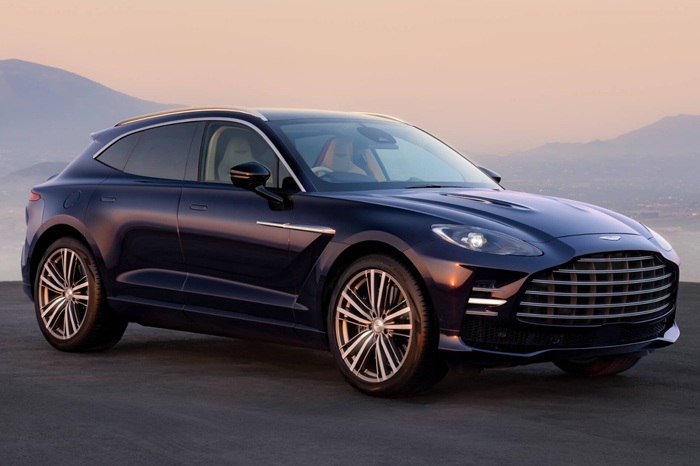
GAYDON: Aston Martin has unveiled the new DBX GT, a more comfort- and luxury-focused interpretation of its high-performance SUV that combines a 727PS twin-turbo V8 with revised suspension, improved cabin isolation and a substantially upgraded interior.
The DBX GT joins the performance-focused DBX S and is intended to broaden Aston Martin’s SUV range by offering customers a quieter and more understated alternative without sacrificing the performance expected from the DBX family.
First deliveries are scheduled to begin in the fourth quarter of 2026.
Aston Martin CEO Adrian Hallmark said: “DBX GT is aimed at customers who prefer assured elegance over sporting aggression and demand a higher degree of luxury. By refining the visual drama and elevating the interior with new elements of craftsmanship, the DBX GT delivers a true ultra-luxury experience; one which comes with no sacrifice in performance.”
Same 727PS V8, Different Personality
At the heart of the DBX GT is the bespoke 4.0-litre twin-turbocharged V8 also used in the DBX S. It produces 727PS and 900Nm of torque, with turbocharger technology shared with Aston Martin’s mid-engined Valhalla supercar.
Performance remains firmly in super-SUV territory. Aston Martin says the DBX GT can accelerate from 0-60mph in 3.1 seconds and reach a top speed of 193mph.
Carbon-ceramic brakes measuring 420mm at the front and 390mm at the rear are retained, while the GT also receives the faster steering ratio used by the DBX S. Its turning circle remains 12.0 metres.
So while the GT may be dressed for the drawing room, the hardware underneath has clearly not forgotten where the gym is.
Suspension Retuned for Greater Comfort
The DBX GT receives its own suspension calibration aimed at improving ride quality without diminishing handling.
A unique damper-valve system has been developed to better manage high-frequency, low-amplitude disturbances such as coarse road surfaces and rumble strips. Aston Martin says this helps prevent unwanted vibrations from reaching the cabin.
Spring behaviour also changes according to the selected drive mode, altering roll stiffness through corners to improve grip and steering response.
Chief Technology Officer Ian Hoban said: “The challenge with DBX GT was achieving meaningful improvements in comfort and refinement in everyday use cases, but keeping the same class-leading reserves of performance and handling we have achieved with the DBX S. This was delivered via a combination of small but significant hardware upgrades together with a targeted suite of calibration changes to the chassis and powertrain. The results are highly satisfying; noticeable reduction in unwanted noise intrusion, greater isolation from road imperfections and a tangible uplift in refinement, but with the breathtaking performance, handling poise and driver connection for which the DBX is renowned.”
The GT receives a recalibrated throttle pedal designed to provide a more progressive response, while the nine-speed wet-clutch automatic transmission has been retuned for smoother and more consistent shifts during both low-speed driving and full-throttle acceleration.
Lessons from the Valhalla programme have also resulted in a new transmission-mount bush with increased stiffness. Two additional longitudinal dampers have been fitted between the body and rear subframe to improve structural composure over large bumps, sharp crests and severe suspension compressions.
New 22-Inch Wheels Prioritise Ride Quality
Aston Martin has made 22-inch forged wheels standard on the DBX GT, finished in Satin Titanium with diamond-turned detailing.
They are paired with Pirelli Scorpion Zero All-Season tyres, a combination selected to reduce road noise and improve ride compliance.
Customers seeking a more performance-oriented setup can specify optional 23-inch wheels with either Pirelli P-Zero Summer or Scorpion Zero All-Season tyres.
The exhaust has also been given a GT-specific tune. Aston Martin says double mixing of gas flow inside the rear muffler reduces harsh metallic frequencies and produces a cleaner, richer exhaust note.
GT mode keeps things deliberately restrained, while Sport and Sport+ modes allow the V8 to become considerably less discreet.
More Understated Exterior Design
Visually, Aston Martin has deliberately moved the DBX GT away from the overtly sporting character of the DBX S.
The front end receives a new double-vaned grille available in bright or dark finishes. Split metal grille vanes extend towards the outer vents and daytime running lights, creating a stronger horizontal emphasis across the nose.
A new two-piece metal side strake features contrasting polished and satin finishes inspired by traditional watchmaking techniques.
The lower front bumper, side sills and rear diffuser are painted in the body colour as standard, reinforcing the GT’s cleaner appearance.
At the rear, new quad exhaust outlets are arranged horizontally in pairs. They use polished outer surfaces with satin-anodised inner sections and are designed to visually broaden the vehicle’s stance.
Aston Martin EVP and Chief Creative Officer Marek Reichman said: “Aston Martin is uniquely placed to combine ultra-luxury and performance. All our cars combine both, but each car finds a different balance, both visually and dynamically. With DBX GT we have taken a more discreet approach. One which downplays its outright performance and instead exudes a quiet charisma. Elegantly understated, yet safe in the knowledge it possesses the same performance and class-leading dynamics expected of a DBX.”
Redesigned Seats and More Rear-Seat Comfort
The cabin receives some of the DBX GT’s most significant changes.
Both the front and rear seats have been redesigned with additional cushioning, revised bolsters and altered comfort contours. A 10mm layer of memory foam has been incorporated into the seat cushion structure, while reshaped bolsters are intended to improve both lateral support and long-distance comfort.
The GT also introduces a new individual rear-seat design while retaining five-seat capability. The two outer rear positions receive more sculpted forms, extended headrests and additional bolstering.
A panoramic glass roof is standard.
GT-specific monotone, duotone and tritone upholstery combinations are available, together with unique quilting, perforation and embroidery patterns.
Aston Martin says each front seat uses 691 metres of thread, incorporates 3,297 perforation holes and requires more than four and a half hours of craftsmanship.
Semi-aniline leather, deep-pile floor mats, anodised metal switchgear and a metal drive-mode rotary controller further distinguish the GT interior.
Cabin Gets Quieter
Greater acoustic refinement has also been a priority.
Aston Martin has added targeted improvements to the body structure and cabin sealing, together with additional sound-deadening material in the doors, wheel-arch areas and rear luggage compartment.
Acoustic laminated rear side glass and deeper carpeting provide further isolation from road, wind and traffic noise.
According to Aston Martin, the changes result in a 13% improvement in the vehicle’s “Articulation Index”, an industry measure intended to quantify how easily occupants can hold a conversation while travelling.
The quieter environment should also benefit telephone calls and the Bowers & Wilkins audio system — although with 727PS available under the bonnet, silence remains very much a driver-selectable experience.
A Different Take on the Performance SUV
The DBX GT represents Aston Martin’s attempt to divide the increasingly broad high-performance SUV market more precisely.
Rather than chasing additional power over the DBX S, the company has concentrated on ride comfort, noise isolation, craftsmanship and restrained exterior detailing while retaining the same headline performance figures.
That distinction may prove important at the upper end of the luxury SUV market, where outright acceleration is increasingly abundant and buyers are just as likely to judge a vehicle by how quietly it crosses a rough road as by how quickly it crosses 60mph.
With the DBX GT, Aston Martin is effectively arguing that extreme performance need not announce itself quite so loudly — at least until Sport+ mode is selected.