
São Paulo: Hyundai has launched the new Hyundai i20 in Brazil, positioning it as a fresh option for buyers who are not fully ready to leave hatchbacks behind, but also want a taste of the SUV life. In simple terms, it is Hyundai’s answer to the customer who says, “I want a hatchback, but make it look more adventurous.”
The new i20 becomes the third Hyundai model to be produced in Brazil and will be manufactured at the brand’s Piracicaba plant in São Paulo, alongside the HB20 and Creta. Hyundai says the model has been developed specially for the Brazilian market and will initially be sold only in Brazil.
Prices start at R$ 99,990 (INR 18.77 lakh) for the entry-level Comfort variant. The model will be offered in six versions, four of which will use a 1.0-litre turbo engine.
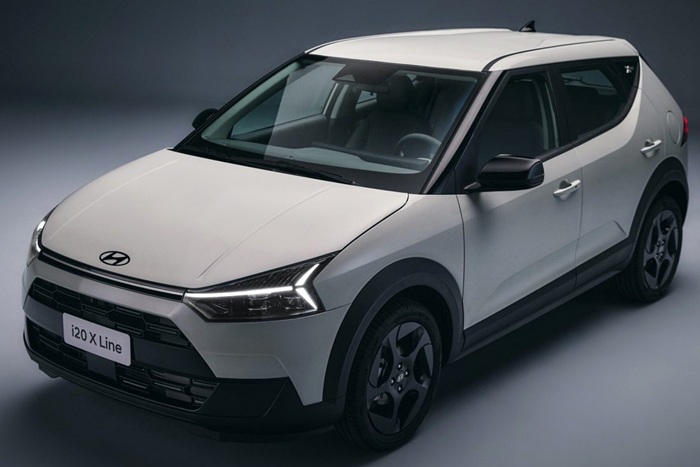
Positioned Between HB20 and Creta
The new Hyundai i20 has been placed strategically between conventional hatchbacks and compact SUVs. Hyundai says the model has been created for customers transitioning toward SUVs, but who still want the practicality and efficiency of a hatchback.
It is larger than traditional hatchbacks and offers more width, wheelbase and boot capacity than several hatchback and entry-level SUV rivals. The new i20 measures 4,130 mm in length, 1,780 mm in width, 1,495 mm in height, and has a 2,580 mm wheelbase. The boot capacity stands at 346 litres, expanding to 1,152 litres with the rear seats folded.
That means it should carry weekend luggage, supermarket runs and, if required, the emotional baggage of choosing between a hatchback and an SUV.
‘Art of Steel’ Design Makes Its Brazil Debut
The new i20 introduces Hyundai’s latest design language in Brazil, called “Art of Steel.” According to the company, the theme is inspired by the straight cuts and sculpted surfaces seen in steel artwork.
The front and side sections have been designed to give the car a stronger and more aerodynamic look. Hyundai has also added a new lighting signature called “H-Architecture,” which reinterprets the brand’s H logo through continuous lighting elements in the headlamps and tail-lamps.
Depending on the version, the new i20 gets a horizontal LED light bar at the front and rear, projector headlamps, 17-inch alloy wheels, automatic folding mirrors, black gloss front grille, pronounced wheel arches, shark-fin antenna and a sportier rear bumper design.
The colour options include Atlas White, Onix Black, Brisk Silver, Sand Silver, Sapphire Blue, Shadow Grey, Silk Grey and the new Lumina Grey.
Premium-Tech Cabin With Big Screens
Inside, Hyundai has used a theme called “Dynamic Premium Tech.” The cabin gets a minimalist digital dashboard, a modern steering wheel featuring Hyundai’s H in Morse code, two-tone leather seats and dark metallic interior door handles.
Higher variants feature a 12.3-inch digital instrument cluster and a 12.3-inch infotainment screen, giving the dashboard a properly modern layout. The new i20 also gets vertical air vents, rear AC vents, multiple storage spaces, wireless Apple CarPlay and Android Auto, a six-speaker audio system, wireless phone charger, digital automatic climate control and synthetic leather-wrapped steering wheel.
For rear passengers, Hyundai claims generous space, with 917 mm of legroom, 961 mm of headroom and 1,391 mm of shoulder room. In other words, the back seat has not been treated like an afterthought, which is always good news for families and friends who are not allowed to call shotgun.
OTA Updates and Bluelink Connected Tech
The new Hyundai i20 also marks the debut of OTA, or Over-The-Air software updates, in Hyundai models manufactured in Brazil. This allows the car’s software to be updated remotely, similar to a smartphone, without visiting a dealership.
Hyundai’s Bluelink connected car system is standard across all versions, although features vary depending on the variant.
Other convenience features include an electronic parking brake, paddle shifters, push-button start with smart key, rear occupant alert, tyre pressure monitoring system, rear parking sensor and reversing camera.
Hyundai SmartSense Safety Pack
Safety is one of the major highlights of the new i20. Hyundai is offering its SmartSense package with several advanced driver assistance systems.
Features include rear cross-traffic collision assist, lane keeping assist, lane following assist, driver attention warning, autonomous emergency braking with pedestrian and cyclist detection, safe exit warning, blind-spot collision warning, adaptive cruise control with Stop & Go and high beam assist.
All versions get six airbags as standard, along with ABS with EBD, electronic stability control, traction control, emergency stop signal, hill-start assist, ISOFIX child seat mounts, three-point seatbelts for all passengers and automatic door locking at 20 km/h.
Special X Line Edition for Early Buyers
Hyundai is also offering a special X Line version of the new i20. This edition comes with a numbered plaque inside the cabin, giving early buyers a sense of exclusivity.
The X Line gets black Hyundai and i20 badges, 17-inch black gloss alloy wheels, black gloss mirror caps, X Line badging on the C-pillar, black gloss grille and black rear bumper protectors. Inside, it adds X Line door sills and rubber mats with raised edges.
The X Line is available in two shades: Shadow Grey and the new Lumina Grey.
Engine Options
The new Hyundai i20 is available with two 1.0-litre flex-fuel engine options.
The entry-level Kappa 1.0-litre naturally aspirated engine produces 80 hp on ethanol and 75 hp on petrol, with peak torque of 10.2 kgm on ethanol and 9.6 kgm on petrol.
The more powerful Kappa 1.0-litre Turbo GDI engine produces 115 hp on both petrol and ethanol. It delivers 17.5 kgm of torque from as low as 1,500 rpm, which should make it more suitable for city overtakes and highway runs.
Hyundai says the platform has also been strengthened for Brazilian conditions, using ultra-high and high-strength steel in key areas including the A- and B-pillars, floor and roof structure.
Warranty and Maintenance
The new Hyundai i20 comes with a five-year unlimited kilometre warranty for private buyers. For commercial use, the warranty is five years or 100,000 km.
Hyundai has also announced fixed maintenance prices up to 60,000 km. For the 1.0 Turbo GDI versions, the total maintenance cost remains below R$ 4,900, which the company says is among the most competitive in the hatchback and entry-level SUV space.
Variant Prices
The new Hyundai i20 range starts at R$ 99,990 for the Comfort version with the 1.0 naturally aspirated engine. The Limited version with the same engine is priced at R$ 104,990 and adds features such as 16-inch alloy wheels, tyre pressure monitoring and ADAS features.
The 1.0 turbo range starts with the Limited variant at R$ 125,990, adding an automatic transmission, synthetic leather steering wheel and black gloss front grille.
Higher variants include the X Line, Platinum and Ultimate, with the top-end Ultimate getting features such as the horizontal LED light bar, dual 12.3-inch screens, paddle shifters and more advanced ADAS functions including rear cross-traffic assist, blind-spot assist and safe exit assist.
With the new i20, Hyundai is clearly trying to create a middle path between hatchbacks and SUVs in Brazil. Whether customers call it a hatchback, crossover or “almost-SUV but not quite,” Hyundai will probably not mind, as long as they call it from the showroom.