

BMW has unveiled the new-generation 3 Series, taking one of its longest-running model lines into the Neue Klasse era with a fully electric BMW i3, new petrol-powered variants and an M Performance flagship. The electric i3 will be offered in two versions from launch, with the range-topping i3 50 xDrive delivering up to 912 km of WLTP range and DC fast charging at up to 400 kW.
The new 3 Series represents a major technological shift for the sedan while retaining multiple powertrain choices. Alongside the electric i3, BMW will offer models powered by petrol engines with 48V mild-hybrid technology, while a plug-in hybrid version is scheduled to join the range over the coming year.
For buyers who still prefer six cylinders and petrol pumps, the new BMW M350 xDrive will sit at the top of the combustion-engine line-up with 443 hp and all-wheel drive.
BMW says the combination reflects its technology-open approach, with electric, mild-hybrid petrol and plug-in hybrid powertrains sharing the 3 Series family.
BMW i3 Brings Neue Klasse Technology to the 3 Series
The biggest change is the arrival of the first fully electric BMW 3 Series based on the Neue Klasse architecture.
The new BMW i3 uses sixth-generation BMW eDrive technology, commonly referred to as Gen6. The system introduces cylindrical battery cells, an 800-volt electrical architecture, new electric motors and bidirectional charging capability.
Two electric versions will be available initially: the BMW i3 50 xDrive and BMW i3 40 xDrive. Both use two electric motors, with one mounted on each axle.
The BMW i3 50 xDrive produces a combined 345 kW, or 469 hp, and 645 Nm of peak torque. BMW claims a 0-100 km/h time of 4.7 seconds.
Its 108.7 kWh high-voltage battery provides a maximum claimed range of 912 km under the WLTP testing cycle.
The 800V architecture also allows DC charging at rates of up to 400 kW. BMW says that under suitable fast-charging conditions, the i3 50 xDrive can add enough energy in 10 minutes for as much as 423 km of driving.
The BMW i3 40 xDrive develops 275 kW, or 374 hp, and uses an 82.8 kWh battery. Its maximum WLTP range is listed at 710 km.
BMW is also preparing a more performance-focused version. The BMW i3 M60 xDrive M Performance model is scheduled to arrive in 2027.
BMW M350 xDrive Gets 443 hp Six-Cylinder Engine
At the other end of the powertrain spectrum sits the new BMW M350 xDrive, which becomes the combustion-engine flagship of the 3 Series range.
It uses a 3.0-litre inline six-cylinder petrol engine paired with a 48V mild-hybrid system and crankshaft-driven starter generator.
Maximum output stands at 326 kW, or 443 hp.
BMW claims the M350 xDrive can accelerate from 0-100 km/h in 4.1 seconds before reaching an electronically limited top speed of 250 km/h.
Two additional four-cylinder petrol variants will accompany the M350 xDrive when the combustion-engine range is launched. All petrol engines use the latest generation of BMW TwinPower Turbo technology.
A plug-in hybrid 3 Series is planned for introduction during the following year.
New Design Shared Across Electric and Petrol Versions
BMW has deliberately kept the visual differences between electric and combustion-powered versions relatively small.
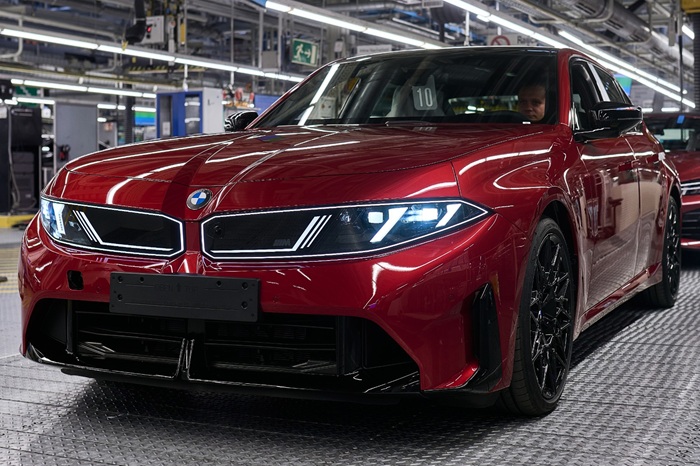
Both adopt the Neue Klasse design language, adapted to the proportions of a sports sedan.
The new 3 Series uses what BMW describes as a modern 2.5-box profile, combining a longer wheelbase with short overhangs, a set-back glasshouse and prominently flared wheel arches.
A pronounced character line runs along the sides and is intended to visually lower the car, while flush-fitting door handles extend automatically when the vehicle is unlocked.
At the front, BMW’s traditional kidney grille and twin-headlight themes have been reinterpreted as a more integrated visual unit.
M Performance variants receive M Yellow Lights inspired by racing-car design.
The rear uses a strongly horizontal lighting treatment, while the widened wheel arches emphasise the car’s stance.
Electric i3 models will be offered with wheel sizes ranging from 19 to 21 inches. Combustion-engine versions will use 18- to 20-inch wheels.
Customers will also be able to specify the M Sport package or M Sport package Pro.
Among the available exterior colours is M Le Castellet Blue metallic, while additional BMW Individual finishes are scheduled to arrive during 2027.
17.9-Inch Display and Panoramic iDrive Transform the Cabin
Inside, the new 3 Series adopts BMW’s latest Panoramic iDrive interface, bringing a significantly different dashboard layout from previous generations.
The system consists of four main elements: BMW Panoramic Vision, the optional BMW 3D Head-Up Display, a 17.9-inch Central Display and a multifunction steering wheel.
BMW Panoramic Vision projects information across an area designed to place key driving data within the driver’s field of view, while the central touchscreen is angled towards the driver.
The steering wheel has also been redesigned, including a distinctive central spoke in its upper section. M and BMW Individual steering wheels will be available as options.
A large panoramic sunroof with climate comfort glazing combines with the expansive glass area to increase the sense of space inside the cabin.
Standard seats provide electric adjustment, memory functionality and BMW’s Travel & Comfort System. Multifunction and M Sport seats will be optional, along with rear-seat heating.
Customers can also upgrade from the standard audio system to Harman Kardon hi-fi and surround-sound systems.
Four coordinated interior designs will be available, while BMW’s My Modes system allows drivers to customise displays, sounds, lighting and aspects of the drive system.
BMW Operating System X Adds Alexa+ AI Integration
The new 3 Series runs BMW Operating System X, which is based on the Android Open Source Project.
BMW says the architecture has been designed to support long-term software updates, upgrades and additional digital services.
The Panoramic iDrive interface combines touchscreen, physical and voice controls rather than relying on a single method of interaction.
BMW’s Intelligent Personal Assistant plays a central role in the system, while integration of Amazon Alexa+ AI technology is intended to enable more conversational voice interaction.
The optional BMW Digital Premium package adds further functionality, including Security Assistant and expanded BMW Maps navigation features.
Regular Software Updates will allow BMW to add and revise functions over the vehicle’s lifetime.
‘Heart of Joy’ Controls Electric Driving Dynamics
BMW is also using the new 3 Series to introduce a major change in the way its electric vehicles manage driving dynamics.
The electric i3 uses the company’s Heart of Joy high-performance computer, which integrates multiple powertrain and chassis-control functions into a single system.
BMW says the computer works 10 times faster than previous control systems.
Its Driving Stack combines drive-system and dynamic-control functions that were previously handled by separate systems, with the aim of improving response and coordination.
Combustion-powered versions use their own BMW Driving Stack, calibrated specifically around their mechanical powertrains.
Optional adaptive suspension and adaptive M suspension will be offered on combustion-engine models. Adaptive M suspension comes as standard on the M350 xDrive and will also be available as an option on the all-wheel-drive i3.
M350 xDrive Introduces Drift Moment
The M350 xDrive adds another unusual feature called Drift Moment.
Activated through the Central Display, the system can send engine power exclusively to the rear wheels, allowing the driver to deliberately initiate controlled oversteer in suitable circumstances.
BMW describes the feature as bringing an experience previously associated with higher-performance BMW M models to the M Performance 3 Series.
It is perhaps the clearest sign that, even as the 3 Series becomes increasingly digital and electrified, BMW has not entirely forgotten that some customers still regard going sideways as a form of entertainment.
Level 2 Driver Assistance and Hands-Free Motorway Driving
The new 3 Series will also introduce an expanded range of standard and optional driver-assistance systems.
BMW says SAE Level 2 functions and active safety systems have been improved compared with the previous generation.
Its Symbiotic Drive technology is designed to coordinate driver inputs with automated assistance more naturally.
The Motorway Assistant will permit hands-free driving at speeds of up to 130 km/h in 21 countries, subject to applicable conditions and regulations.
From 2027, BMW also plans to introduce additional navigation-guided, partially automated driving functions for urban environments.
BMW i3 Production Returns 3 Series to Munich
The new electric BMW i3 will be produced at BMW Group Plant Munich, giving the company’s home factory an important role in the shift towards the Neue Klasse generation.
The location has produced BMW vehicles for more than 100 years and was also where the first BMW 3 Series rolled off the production line in 1975.
In 2026, the same plant begins production of the first fully electric 3 Series.
BMW says Plant Munich will switch completely to production of fully electric Neue Klasse models next year.
Combustion-powered versions of the new BMW 3 Series will instead be manufactured at BMW Group Plant Dingolfing in Bavaria.
Key electric-drive and combustion-engine components will come from BMW Group Plant Steyr in Austria, while high-voltage batteries for the electric models will be supplied by the new BMW Group Plant Irlbach-Straßkirchen in Bavaria.
BMW says the new 3 Series also follows its broader sustainability strategy across the supply chain, manufacturing process and vehicle-use phase.
More than five decades after the original 3 Series established itself as a central part of BMW’s range, the latest generation marks perhaps its biggest structural change yet. Electric propulsion is no longer a separate side story, but part of the core model family alongside petrol and, soon, plug-in hybrid variants — a transition that illustrates how traditional performance sedans are being reshaped without abandoning every familiar ingredient.