
Barretos, São Paulo: Volkswagen has unveiled the exterior design of its new Tukan pickup truck in Brazil, marking the first concrete step in a broader pickup offensive for Brazil and South America. Developed and built entirely in Brazil, the Tukan will enter the Brazilian market in the first half of 2027 with both single-cab and double-cab configurations.
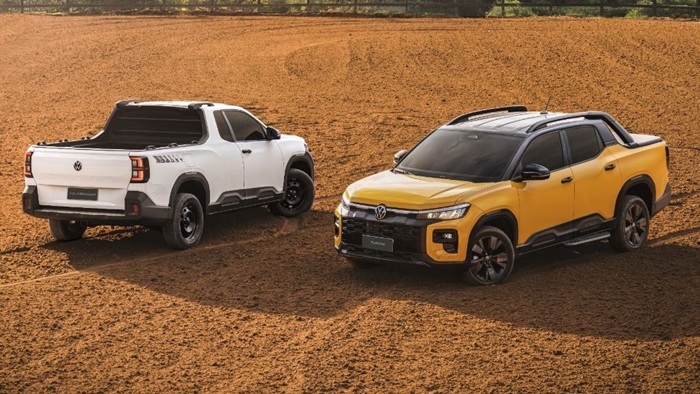
The new pickup made its full public debut during the 71st Festa do Peão de Boiadeiro in Barretos, where Volkswagen is participating for the 32nd time. The company presented the double-cab Tukan in its range-topping Extreme specification, finished in the launch colour Amarelo Canário, while the previously unseen single-cab version appeared in entry-level Robust trim.
The Tukan will also become the first Volkswagen pickup globally to use the MQB platform, although the architecture has been substantially adapted for commercial and load-carrying duties. Volkswagen says the model has already completed more than 2 million kilometres of testing, including evaluations involving customers using prototypes in real-world conditions.
Production will take place at Volkswagen’s São José dos Pinhais plant in Paraná, with the company saying 76% of the Tukan’s components will be locally sourced.
Tukan to take Volkswagen into a new segment in Brazil
Volkswagen describes the Tukan as the beginning of a new chapter in its Brazilian pickup portfolio and says the vehicle will take the company into a segment in which it has not previously competed locally.
The launch forms part of Volkswagen’s wider plan to introduce 21 new models in South America by 2028, supported by an investment of R$20 billion in the region.
Ciro Possobom, President and CEO of Volkswagen do Brasil, said pickup trucks have become increasingly significant in the Brazilian market.
“Pickup trucks have doubled their share of the Brazilian market over the past decade and are now serving an increasingly diverse range of needs. We have a strong legacy in this segment in Brazil, and the Tukan opens a new front for Volkswagen do Brasil. Designed, developed and produced in the country, with direct customer participation throughout its development, it takes us into a new segment and expands our presence in a market where we still have considerable room to grow,” said Ciro Possobom, President and CEO of Volkswagen do Brasil.
Volkswagen said the Tukan has been designed around four principal attributes: robustness, functionality, protection and versatility, with the two cab formats aimed at customers with noticeably different priorities.
The double cab combines the working characteristics of a pickup with technology, comfort and versatility intended to broaden its everyday appeal.
The single cab, meanwhile, is more unapologetically businesslike. A shorter passenger compartment creates space for a longer cargo bed, while decorative elements have been reduced in favour of practical solutions designed for professional users. In other words, this Tukan appears rather more interested in carrying tools than collecting lifestyle accessories.
Tukan gets its own identity despite T-Cross connection
Although the Tukan is based on an architecture related to the Volkswagen T-Cross, Volkswagen’s designers deliberately avoided simply turning the SUV into a pickup with a cargo bed attached.
José Carlos Pavone, Head of Design at Volkswagen for the Americas, noted that earlier car-derived pickups often shared much of their visual identity with the passenger models on which they were based.
For the Tukan, Volkswagen instead developed a distinctive front end with elevated lighting elements and LED headlights as standard from the base version.
Black trim and bumper air intakes are used to visually frame the nose, while the design is intended to communicate greater height, strength and protection.
Along the sides, Volkswagen’s designers divided the vehicle visually into three layers: the bodywork, glasshouse and a stronger protective lower section.
Four character lines converge towards the centre of the pickup to create an “X” theme, while angular wheelarches and a higher beltline further distinguish the Tukan from the T-Cross.
At the rear, the LED lighting signature, bumper and other graphic elements were designed as one composition wrapping around the tailgate.
Pavone said the team’s approach extended beyond simply adding styling elements.
“The design work carried out on the Tukan reflects an idea that guided the entire project: creativity did not simply mean adding elements to the base vehicle. At different stages, and particularly with the Tukan single-cab version, it also meant understanding what each configuration genuinely needed to have — or could do without — in order to fulfil its purpose.”
Single-cab and double-cab models designed for different jobs
Developing two variants with separate missions while maintaining a recognisable family appearance was one of the central challenges of the Tukan programme.
“Form and function have gone hand in hand since the beginning of the Tukan project, and each configuration reflects that relationship according to its own objectives,” Pavone said.
Volkswagen says feedback from pickup users influenced a number of design decisions.
One example can be found on the single-cab Tukan’s rear end. Unlike the double cab, it does without the black visual element connecting the taillights.
According to Pavone, customers taking part in clinics preferred a simpler treatment with fewer decorative pieces, particularly where ease of use and maintenance were priorities.
“A clear example of this active listening can be seen at the rear of the Tukan single-cab. This version does without the black visual element found on the double-cab model that connects the taillights. During customer clinics, participants showed a preference for a solution with fewer decorative components and greater simplicity in everyday use and maintenance.”
The cargo box was similarly developed with multiple applications in mind and will be capable of accommodating pallets of different sizes, according to Volkswagen.
An integrated toolbox will also form part of the pickup’s practicality-focused design.
Volkswagen says it is developing a broad range of accessories and application-specific solutions for the Tukan, with further details to be announced closer to launch.
First Volkswagen pickup built on MQB architecture
Underneath, the Tukan represents a significant engineering departure for Volkswagen.
It is the company’s first pickup to use the MQB modular architecture, but the rear of the platform has been redesigned to meet the demands of carrying cargo and operating in tougher conditions.
The Tukan receives an exclusive rear leaf-spring suspension system from the base version, a layout more typically associated with utility-focused pickups.
Volkswagen says the setup has been engineered to combine payload capability and durability with ride comfort, stability and the driving characteristics expected from the brand.
The Tukan’s wheelbase has also been extended compared with the vehicle from which its architecture originates. The additional length allowed engineers to accommodate the pickup bed while retaining passenger space and comfort.
Ricardo Plöger, Vice-President of Product Development at Volkswagen for South America, said the package was developed to suit a range of professional applications.
“The result is a vehicle that can easily adapt to the demands of different sectors, offering greater practicality, efficiency and better use of its load-carrying capacity.”
Volkswagen has not yet disclosed several key technical specifications, including engine options, transmissions, payload figures, cargo-bed dimensions or final dimensions of the vehicle.
More than 2 million kilometres of development testing
Volkswagen says the Tukan’s development programme has already exceeded 2 million kilometres before its commercial debut.
Part of that programme includes what the company describes as a first for Volkswagen do Brasil: allowing customers to evaluate a pickup in real-world working conditions during development.
The intention was to expose prototypes to situations extending beyond controlled proving grounds and obtain feedback from people accustomed to using pickups as working vehicles.
“Beyond observing the Tukan’s behaviour in controlled environments, the purpose of these tests was to expose the model to different real-world working and usage conditions and hear directly from people who understand the practical demands of a pickup truck,” Plöger said.
Volkswagen says this feedback has already resulted in engineering changes.
Testing in environments with high levels of dust led engineers to improve the engine air-intake system, providing greater protection for the engine and helping maintain performance and component durability in demanding conditions.
The air-conditioning system was also revised after customer feedback, with increased cooling capacity intended for operation in high ambient temperatures.
They are relatively unglamorous changes compared with giant screens or illuminated badges, perhaps, but anyone spending a working day in dust and Brazilian heat may consider them rather more important.
Amarelo Canário becomes the Tukan’s signature launch colour
The Barretos unveiling completes a gradual reveal process that Volkswagen began earlier in 2026.
In February, when announcing its sponsorship of the Brazilian Football Confederation (CBF) and Brazil’s national football teams, Volkswagen disclosed the Tukan name for the first time and confirmed the return of Amarelo Canário to its colour palette as one of the pickup’s launch shades.
In May, the Tukan appeared publicly during the announcement of the Brazilian men’s national team squad. At that event, its name was visible across the tailgate, although the vehicle remained covered in an artistic camouflage inspired by Brazilian themes and created by Volkswagen do Brasil’s design team.
Barretos marks the first time the name, production design and yellow launch colour have been shown together on the completed exterior.
Nearly six decades of Volkswagen pickups in Brazil
Although the Tukan enters a new segment for Volkswagen in Brazil, pickups have been part of the manufacturer’s local history for almost six decades.
That story began in 1967 with the Kombi Pick-up, which adapted the utility vehicle for cargo transport.
The Saveiro followed in 1982, developed from the Gol family. Volkswagen says the model has now remained in continuous production for 44 years, making it the longest-running pickup currently offered in the Brazilian market.
In 2010, the Amarok expanded Volkswagen’s presence into the midsize pickup category in South America.
The Tukan’s design reportedly contains an “easter egg” referencing the Kombi Pick-up, Saveiro, Amarok and Tukan, although Volkswagen has deliberately declined to reveal its location. Visitors in Barretos will apparently have to do some automotive archaeology of their own.
Volkswagen places bigger bet on South America’s pickup market
With the Tukan, Volkswagen is attempting to connect its long Brazilian pickup history with a new locally developed product positioned for both private and professional users.
The decision to offer two cab styles from the outset, develop a specialised leaf-spring rear suspension and involve working customers during testing suggests Volkswagen is treating utility requirements as more than styling theatre.
Important details — particularly powertrains, pricing, payload and final specifications — remain to be announced before the first-half 2027 launch.
Still, with local development, 76% parts localisation, more than 2 million kilometres of testing and production already assigned to São José dos Pinhais, the Tukan has moved well beyond the concept stage. Its arrival also underlines how important pickups have become to Volkswagen’s wider South American strategy — a market where, increasingly, carrying the load means carrying a significant share of the industry’s growth ambitions as well.