
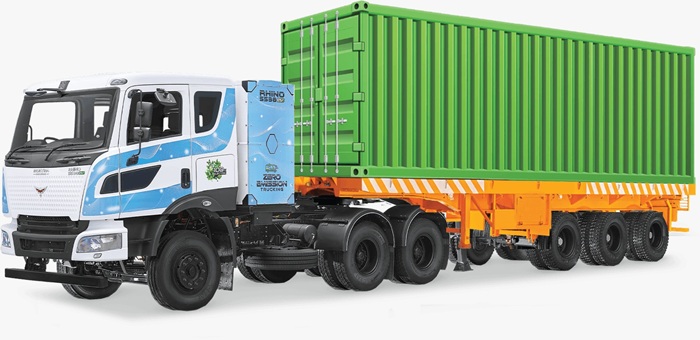
MANESAR: TVS Vehicle Mobility Solutions (TVS VMS), part of the TVS Mobility Group, has entered electric trucking for the first time, deploying an initial fleet of 57 Montra Electric Rhino 5538 EV 4×2 TT heavy commercial trucks as the two companies prepare to expand their collaboration to more than 300 electric trucks during FY 2026–27.
The 57 electric trucks were flagged off in Manesar on Friday and will be deployed in commercial freight operations on a primary logistics route in Chhattisgarh.
Under the first phase, the trucks will operate across a lead distance of about 190 km. Three dedicated charging stations have been positioned along the operation to support vehicle uptime and reduce disruptions to freight movement.
The deployment represents a notable change for TVS VMS, which has spent more than seven decades operating conventional fossil-fuel-powered trucks. Its move into electric heavy commercial vehicles will therefore provide a significant real-world test of battery-electric technology in an industry where range, payload, charging time and uptime matter rather more than how impressive a truck looks at a launch event.
The companies said the project is intended to reduce diesel consumption and carbon emissions while lowering operating costs and total cost of ownership for freight customers. The larger objective is to demonstrate whether electric heavy-duty trucks can be integrated into demanding commercial logistics operations at scale.
More Than 300 Electric Trucks Planned in FY27
Following the initial deployment, Montra Electric and TVS VMS plan to put more than 300 electric trucks into operation during FY 2026–27.
That would make the current 57-truck deployment the first stage of a considerably larger electric freight programme rather than a limited demonstration fleet.
The collaboration combines Montra Electric’s electric medium and heavy commercial vehicle technology with TVS VMS’s fleet-management operations. TVS VMS said its role encompasses vehicle leasing, driver operations, maintenance, insurance, charging infrastructure and connected telematics.
The flag-off ceremony in Manesar was attended by senior executives from both companies. Montra Electric was represented by Navneet Sethi, Chief Executive Officer, eM&HCV Division, and P.V. Satyanarayana, Chief Business Officer, along with other members of the company’s team.
TVS Vehicle Mobility Solutions was represented by Madhu Raghunath, Chief Executive Officer, and K. Ramesh, Head – EV Business, along with members of the TVS VMS leadership team.
Jalaj Gupta, Managing Director, Montra Electric, said: “For a partner like TVS VMS, with seven decades of experience to put our electric trucks into live freight operations is exactly the validation India’s logistics industry needed. This is proof that our technology is ready for commercial scale. It also reflects the depth of what we’ve built at Montra Electric with products engineered to address the specific operational needs of this market. Our team worked with TVS VMS to plan the operations, set up charging around their exact routes, and our telematics platform keeps optimising performance as the fleet runs. That’s the difference between a truck that works on paper and a fleet that works on the road.”
The companies are placing particular emphasis on route-specific charging infrastructure and telematics, reflecting one of the central challenges facing electric heavy trucks: commercial operators need predictable vehicle availability, not merely competitive specifications.
Navneet Sethi, CEO, Montra Electric (eM&HCV Division), said: ” For years, industries built around heavy, continuous haulage, steel being a prime example, have questioned whether electric HCVs can genuinely stand up to sustained heavy-load freight, and that scepticism has shaped how slowly this sector has moved toward electrification. TVS VMS putting our Rhino trucks into live operations answers that question decisively, for us and for every heavy-load industry watching closely. This is a company with over seven decades of running conventional trucking now choosing to enter electric trucking for the first time, and choosing us to do it is validation that our platform can handle the demands of commercial-scale freight. For Montra Electric, this is a marker of how electric heavy trucking moves from possibility to standard practice in India, and we intend to lead that shift at national scale.”
Madhu Raghunath, CEO of TVS VMS, added: “This strategic partnership marks a decisive step in advancing India’s green logistics infrastructure. TVS Vehicle Mobility Solutions is proud to power this transition through our full-suite, end-to-end lifecycle management platform—integrating vehicle leasing, driver operations, maintenance, insurance, charging ecosystem, and connected telematics to make zero-emission fleet operations effortless and commercially viable.”
Montra Rhino 5538 EV: Battery, Power and Range
The vehicle at the centre of the deployment is the Montra Rhino 5538 EV 4×2 TT, a 55-tonne Gross Combination Weight electric heavy-duty tractor-trailer manufactured at Montra Electric’s IPL Tech Electric Pvt Ltd facility in Manesar.
The truck uses a 282 kWh lithium iron phosphate, or LFP, battery paired with a Permanent Magnet Synchronous Motor. The powertrain produces 280 kW of peak power and 2,000 Nm of torque.
Montra says the Rhino offers 18% gradeability and uses a six-speed Automated Manual Transmission, or AMT, designed to cope with sustained heavy-load applications.
Its tested driving range is up to 198 km per charge on a duty cycle involving one-way travel with a load and the return journey without one. That operating pattern is particularly relevant to industrial freight, where a predictable route can make charging infrastructure considerably easier to plan.
The Rhino is offered with two battery configurations.
The fixed-battery version can be fast-charged from 20% to 100% in around 60 minutes. A battery-swapping version is also available, allowing the battery pack to be replaced in under six minutes.
For high-utilisation commercial fleets, those figures are important because downtime can quickly turn into lost revenue. Electric trucks may have impressive torque figures, but logistics operators ultimately tend to be more interested in whether the vehicle is ready when the next load is waiting.
Electric Heavy Trucks Face Their Commercial Test
While electric passenger vehicles have become increasingly visible, electrifying heavy commercial transport presents a different set of challenges. Heavy payloads, long operating hours, charging requirements and the economics of fleet utilisation make truck electrification particularly dependent on carefully planned routes and infrastructure.
The TVS VMS deployment attempts to address that equation by combining electric trucks with dedicated charging stations, telematics and lifecycle fleet management rather than treating the vehicle as a standalone product.
For Montra Electric, the programme also gives the Rhino 5538 EV an opportunity to demonstrate its capabilities under live commercial conditions instead of controlled trials.
The significance of the partnership will ultimately be determined less by the flag-off ceremony than by what happens after the trucks begin carrying freight. If the 57-vehicle fleet delivers the required uptime, operating economics and reliability — and the planned expansion beyond 300 trucks follows — the project could provide an important reference point for wider adoption of electric heavy commercial vehicles in India.
In an industry built around keeping goods moving, that real-world performance will be the metric that matters most.