There is something inherently amusing about a seven-seat family SUV wearing an RS badge. Seven seats traditionally suggest school runs, grandparents, airport luggage and arguments about who gets the last charging port. RS, meanwhile, suggests turbochargers, fast corners and a mild disregard for how carefully the groceries have been packed. The 2026 Škoda Kodiaq RS attempts to combine both worlds, which means you can theoretically take six people to dinner and make at least three of them regret eating beforehand.
This is the performance flagship of the Kodiaq family, and in India it occupies a particularly interesting bit of territory. The regular Kodiaq starts at around ₹37 lakh ex-showroom, whereas the RS arrives at approximately ₹67 lakh. That is not an upgrade; that is an entirely different financial conversation. But the RS is also rather more exclusive: only 50 units have been earmarked for India, making it considerably rarer than the ordinary Kodiaq and, quite possibly, some far more exotic-looking machinery.
The formula is deceptively straightforward. Take Škoda’s sensible seven-seat crossover SUV, give it more power, all-wheel drive, adaptive chassis technology, bigger wheels, sharper styling, a considerably more purposeful cabin and enough electronic chassis acronyms to make an IT department feel inadequate. What emerges is not a Porsche Cayenne impersonator and nor should it be. Instead, the Kodiaq RS is trying to be something more unusual: a genuinely practical family SUV that hasn’t surrendered every ounce of driving enthusiasm in the pursuit of cupholders.
And there are plenty of cupholders.
From Kodiak bear to Czech performance SUV
The Kodiaq RS story began in 2018, and the car here belongs to the second generation of the Kodiaq family. Its name, of course, is borrowed from Alaska’s Kodiak bear, which seems appropriate for a large, substantial SUV capable of carrying seven people. The spelling was changed to Kodiaq partly to fit Škoda’s SUV naming convention, but the association remains wonderfully suitable: large, powerful and probably best not annoyed.
The RS identity has its roots in Škoda’s motorsport culture, with the designation closely associated with Rally Sport; the supplied specification for this car refers to vRS as “Victory Rally Sport”. Either way, the intention is clear. This is the Kodiaq expected to show more enthusiasm for a winding road than the family Labrador sitting in the third row.
Globally, the Kodiaq has become an important car for Škoda, with approximately one lakh examples sold annually according to the supplied figures, and it has collected numerous family-car awards during its career. That tells you much about the basic vehicle underneath the RS embellishment. Before becoming the sporty one, the Kodiaq first had to become very good at being sensible.
Underneath sits Volkswagen Group’s MQB Evo architecture, the enormously flexible transverse-engine platform family used across a remarkable selection of Volkswagen Group products. The supplied platform list stretches from the Škoda Octavia and Superb to the Audi A3 and Q3, Cupra Formentor, SEAT Leon and numerous Volkswagen models including the Golf, Tiguan, Tayron, T-Roc, Passat, Caddy and Atlas, with further related applications including the Tavendor and Jetta VS8. In other words, MQB has rather more relatives than an Indian wedding.
The RS itself is assembled in the Czech Republic, reinforcing its position as something more specialised than the regular Indian-market Kodiaq.
₹67 lakh: the expensive side of sensible
India gets the Kodiaq RS only with a petrol powertrain and in a single variant, priced at approximately ₹67 lakh ex-showroom according to the supplied figures. Compare that with the standard Kodiaq’s roughly ₹37 lakh starting point and the RS premium becomes impossible to ignore.
You are emphatically not paying ₹30 lakh merely for some red stitching and a quicker 0–100 km/h figure, however. The RS package brings significant changes to the powertrain, chassis, suspension, wheels, braking hardware, equipment and appearance. Whether those changes justify the jump will depend entirely on what you want from a Kodiaq.
If your priority is simply having seven seats in a sophisticated European SUV, buy the regular one and spend the difference on several spectacular holidays.
If you specifically want the most powerful, fastest, most exclusive and most dynamically ambitious Kodiaq available in India, the RS is the reason the word “specifically” exists.
Its limited run of just 50 examples also changes the value equation. This isn’t intended as the rational default Kodiaq. It is the version for someone who has already decided rationality has had quite enough influence over the family-car purchase.
It looks serious without shouting
The Kodiaq RS thankfully doesn’t descend into the increasingly common performance-SUV trap of looking as though every exterior component was designed during an argument.
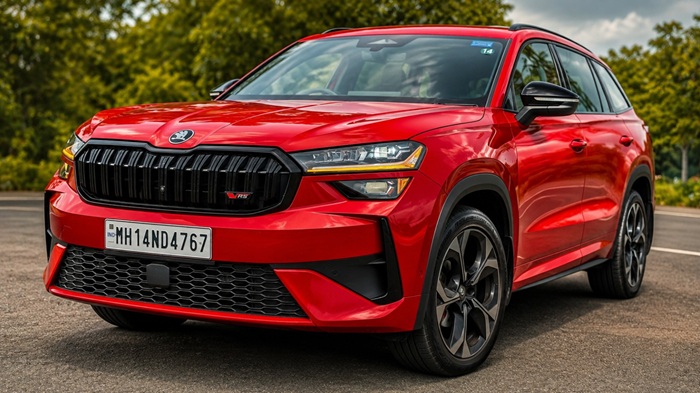
In Velvet Red, the car has presence without appearing cartoonish. White, black and grey are also available in India, while blue, silver and gold shades mentioned in the wider palette are not offered here. Velvet Red suits the RS particularly well because it provides just enough visual theatre without requiring fluorescent paint or a rear wing large enough to host a picnic.
At roughly 4.7 metres long, 1.8 metres wide and 1.7 metres tall, this is a substantial vehicle, but the proportions remain relatively disciplined. The long roof and sizeable glasshouse are reminders that seven-seat practicality still matters, while the RS-specific front and rear bumpers add aggression without making the Kodiaq look like it wants to headbutt every hatchback at a traffic signal.
The grille incorporates a horizontal light strip, a modern design detail that gives the front greater visual width at night. Flanking it are LED Matrix headlights with an Adaptive Front Light System, all-weather lighting, or AWL, and a cornering function. It is sophisticated lighting technology with a very simple objective: illuminate the bit of road you actually intend to use.
There is an underbody guard at the front, though with 20-inch sporting tyres underneath you may still wish to treat serious rock crawling as somebody else’s hobby.
The side profile is particularly effective. Dark chrome on the D-pillar gives the rear section a more expensive finish, while the exterior mirrors are almost comically overqualified. They are electrically adjustable, power folding, heated and auto-dimming, with memory, boarding spot illumination, integrated indicators, cameras and Škoda logo projection. Once upon a time, a wing mirror contained a mirror. Progress has been busy.
The supplied specification also notes Laurin & Klement badging on the fenders of this particular car, an interesting detail given the RS positioning.
There are acoustic front side windows too, contributing to the additional acoustic insulation used throughout the vehicle. That’s important because a sporting SUV still has to spend considerably more time cruising down motorways and sitting in traffic than attacking mountain roads.
Then come the 20-inch Elias alloy wheels. They look suitably serious and are wrapped in 235/45 R20 100V Continental ContiSportContact 5 Extra Load radial tubeless tyres at both ends. Disc brakes sit front and rear. The combination gives the Kodiaq the stance expected of an RS, although those relatively low-profile tyres inevitably mean potholes stop being background scenery and start becoming objects of strategic planning.
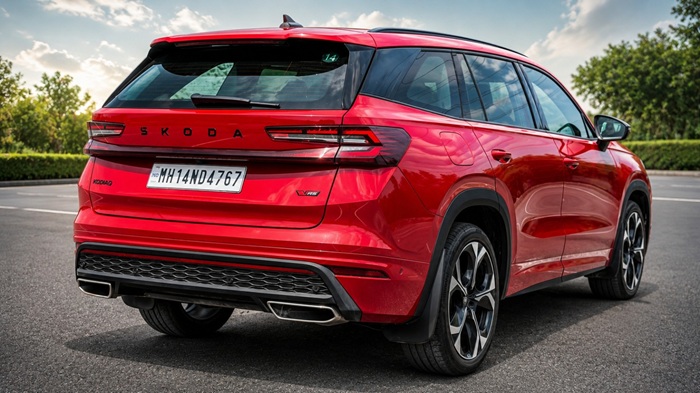
At the rear are familiar C-shaped LED tail-lamps complete with a welcome effect and dynamic indicators. The rear window is heated, and polished stainless-steel exhaust tips provide an appropriate visual reminder that this is the petrol-powered fast one rather than merely a Kodiaq wearing an enthusiastic body kit.
The result is restrained by modern performance-SUV standards. It doesn’t need six fake vents, illuminated badges visible from orbit or wheel arches large enough to shelter livestock. The Kodiaq RS simply looks like a regular Kodiaq has started going to the gym.
Big enough for seven, fast enough to worry them
Size is central to the Kodiaq’s appeal. Ground clearance stands at 194 mm, enough to deal with the majority of Indian speed breakers without requiring a geological survey first. Kerb weight is around 1,900 kg, while gross vehicle weight is approximately 2,500 kg.
It can also tow up to 2,500 kg according to the supplied figures, which is substantial capability for a crossover-based SUV and underlines that this is more than a fashion accessory with enormous wheels.
The boot demonstrates why people buy Kodiaqs in the first place. With all seven seats in position, luggage space is 281 litres. Fold the third row and capacity expands dramatically to 786 litres. Fold the second row as well and the Kodiaq becomes an extremely rapid 1,976-litre furniture transporter.
The tailgate can be opened hands-free by moving your foot beneath the bumper, useful when your arms are full of shopping and considerably less useful when demonstrating it repeatedly to relatives who have already understood the concept.
There’s even an 18-inch spare wheel, which is the sort of practical detail that suddenly becomes much more valuable when you’re 200 km from the nearest premium tyre shop with a damaged 20-inch Continental.
Škoda’s obsession with small practical details continues around the body. Each door gets an automatic door-edge protector, a particularly clever device in narrow Indian parking spaces where the adjacent car is usually parked either six centimetres away or in another district entirely.
Inside: sensible Škoda meets RS enthusiasm
Open the door and the Kodiaq’s biggest talent becomes obvious: it still feels like a proper family car.
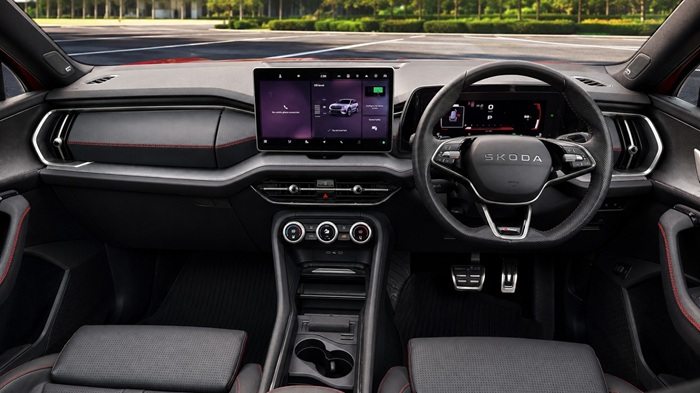
The cabin uses black leather upholstery and introduces the expected RS flavour through a sportier ambience rather than turning the dashboard into a racing simulator. Aluminium pedals help, as does the three-spoke leather multifunction sports steering wheel, but fundamentally this remains a spacious, mature SUV interior.
The front sports seats are a highlight. They are electrically adjustable and bring ventilation, heating, three-position memory and extendable thigh support. The combination matters because aggressively bolstered sports seats can become tedious in a family SUV; these appear designed to support rather than punish.
Ahead of the driver sits a 10.24-inch Virtual Cockpit digital instrument display. The steering wheel provides control over the instrument cluster along with volume, infotainment, voice functions and adaptive cruise control.
Progressive electric power-assisted steering is standard, changing the steering relationship to provide more direct response as required. More on whether that’s worthwhile when we get to the chassis.
The centre of the dashboard is dominated, predictably, by a 12.9-inch touchscreen. It supports wireless SmartLink with Apple CarPlay and Android Auto, navigation, USB connectivity, FM/radio functions, the MyŠkoda Plus app and a connectivity dongle.
But Škoda has wisely resisted the increasingly irritating industry belief that every physical control should be replaced with a touchscreen sub-menu.
Below the display sit the multifunction Smart Dials: tactile rotary controllers capable of operating functions such as climate control, seat ventilation, audio settings and drive modes. It is a wonderfully sensible compromise between digital flexibility and the radical concept of being able to alter the temperature without taking your eyes off the road for five seconds.
There is even a supplied display cleaner for the infotainment screen, an admission by the manufacturer that fingerprints remain undefeated by modern technology.
Climate control is three-zone Climatronic, so different parts of the cabin can disagree about temperature without escalating into constitutional crisis. The dashboard, footwells and doors receive ambient mood lighting, and overhead is a two-piece sliding panoramic sunroof using tinted glass.
One notable omission for India is the head-up display. Whether this matters depends on your relationship with HUDs; some drivers find them indispensable, while others spend ten minutes adjusting the projection before eventually staring at the normal instrument cluster anyway.
Two wireless phone chargers are provided, complete with ventilation to manage device heat. That’s a genuinely thoughtful touch in a world where wireless charging can occasionally transform a smartphone into something approaching a small tandoor.
The audio system is a 13-speaker, 725-watt Canton arrangement with a subwoofer. In a quiet cabin assisted by additional insulation and acoustic side glass, it ought to have the environment required to justify the numbers.
Škoda’s traditional “Simply Clever” touches are scattered around the interior as well. There’s a parking-ticket clip, an umbrella holder in the driver’s door, little waste bins in the doors and tablet holders for rear passengers. None will dominate a showroom walkaround, but after six months of ownership they’re precisely the things you wonder why every manufacturer doesn’t copy.
The frameless auto-dimming interior mirror contributes a little visual sophistication. Anti-trap power windows are fitted, and rear passengers receive rolling sunblinds.
There is also the wonderfully obscure detail that the tyre-pressure information is positioned at the rear passenger-side area rather than where one might conventionally expect it on the driver’s side. It is the kind of fact that sounds utterly insignificant until someone spends ten minutes searching for it.
The second and third rows: RS still means relatives supported
The Kodiaq remains a seven-seater, and this matters because numerous supposedly practical high-performance SUVs become less convincing the moment you move beyond the front seats.
The second row splits 40:20:40 and can both slide and recline. That flexibility lets passengers negotiate the eternal three-row compromise between second-row legroom and giving the people in row three enough space to retain circulation in their feet.
Tablet holders add convenience on longer journeys, while the wide body provides useful shoulder room. The panoramic roof also helps the rear of the cabin feel brighter and less enclosed.
The third row is naturally best regarded as occasional accommodation rather than executive-class seating. Adults can use it, but if you regularly carry seven six-footers across states, a luxury van may be the more diplomatic purchase.
For families, though, the Kodiaq remains an unusually convincing combination of performance and actual usefulness. The RS badge has not required sacrificing the fundamental packaging that made the ordinary Kodiaq successful.
The engine: where sensible becomes interesting
Under the bonnet sits a 2.0-litre, inline-four, turbocharged TSI petrol engine driving through a seven-speed dual-clutch Direct Shift Gearbox, or DSG.
The supplied specification for this India-market car quotes 261 horsepower and 400 Nm of torque. Contemporary published figures for the Kodiaq RS sometimes list the output slightly differently depending on market specification and rounding, but we’ll retain the supplied India-spec figure here rather than quietly swapping numbers.
What matters more is what the performance represents beside the standard Kodiaq.
The regular version also uses a 2.0-litre turbocharged four-cylinder TSI petrol, but in the supplied specification produces 201 horsepower and 320 Nm. It manages 0–100 km/h in 7.9 seconds and has a quoted top speed of 219 km/h.
The RS cuts the claimed sprint to 6.4 seconds and continues to a quoted 231 km/h.
Six-point-four seconds is genuinely quick for a 1.9-tonne, seven-seat SUV. It is not supercar acceleration and nor does it attempt to be, but it is fast enough that a full-throttle start should prompt small objects in the cabin to reconsider where they were placed.
The more meaningful difference is the additional torque. Four hundred Newton metres delivered through all-wheel drive gives the RS the mid-range authority expected of a fast European SUV. Highway overtaking should require considerably less planning than in the standard Kodiaq; squeeze the accelerator, allow the DSG to drop the necessary ratios and there is enough force available to move two tonnes of Czech family transport with convincing urgency.
The gearbox is important here. Volkswagen Group’s seven-speed DSG has always suited turbocharged engines because it can keep them within the useful part of their torque curve while shifting quickly. In calmer driving it should disappear into the background. Call for performance and the shifts become more purposeful.
The Kodiaq RS is E10 petrol compliant, an important ownership consideration in the modern Indian fuel environment.
Seven drive modes are offered: Eco, Comfort, Normal, Sport, Offroad, Snow and Individual.
Seven.
There was once a time when a car had “on” and “off”. The Kodiaq can now apparently be informed about the weather, road surface and your emotional state.
Yet the modes aren’t entirely theatrical because this car combines all-wheel drive with sophisticated adaptive chassis hardware.
The clever bit is underneath
The Kodiaq RS uses an electro-hydraulically controlled inter-axle multi-plate clutch for its all-wheel-drive system. A network of sensors continually evaluates driving conditions and can alter torque distribution as required.
In ordinary conditions, the objective is stability and efficiency. Under acceleration, on slippery surfaces or during more enthusiastic cornering, torque can be directed where it is useful rather than merely where it happens to arrive.
An electronic differential lock further optimises torque distribution for traction and handling, while XDS+ acts as a software-based cross-differential system to influence the car’s cornering behaviour.
None of that turns a 1,900 kg seven-seat crossover into a lightweight sports saloon. Physics has not yet received an over-the-air update.
But clever torque management can make a large car feel significantly more agile by reducing inside-wheel slip, improving traction and helping the car rotate more naturally through corners.
The suspension is equally serious. Up front are MacPherson struts with lower triangular links and a torsion stabiliser, while the rear uses a multi-element axle with longitudinal and transverse links plus its own torsion stabiliser.
More important for the RS is Dynamic Chassis Control Plus, the advanced adaptive suspension system designed to alter damping behaviour for improved comfort, body control and handling.
This is arguably one of the most important components of the entire car.
Performance SUVs have an unfortunate habit of being tuned so firmly that every urban pothole feels like a personal message from the road department. Adaptive damping allows the Kodiaq to broaden its abilities: Comfort mode for broken city roads and passengers, Sport when the road becomes interesting, and Individual if you prefer constructing your own compromise.
Those 20-inch wheels remain a physical limitation, of course. No suspension software can entirely conceal a 45-profile performance tyre hitting a sharp-edged pothole. Low-speed ride quality is therefore unlikely to possess the soft, isolated character of a luxury SUV running smaller wheels and taller sidewalls.
But the payoff comes in control.
The progressive steering should give the Kodiaq a more immediate response as lock is added without making highway cruising nervous. Combined with adaptive damping, XDS+, all-wheel drive and wide Continental tyres, the RS has the hardware to resist the traditional large-SUV sequence of turn, wait, lean, apologise.
You will still know this is a tall car. There will be body movement because there must be body movement. The impressive trick is controlling it rather than pretending gravity no longer applies.
Disc brakes at all four corners provide the stopping hardware needed for a vehicle capable of 231 km/h.
Engine drag torque control, or MSR, also works with the ABS system to help maintain grip on slippery surfaces by managing excessive engine-braking torque. Hill Start Assist and Hill Descent Control further expand the car’s ability outside normal tarmac driving.
With 194 mm of ground clearance, AWD, Offroad and Snow modes, the RS can certainly deal with slippery tracks, poor weather and rough access roads. But those 20-inch ContiSportContact tyres tell you where its priorities really lie. This is an all-weather performance SUV, not a Ladakh expedition truck dressed for a rally stage.
Refinement matters because this is still a Kodiaq
The additional acoustic insulation and acoustic front windows tell you Škoda hasn’t confused “sporty” with “noisy”.
At a cruise, the Kodiaq RS should retain the refinement expected from a premium family SUV, suppressing tyre, wind and drivetrain noise rather than amplifying them purely for drama.
That distinction matters enormously. An aggressively vocal exhaust is entertaining for approximately 17 minutes. After four hours on an expressway with sleeping passengers, it becomes grounds for divorce.
The polished exhaust tips hint at performance but the broader character appears more mature: let the powertrain become interesting when asked, and remain civilised when it isn’t.
Eleven kilometres per litre — ambition has consequences
The claimed average supplied for the RS is 11 km/l, compared with 14 km/l for the standard Kodiaq.
As ever, real-world economy will depend heavily on traffic, driving style, road conditions and how frequently the driver remembers there is an RS badge on the steering wheel.
With 261 horsepower, AWD, nearly 1.9 tonnes to move and the aerodynamic delicacy of a large seven-seat SUV, this was never going to challenge a hybrid hatchback at the fuel pump.
Interestingly, the RS gets a 58-litre fuel tank in the supplied specification, compared with 62 litres for the standard Kodiaq. Combined with the lower quoted economy, that means touring range requires a little more attention.
Drive enthusiastically and the fuel gauge may develop performance aspirations of its own.
Nine airbags and a small army of electronics
Performance is only useful in a family SUV if the car takes safety equally seriously, and the equipment list here is extensive.
The supplied specification includes nine airbags, ABS, EBD, electronic stability control, traction control, hydraulic brake assist, Driver Steering Recommendation, Rain Brake Support, Electronic Stability Braking System and a multi-collision braking system.
ISOFIX child-seat mounting is included, as is tyre-pressure monitoring.
There is also Pre-Crash proactive passenger protection, designed to prepare the vehicle and occupants when the system detects an impending dangerous situation.
Parking assistance is comprehensive. Front and rear Park Distance Control sensors work alongside a 360-degree camera, Manoeuvre Assist and Intelligent Park Assist, which can automate parking manoeuvres. Given that the Kodiaq is almost 4.8 metres long and rolls on expensive 20-inch wheels, this is less gimmick and more alloy-wheel preservation technology.
The ADAS suite includes Front Assist, Side Assist, lane-keeping assistance, blind-spot detection, a lane-change system, rear traffic alert and an exit-warning system.
There is also Advanced Driver Attention with drowsiness monitoring. It watches steering behaviour and driving patterns for signs of fatigue and can alert the driver when concentration appears to be deteriorating.
The second-generation Kodiaq has earned five-star safety ratings from both Euro NCAP and ANCAP, which provides useful independent context for all the electronic terminology.
The trick with modern ADAS, however, is calibration. Safety systems are valuable when their warnings feel intelligent and proportional; less so when every lane marking, scooter and slightly enthusiastic steering movement triggers an electronic committee meeting. The best systems help quietly in the background.
Connected enough to know where you’ve been
The MyŠkoda Plus smartphone app expands the ownership experience beyond the car itself.
From a phone, owners can access vehicle documents, vehicle status, live location, trip information and service history. There is geofencing, dealership location, service booking, a service-cost calculator and access to Škoda accessories.
That can be genuinely useful. Knowing where the car is parked, checking vehicle data remotely and arranging a service without phoning several departments are conveniences owners may actually use rather than demonstrate once during delivery and forget forever.
Keyless entry is fitted too, naturally.
Ownership: Škoda attempts to remove the old jokes
For years, European-car ownership discussions in India could become anxious whenever the words “warranty” and “service cost” appeared in the same sentence.
Škoda is clearly aware of this.
The Kodiaq comes with a four-year/1,00,000 km warranty package according to the supplied information, backed by four years of roadside assistance and four labour-free services. This is especially relevant at RS money, because a ₹67 lakh performance SUV is considerably easier to enjoy when unexpected ownership expenses aren’t constantly whispering from the passenger seat.
The broader Kodiaq’s reputation as a practical long-distance family machine helps here too. Roughly one lakh annual global sales gives the model a meaningful international footprint rather than niche curiosity status.
There is also the usual underlying advantage of Volkswagen Group engineering sharing. Its MQB-based architecture, TSI engine technology and DSG transmission come from an enormous engineering ecosystem, although the RS-specific chassis tuning and hardware make this a more specialised proposition than the ordinary Kodiaq.
The rivals, and the awkward question of ₹67 lakh
The problem for the Kodiaq RS isn’t whether it’s good. The difficult question is what else ₹67 lakh can buy.
Within India’s premium three-row SUV market, the Kodiaq family sits against alternatives such as the Volkswagen Tayron R-Line and Jeep Meridian, with the broader competitive field also including more traditional SUVs.
A Volkswagen Tayron R-Line makes an obvious comparison because it shares the broader Volkswagen Group engineering philosophy and offers a similarly European approach to the large family SUV. Buyers interested primarily in refinement, space and technology rather than the RS badge may find it compelling.
The Jeep Meridian approaches the formula differently, with a more traditional SUV flavour and a strong emphasis on three-row practicality. For buyers whose lives involve rougher roads more frequently than quick corners, that positioning can make sense.
Then there are body-on-frame alternatives such as the Toyota Fortuner. They provide a fundamentally different experience: more rugged, more imposing and better aligned with buyers prioritising proven rough-road toughness, commanding road presence and a traditional SUV feel. What they generally cannot replicate is the Kodiaq RS’s combination of DSG quickness, adaptive chassis sophistication and car-like cornering attitude.
The most dangerous rival, however, might be parked in the same Škoda showroom.
The regular Kodiaq.
At around ₹37 lakh to start in the supplied pricing, the ordinary version gives you the essential seven-seat packaging, the turbo-petrol architecture and much of the fundamental Kodiaq experience while leaving an enormous amount of money in your bank account.
Its 201-horsepower, 320 Nm engine is hardly feeble either. A 7.9-second 0–100 km/h time is already more than adequate for a family SUV, and its quoted 14 km/l economy and larger 62-litre tank make it the more sensible long-distance choice.
So the RS cannot win by being sensible.
Fortunately, it doesn’t try.
Verdict: wonderfully unnecessary
The 2026 Škoda Kodiaq RS is exactly the sort of car that exists because not every automotive decision needs to survive a spreadsheet.
As an ordinary seven-seat SUV, the standard Kodiaq already does the important things: it is spacious, cleverly packaged, refined, practical and packed with useful details. The RS then takes that sensible foundation and asks a magnificently unnecessary question: what if it were considerably faster?
The answer is a 1.9-tonne Czech family SUV capable of hitting 100 km/h in a supplied 6.4 seconds and continuing to 231 km/h, while still carrying seven seats, an umbrella in the door, tablet holders, waste bins and nearly two cubic metres of cargo space with the rear seats folded.
That contrast is the Kodiaq RS’s entire appeal.
It doesn’t hide its mass like a true sports car, nor should anybody expect it to. Twenty-inch wheels will inevitably make ugly Indian roads more noticeable. An 11 km/l claimed average and 58-litre fuel tank mean enthusiastic driving comes with regular petrol-station appointments. And at approximately ₹67 lakh ex-showroom, the financial jump over the standard Kodiaq is enormous.
The third row is also ultimately occasional adult accommodation rather than somewhere you’d volunteer to spend an entire cross-country journey, and some buyers will correctly conclude that paying so much for a faster version of a family crossover makes about as much rational sense as fitting racing shoes to a Labrador.
Those buyers should purchase the regular Kodiaq.
The RS is for somebody else.
It is for the buyer who genuinely needs a family SUV but refuses to accept that practicality should require surrendering every mechanical pleasure. Someone who wants the space for children, parents, luggage and holidays, but also appreciates a quick DSG shift, well-controlled body movement, torque-vectoring technology and the satisfying punch of 400 Nm.
Dynamic Chassis Control Plus, progressive steering, XDS+, AWD and the electronic differential systems give the RS genuine technical substance beneath the badges. The cabin successfully blends digital technology with physical controls. Škoda’s familiar practical touches prevent the performance makeover from erasing what made the Kodiaq appealing in the first place. And with only 50 examples allocated to India, it has rarity on its side.
Most importantly, the Kodiaq RS has a personality.
It is not trying desperately to become a sports car, and it isn’t pretending to be an expedition vehicle merely because it has all-wheel drive. It is a fast, sophisticated, slightly eccentric European family SUV built for someone whose life requires seven seats but whose right foot still remembers what weekends used to be like.
At ₹67 lakh, nobody needs a Kodiaq RS.
And that may be precisely why the right buyer will want one.