

Hansalpur/New Delhi: Maruti Suzuki India Limited has commenced commercial production at the fourth plant of its Hansalpur manufacturing facility in Gujarat, increasing the site’s annual capacity from 750,000 vehicles to 1 million units.
The expansion makes Hansalpur the first Suzuki manufacturing facility globally to achieve an annual production capacity of 1 million vehicles at a single location. Maruti Suzuki also described it as India’s largest passenger vehicle manufacturing facility at one site.
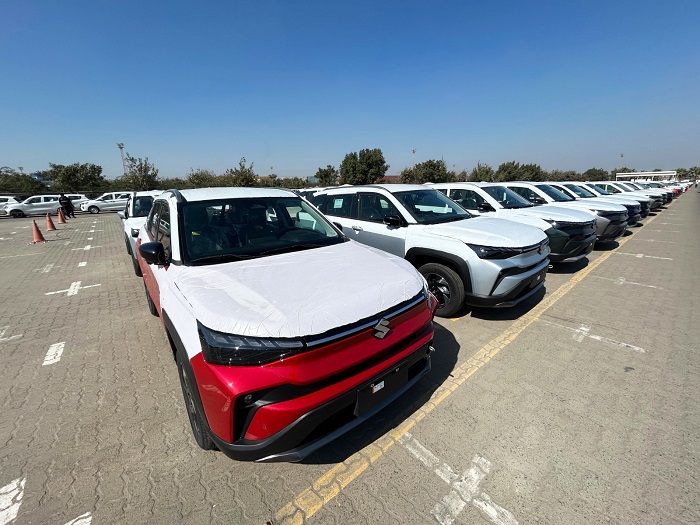
The newly operational Plant D has an annual capacity of 250,000 units and will initially manufacture the company’s flagship battery-electric vehicle, the e Vitara.
With the addition of Plant D, Maruti Suzuki’s total manufacturing capacity in India has risen to 2.9 million vehicles annually.
The company said cumulative investment at the Hansalpur facility now stands at ₹25,288.7 crore, including an estimated ₹3,900 crore invested in the fourth plant. The expansion is substantial even by automotive manufacturing standards, where adding another quarter-million vehicles is rarely a minor adjustment to the factory calendar.
The Hansalpur facility currently manufactures the Fronx, Baleno, Swift and e Vitara. It has also developed into a major export centre for Maruti Suzuki, accounting for nearly 47% of the company’s overseas shipments during the 2025-26 financial year.
Speaking on the expansion, Hisashi Takeuchi, Managing Director & CEO, Maruti Suzuki India Limited, said, “Gujarat has emerged as a manufacturing and export hub for Maruti Suzuki, backed by strong infrastructure and a progressive industrial ecosystem. The start of commercial production at the fourth plant of our Hansalpur facility augments its annual production capacity to one million vehicles, making it India’s largest passenger vehicle manufacturing facility at a single location. The new line will further strengthen our ability to meet the growing demand from customers in India and overseas while advancing our ‘Make in India, Make for the World’ vision and expanding our global footprint.”
He added, “Together, the Hansalpur and the upcoming Sanand facility in Gujarat will play a pivotal role in achieving our long-term ambition of producing 4 million units annually in India. These projects reflect our commitment to strengthening India’s manufacturing competitiveness, creating employment, boosting exports, and contributing towards Viksit Bharat.”
Hansalpur to Support 4-Million-Unit Production Goal
Maruti Suzuki is aiming to raise its annual production in India to 4 million vehicles over the long term. The Hansalpur expansion and the company’s upcoming manufacturing facility at Sanand are expected to play an important role in meeting that target.
The additional capacity also comes as the carmaker prepares to expand its electric-vehicle operations. The production of the e Vitara at Plant D places Hansalpur at the centre of Maruti Suzuki’s battery-electric vehicle manufacturing and export plans.
Railway Siding Supports Greener Vehicle Dispatches
Maruti Suzuki commissioned an in-plant railway siding at Hansalpur in March 2024 under the Prime Minister’s GatiShakti programme. The company described it as India’s first automobile in-plant railway siding.
Vehicle dispatches through the facility began in March 2023, and Maruti Suzuki said more than 750,000 vehicles have since been transported using the railway network.
According to the company, shifting vehicle transportation from roads to rail has helped reduce carbon dioxide emissions and fuel consumption while easing road congestion.
In February 2026, the Gujarat in-plant railway siding became the world’s first modal-shift transportation project to be registered under Verra’s Verified Carbon Standard programme.
Skill Development Initiatives in Gujarat
Maruti Suzuki has established two Japan-India Institutes for Manufacturing in Mehsana and Gandhinagar. More than 1,200 students have been trained across the two institutes, which were developed as part of a collaborative initiative between the governments of India and Japan.
The company is also working with the Gujarat government to establish Advanced Manufacturing Labs at five Industrial Training Institutes in Palanpur, Bhavnagar, Surendranagar, Godhra and Dahod.
The laboratories are intended to recreate shop-floor working environments and provide students with industry-relevant training in advanced manufacturing. Maruti Suzuki said further expansion of the initiative is being planned.
Automobile Skill Enhancement Centres have also been established at government ITIs in Ahmedabad, Surat and Dhoraji to support students enrolled in automobile-related trades.
High-voltage training courses for electric and hybrid vehicles are being conducted across nine ITIs in Gandhinagar, Gandhidham, Rajkot, Bhavnagar, Mehsana, Jamnagar, Godhra, Bhuj and Vadodara.
Maruti Suzuki and the Gujarat government have additionally established the International Automobile Centre of Excellence in Gandhinagar. The centre has the capacity to train 5,000 students annually in vehicle manufacturing and servicing.
Education, Healthcare and Community Projects
In 2021, Maruti Suzuki established a CBSE English-medium school in Sitapur in partnership with the Podar Education Network. More than 800 students from nearby villages are currently enrolled at the school.
The company also established a multi-specialty hospital in Sitapur in 2021 in partnership with the Zydus group of hospitals and the Ramanbhai Foundation.
Maruti Suzuki said the hospital has provided affordable tertiary healthcare to more than 1.5 lakh people from over 400 nearby villages since it began operations.
The hospital is accredited by the National Accreditation Board for Hospitals and Healthcare Providers and has received a gold quality certification from the Quality Council of India.
Maruti Suzuki is also undertaking community-development projects across 26 villages adjoining its manufacturing facility. These include initiatives related to water, sanitation, education, healthcare, women and child welfare, tree plantation, CCTV surveillance and other community infrastructure.
In the area of road safety, the company said it has provided driving training to more than 60,000 people through the All Gujarat Institute of Driving, Technical Training and Research in Vadodara.
The Hansalpur expansion strengthens Gujarat’s position as a major automotive manufacturing and export centre while giving Maruti Suzuki additional capacity for both conventional vehicles and its emerging electric-vehicle portfolio. The larger test will be how effectively that capacity is translated into domestic sales, exports and a competitive transition to electric mobility.
| Maruti Suzuki Manufacturing Footprint | |
| Plants & Capacity break up | Hansalpur – 1 million units per annum Manesar – 0.9 million units per annum Gurugram – 0.5 million units per annum Kharkhoda – 0.5 million units per annum |
| Overview of Maruti Suzuki’s Hansalpur facility in Gujarat | |
| Plant location | Hansalpur, Gujarat |
| Area | 640 acres with integrated suppliers’ park |
| Total investment | INR 252,887 million (INR 25,288.7 crore) |
| Production capacity | 1 million units annually |
| Start of operation | Plant A – February 2017Plant B – January 2019 Plant C – April 2021 Plant D – July 2026 |
| Current production models | Plant A: Baleno Plant B: FRONX & Swift Plant C: FRONX & e VITARA Plant D: e VITARA |
| Production milestones | Cumulative 1 million – 21st October 2020Cumulative 2 million – 18th August 2022Cumulative 3 million – 4th December 2023Cumulative 4 million – 4th March 2025Cumulative 5 million – 7th May 2026 |