The Indian car market is a strange place. Hatchbacks think they are SUVs, SUVs think they are coupes, and everyone thinks they need 20-inch wheels to go over a pothole. In this circus of confused identities, the Škoda Kushaq has always been refreshingly honest. It never tried to be something it isn’t. It came in 2021 as a compact crossover SUV, and in 2026 it returns in its first-generation facelift looking more mature, more premium, and far more confident about its place in life.
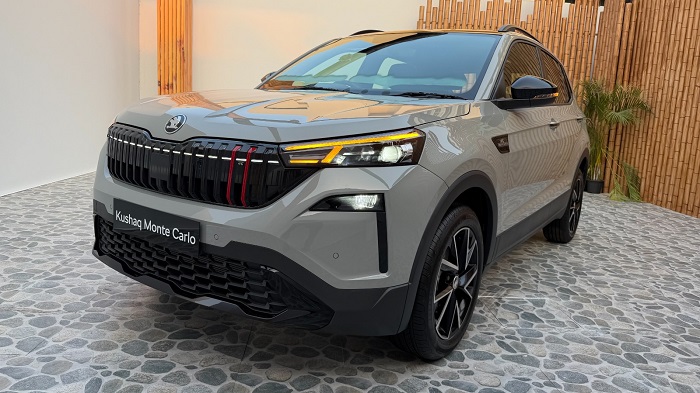
The name itself sets the tone. Kushaq is a Sanskrit word meaning king or emperor, and thankfully Škoda has treated that title with respect. This facelift doesn’t scream for attention. It doesn’t add fake vents or unnecessary chrome. Instead, it feels like a king who has stopped proving himself and started enjoying his status.
This is still a petrol-only car, because diesel in 2026 is like a landline phone. Technically it exists, but nobody under 40 is interested. The expected price range starts around ten lakh rupees ex-showroom and stretches up to about eighteen lakh for the top variant. The one you are looking at here is the Monte Carlo, the sportiest and most visually aggressive version of the Kushaq. The official prices are expected next month, but bookings are already open because in India, we love ordering cars before knowing what they cost. It’s called faith. Or madness. Sometimes both.
Under the skin, nothing dramatic has changed, and that’s actually a good thing. The Kushaq is built on Volkswagen Group’s MQB A0 IN platform, which also supports the Slavia, Taigun, Virtus and the upcoming Kylaq. This platform was specifically adapted for Indian roads, which means it understands speed breakers, broken tarmac, unpredictable traffic and the emotional trauma of monsoon season. Assembly happens in India and Vietnam, and the car is exported to places like Brunei and the Middle East, which is a nice reminder that something designed for Indian chaos can also survive international roads.
Safety has always been one of Kushaq’s strongest weapons, and the facelift continues that tradition proudly. Global NCAP has given it a full five-star rating, and in today’s market that’s not just a number, it’s a selling point. Six airbags, electronic stability control, traction control, multi-collision braking, hill hold, tyre pressure monitoring, ISOFIX mounts, rear camera and a long list of electronic safety systems mean this is one of those rare cars that feels genuinely protective without making you feel like you’re driving a laboratory experiment.
Ownership also looks far less scary than older European cars. Škoda offers a four-year or one lakh kilometre warranty, four years of roadside assistance and four labour-free services. Service intervals are every fifteen thousand kilometres, which means you spend more time driving than sitting in waiting rooms pretending to read old magazines.
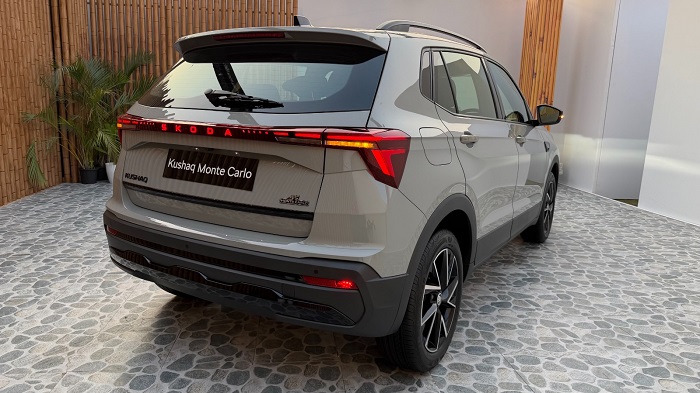
Visually, the 2026 facelift makes the Kushaq look sharper and more premium without losing its original character. The front gets the illuminated Škoda grille, crystalline LED headlamps with DRLs, LED fog lamps with cornering function and a glossy black diffuser that actually looks tasteful for once. The Monte Carlo badges with red accents add a subtle sporty touch instead of turning the car into a rolling sticker shop. The black roof in the dual-tone version, 17-inch dual-tone alloy wheels, split LED tail lamps with sequential indicators and illuminated ŠKODA lettering at the back make the car look like it belongs to a more expensive segment.
Dimension-wise, the Kushaq stays perfectly balanced. At around 4.2 metres long with 188 mm of ground clearance, it feels easy to drive in the city but confident enough for highways and bad roads. It’s not massive, and that’s its biggest advantage. You don’t need a pilot’s license to park it.
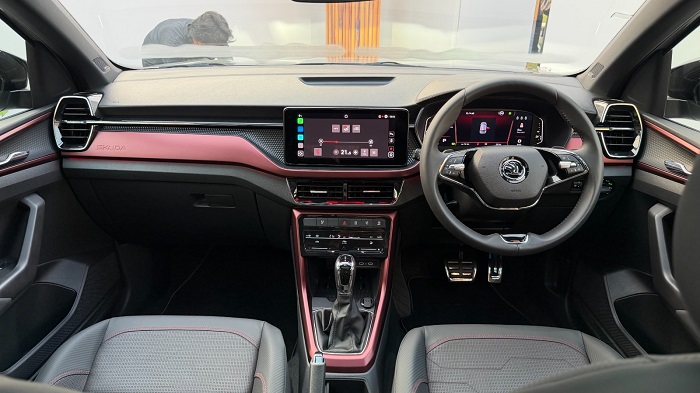
Inside, the facelift finally brings the cabin up to modern expectations. The dashboard is dominated by a 10-inch touchscreen infotainment system and a 10.24-inch fully digital instrument cluster, which Škoda calls the virtual cockpit. It supports wireless Android Auto and Apple CarPlay, an AI companion app powered by Google, and Škoda’s own connected tech that lets you track the car, monitor driving behaviour and even set geofencing limits. Basically, the car knows more about your life than your parents.
The Monte Carlo interior feels genuinely premium. Red and black leatherette upholstery, ambient lighting, aluminium pedals, illuminated scuff plates and a two-spoke multifunction steering wheel with red stitching make it feel sporty without being childish. The front seats are electrically adjustable and ventilated, which in Indian summers is not a luxury, it’s survival equipment. The rear seats even get a massage function, which is the kind of feature you usually expect in cars that cost as much as small apartments.
There’s also a panoramic electric sunroof with anti-pinch technology, now available across all variants, because apparently in 2026, no sunroof equals emotional damage. Add wireless charging, cooled glovebox, automatic climate control with air care function, auto-dimming mirrors and LED reading lights, and the Kushaq suddenly feels far more premium than its price tag suggests.
Practicality hasn’t been forgotten either. Boot space stands at 385 litres, which expands to 1405 litres when the rear seats are folded. That’s enough for family trips, airport runs and that one friend who packs like they’re migrating permanently.
On the road, the Kushaq remains front-wheel drive, and that’s perfectly fine because this car was never meant to pretend it’s a mountain goat. Suspension is tuned for comfort with enough firmness to keep things stable at highway speeds. It feels planted, predictable and easy to live with, which is exactly what most Indian buyers actually want, even if they talk about off-roading on Instagram.
Transmission options include a six-speed manual, a seven-speed DSG automatic and now an eight-speed torque converter automatic, which is excellent news for people who drive in traffic and still want their knees to function after 40.
Engine choices remain petrol-only with two turbo options. The 1.0-litre three-cylinder TSI produces around 114 horsepower and 178 Nm of torque, offering decent performance with respectable fuel efficiency. The larger 1.5-litre four-cylinder TSI delivers around 147 horsepower and 250 Nm, along with active cylinder technology that shuts down two cylinders when cruising to save fuel. Both engines are E20 compliant and feel punchy, smooth and far more enthusiastic than their small displacement suggests. Final figures are yet to be officially confirmed, but even on paper, they already look solid.
So what is the Škoda Kushaq 2026 facelift really about?
It’s not about being the biggest.
It’s not about being the cheapest.
It’s not about shouting for attention.
It’s about being balanced. Safe but fun. Premium but practical. European in engineering but Indian in everyday usability.
The Kushaq feels like that rare car which grows with you. It works when you’re young and ambitious, and it still makes sense when you have responsibilities, EMIs and back pain. It doesn’t try to impress strangers. It simply keeps its owner happy.
And that, in the end, is exactly how a real king behaves.