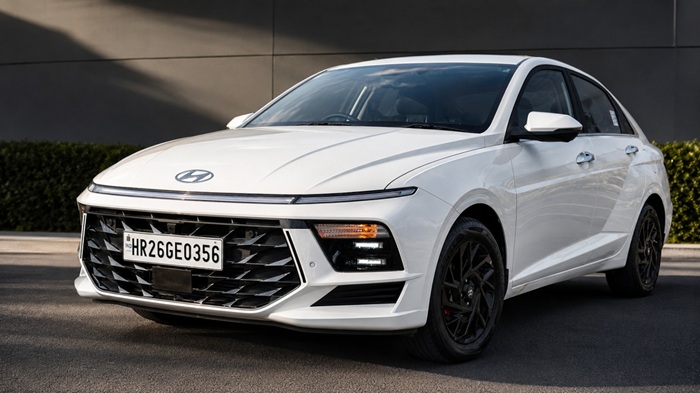
Gurugram: Hyundai Motor India Limited (HMIL) has announced that the new Hyundai Verna has secured a five-star safety rating under the Bharat New Car Assessment Programme (Bharat NCAP), becoming the first model in its segment to achieve the distinction, according to the automaker. The rating highlights the sedan’s performance in adult and child occupant protection assessments, adding another significant credential to its growing list of safety technologies.
Launched in March 2026, the updated Verna has now received independent recognition for its occupant protection capabilities. The assessment evaluates vehicle safety through standardised crash-testing procedures, providing Indian car buyers with an additional reference point when comparing models.
The five-star result comes as manufacturers increasingly emphasise crashworthiness alongside styling, performance and technology, reflecting the growing importance of independently assessed vehicle safety in India’s passenger car market.
Hyundai Verna’s Five-Star Safety Rating: What It Means
According to Hyundai, the new Verna demonstrated strong performance in both Adult Occupant Protection (AOP) and Child Occupant Protection (COP) assessments conducted under Bharat NCAP.
The company attributes the result to the sedan’s body structure, occupant protection systems and integrated safety technologies designed to reduce the consequences of collisions.
While Hyundai has confirmed the overall five-star rating, its announcement did not specify the individual numerical scores awarded for adult and child occupant protection.
Commenting on the achievement, Tarun Garg, Managing Director & CEO, Hyundai Motor India Limited, said, “At Hyundai Motor India, safety remains at the core of our product philosophy. The 5-Star Bharat NCAP rating achieved by the new Hyundai Verna is a testament to our commitment to providing the highest standards of occupant protection and advanced safety technologies to Indian customers. The new Verna delivers an exceptional combination of style, technology, performance and safety. This recognition further strengthens customer confidence in Hyundai’s engineering excellence and our vision of making safer mobility accessible to all.”
More Than 75 Safety Features, Including Seven Airbags
Hyundai says the new Verna offers more than 75 advanced safety features, including 35 standard safety features, with technologies covering occupant protection, collision prevention, vehicle stability and driver assistance.
Among its notable safety provisions is a seven-airbag configuration comprising driver, front passenger, side, curtain and centre-side airbags.
The sedan also features Electronic Stability Control (ESC) with Vehicle Stability Management (VSM), Anti-lock Braking System (ABS) with Electronic Brakeforce Distribution (EBD), Hill Start Assist Control (HAC) and all-wheel disc brakes.
Additional safety equipment includes an Electronic Parking Brake (EPB) with Auto Hold, Highline Tyre Pressure Monitoring System (TPMS), rain-sensing wipers and rear parking sensors.
For child passenger protection, the Verna offers ISOFIX child-seat anchors, while three-point seatbelts and seatbelt reminders are provided for all seating positions.
The equipment list is extensive, although the Bharat NCAP result arguably carries greater weight than simply counting safety features.
Level 2 ADAS Brings 20 Driver Assistance Technologies
A central component of the Verna’s technology package is Hyundai SmartSense Level 2 Advanced Driver Assistance Systems (ADAS), comprising 20 driver assistance features.
These systems are designed to support drivers by improving awareness of surrounding traffic conditions and assisting in potentially hazardous situations.
The sedan also offers a Surround View Monitor (SVM), which provides a view of the vehicle’s surroundings, and a Blind Spot View Monitor (BVM), helping drivers monitor areas that may otherwise be difficult to see.
An integrated dashcam further expands the Verna’s technology offering, providing an additional means of recording driving events.
These technologies complement the vehicle’s passive safety systems. However, driver assistance features are not a substitute for attentive driving, and Level 2 automation continues to require driver supervision.
Safety Meets Comfort and Performance
Beyond its safety credentials, the new Hyundai Verna combines updated exterior styling and driving dynamics with technology-focused interior features.
The sedan offers a Bose premium sound system alongside its driver assistance and convenience technologies, reflecting Hyundai’s approach to combining comfort and connectivity with occupant protection.
The November 2026 Bharat NCAP announcement follows the model’s March 2026 launch, giving prospective buyers an independently assessed safety rating to consider alongside its equipment and driving characteristics.
For Hyundai, the result also provides an opportunity to strengthen the Verna’s position in a competitive sedan market, where customers are increasingly evaluating vehicles on more than conventional measures such as power, fuel efficiency and cabin features.
Bharat NCAP Rating Adds Weight to India’s Vehicle Safety Push
The Bharat New Car Assessment Programme provides a framework for assessing passenger vehicle crash safety in India, helping consumers make better-informed purchasing decisions.
For manufacturers, such assessments provide an independent measure of occupant protection rather than relying exclusively on equipment specifications and company claims.
The Hyundai Verna’s five-star result adds to the growing emphasis on crash-tested safety in the Indian automotive industry. As safety ratings become a more prominent consideration in purchasing decisions, independent crash-test performance is increasingly important in determining how vehicles are judged.
For prospective Verna buyers, the latest certification offers reassurance backed by formal testing. For the wider industry, it reinforces a straightforward message: sophisticated technology and attractive design may draw customers into showrooms, but demonstrable safety credentials are becoming just as important in helping them make their final choice.