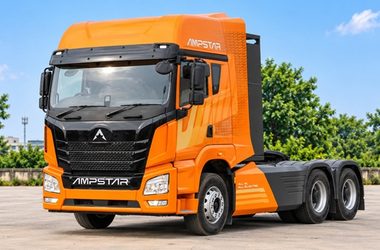
Mumbai: JSW Greentech Limited, the electric commercial vehicle arm of the JSW Group, has announced its first commercial order for 100 Ampstar 4×2 55T electric tractor trucks, marking the brand’s entry into heavy-duty industrial transportation. The vehicles will support JSW Cement’s logistics operations, transporting clinker and slag between Andhra Pradesh and Karnataka through a dedicated electric freight corridor.
The order comes just over a month after Ampstar was unveiled and coincides with the Automotive Research Association of India (ARAI) granting Central Motor Vehicle Rules (CMVR) certification to the Ampstar 4×2 and 6×4 electric tractor trucks.
The certification confirms that the vehicles meet the applicable safety, performance and regulatory requirements for operation on Indian roads, clearing an important hurdle as the company moves from product introduction to commercial deployment.
100 Electric Trucks to Serve a 330-Km Industrial Corridor
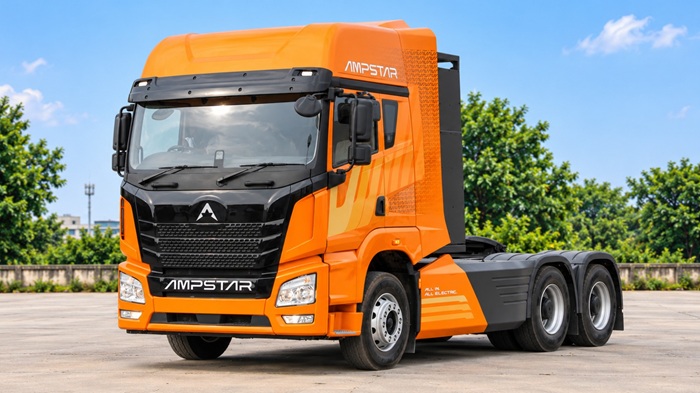
The fleet of 100 Ampstar 4×2 55T electric prime movers will operate on an approximately 330-km corridor connecting Nandyal in Andhra Pradesh with Vijayanagar in Karnataka.
The trucks will transport an estimated 1.25 lakh tonnes of clinker and slag every month for JSW Cement Limited, making the project a substantial application of battery-electric technology in industrial freight movement.
JSW Eco-Mobility, a subsidiary of JSW Greentech, will provide Battery-as-a-Service (BaaS) support and develop four dedicated battery-swapping stations along the corridor. Paradeep Parivahan Limited will participate as the logistics partner.
The battery-swapping arrangement is intended to minimise charging-related downtime and support continuous freight operations, where keeping vehicles moving is just as important as having enough power to move them.
Ampstar 55T Electric Truck Delivers 430 kW and 2,600 Nm
Designed for demanding Indian commercial operating conditions, the Ampstar 4×2 55T electric tractor truck develops a peak power output of 430 kW and peak torque of 2,600 Nm.
These specifications position the vehicle for heavy-duty industrial haulage, an application where payload demands, vehicle availability and operating efficiency play central roles in fleet economics.
According to JSW Greentech, the project is expected to save approximately 4.5 crore litres of diesel over the contract period while avoiding an estimated 6,250 tonnes of carbon dioxide emissions.
The company has not specified the duration of the contract or detailed the methodology behind these environmental estimates.
JSW Greentech Targets Commercial Viability Through Battery Swapping
Sumit Mittal, CEO of JSW Greentech Limited, described the deployment as a major milestone in the company’s electric commercial vehicle strategy.
“In just over a month, we have reached a significant milestone, with the first 100 trucks being deployed for JSW Cement’s industrial freight movement, supported by JSW Eco-Mobility as Battery-as-a-Service (BaaS) partner.”
Mittal said the project brings together electric vehicles, supporting infrastructure and energy services in an integrated operating model intended to make heavy-duty electric transportation commercially viable.
Narinder Kahlon, Director Finance, JSW Cement, emphasised the importance of reducing emissions across the company’s supply chain.
“With an integrated electric mobility solution backed by battery-swapping infrastructure, we aim to reduce our dependence on diesel, lower emissions and advance our sustainability objectives without compromising operational efficiency”
The project will provide an opportunity to assess whether a dedicated battery-swapping network can support the operational demands of regular heavy-duty freight movement.
Manufacturing Facility in Maharashtra to Produce 15,000 Electric Vehicles Annually
Ampstar vehicles will be manufactured at JSW Greentech’s integrated greenfield facility being developed at AURIC in Chhatrapati Sambhajinagar, Maharashtra.
Spread across approximately 90 acres, the facility is planned to have an annual production capacity of 15,000 electric buses and trucks.
The manufacturing complex will include an automated truck-cabin production line and an integrated battery ecosystem. Engineering and product development activities will be supported by JSW Greentech’s research and development centre in Pune.
Incorporated in 2024, JSW Greentech is building its electric commercial vehicle portfolio under the Ampstar brand, focusing on products suited to Indian operating conditions.
Ampstar Plans Tippers and Fixed-Body Dumpers
Beyond its initial tractor-truck offerings, Ampstar intends to expand its commercial vehicle portfolio to include electric tippers and fixed-body dumpers.
The company is targeting a broad range of commercial applications with power configurations from 150 kW to 500 kW.
Customers will be offered multiple acquisition and operating arrangements, including outright purchase, leasing and Battery-as-a-Service. The company also plans to provide charging infrastructure, financing solutions and after-sales support.
These options are intended to address the varying financial and operational requirements of commercial fleet operators, particularly those evaluating the transition from conventional diesel-powered trucks.
A Test Case for Heavy-Duty Electric Freight in India
While electric mobility has gained considerable attention in passenger vehicles and urban transportation, electrifying heavy-duty industrial freight presents a different set of challenges, particularly around infrastructure, vehicle utilisation and operating costs.
JSW Greentech’s initial 100-truck deployment brings these considerations into focus through a defined industrial route, dedicated battery-swapping infrastructure and an established freight requirement.
For Ampstar, securing its first commercial order represents an important step beyond its product launch. The more significant test will come through daily operations, where reliability, turnaround times and cost efficiency will determine whether the model can be replicated across other industrial corridors.
As India’s commercial transport sector explores alternatives to diesel, the project’s performance could offer useful insights into the practical role of battery-electric trucks in moving the country’s industrial goods.