
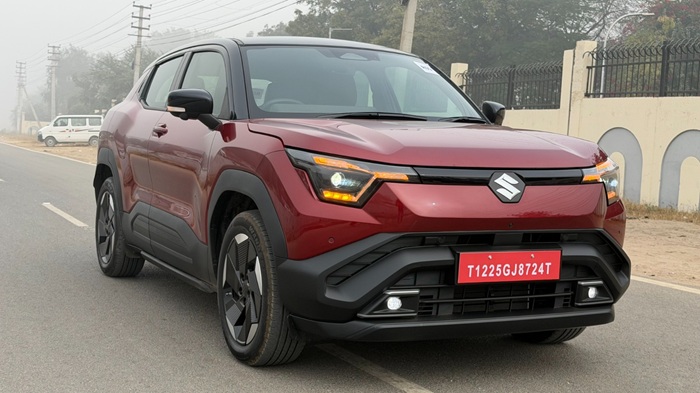
Hansalpur/New Delhi: Maruti Suzuki India Limited has crossed the milestone of 50,000 electric vehicle exports, strengthening its position as India’s largest exporter of electric passenger vehicles. The achievement comes just over a year after the company began shipping its Made-in-India e Vitara electric SUV to international markets in August 2025, with exports now reaching nearly 50 countries.
The milestone highlights the growing role of India as a manufacturing and export hub for electric vehicles, particularly as global automakers expand their production networks to meet international demand.
According to the company, Maruti Suzuki accounted for nearly 93% of India’s electric passenger vehicle exports between April and September 2026, maintaining its leadership in a segment increasingly important to the country’s automotive ambitions.
Europe Leads Demand for Made-in-India Electric Vehicles
Europe was the first international market to receive the e Vitara and continues to be its largest export destination. The electric SUV is now shipped to nearly 50 countries, including the United Kingdom, Norway, Germany, Japan and Switzerland.
Maruti Suzuki emerged as India’s leading electric vehicle exporter in FY2025-26 and retained that position during the first half of FY2026-27.
The company’s dominance in electric passenger vehicle exports is particularly significant considering that India’s domestic EV market remains in a relatively early stage of development compared with several international markets.
For Maruti Suzuki, the export milestone also marks a notable expansion beyond its established reputation for manufacturing conventional petrol-powered vehicles.
Hisashi Takeuchi Highlights India’s Manufacturing Capabilities
Commenting on the achievement, Hisashi Takeuchi, Managing Director & CEO, Maruti Suzuki India Limited, said:
“Maruti Suzuki’s EV export journey began in August 2025 when the Hon’ble Prime Minister of India, Shri Narendra Modi, commemorated the start of production of the e Vitara at the Hansalpur facility, for sale in over 100 countries. At the same event, he hailed Maruti Suzuki as a brand ambassador^ of the ‘Make in India’ initiative. Today, Maruti Suzuki exports EVs to nearly 50 of these countries, with Europe being the largest destination. In April-September 2026, Maruti Suzuki accounted for nearly 93%** of India’s electric passenger vehicle exports. This milestone reflects India’s advanced manufacturing capabilities and its growing competitiveness.”
The company began its international EV export journey in August 2025, when Prime Minister Narendra Modi attended an event marking the commencement of e Vitara production at the Hansalpur manufacturing facility in Gujarat.
The electric SUV was developed for global markets, with plans to sell it in more than 100 countries.
Gujarat’s Hansalpur Plant Becomes a Major Global EV Manufacturing Hub
At the centre of Maruti Suzuki’s electric vehicle export operations is its Hansalpur manufacturing facility in Gujarat, which serves as the exclusive production location for Suzuki’s first global battery electric vehicle.
The facility has recently expanded its annual production capacity to 1 million vehicles, making it the first Suzuki manufacturing plant anywhere in the world to achieve that capacity at a single location.
Maruti Suzuki has invested a cumulative INR 252,887 million (₹25,288.7 crore) in the Hansalpur facility, underlining its importance within Suzuki’s international manufacturing network.
The plant has also become a major contributor to the company’s overseas business, accounting for nearly half of Maruti Suzuki’s total vehicle exports during FY2025-26.
While the facility manufactures vehicles beyond the e Vitara, its expanded capacity provides an important manufacturing base for Suzuki’s global operations.
Maruti Suzuki Commands Over 50% of India’s Passenger Vehicle Exports
Maruti Suzuki’s achievements in electric vehicle exports come alongside its established position in India’s broader passenger vehicle export market.
The company has remained India’s largest passenger vehicle exporter for five consecutive years and accounted for more than 50% of the country’s passenger vehicle exports between April and September 2026.
Its international portfolio currently comprises 16 models exported to nearly 120 countries, reflecting a global distribution network that extends well beyond its domestic market.
The addition of electric vehicles to this export portfolio represents an important step in Suzuki’s international electrification strategy.
It also illustrates how Indian manufacturing facilities are increasingly being used to produce vehicles for markets with different regulations, consumer preferences and technological requirements.
India’s EV Export Ambitions Gather Momentum
Maruti Suzuki’s 50,000-unit milestone comes as India’s automotive industry seeks to strengthen its position in the global electric mobility supply chain.
The company’s nearly 93% share of electric passenger vehicle exports during April–September 2026 demonstrates its current dominance in the category, although the longer-term competitive landscape will depend on how other manufacturers expand their electric vehicle export operations.
For Maruti Suzuki, the next challenge will be translating this early export leadership into sustained international demand as the e Vitara reaches additional markets.
Beyond the numbers, the milestone carries wider significance for India’s automotive industry. It demonstrates that vehicles manufactured in India are increasingly being positioned for international electric mobility markets, with Gujarat’s Hansalpur facility playing a central role in that transition. The country is not merely preparing for an electric future at home; it is already shipping part of that future overseas.