
Tokyo: Mitsubishi Motors Corporation has unveiled the fully redesigned, all-new Pajero, reviving one of its most recognisable SUV nameplates as a new-generation flagship with a 2.4-litre diesel engine, ladder-frame construction, Super-All Wheel Control and a seven-seat cabin.
The new Pajero will be produced at Mitsubishi Motors’ manufacturing base in Thailand and will first go on sale in the Thai market. Japan and Australia are scheduled to follow during fiscal 2026, while Mitsubishi plans to expand the SUV to around 100 countries from fiscal 2027, including markets across ASEAN, Latin America and the Middle East.
For a nameplate that has spent decades making mud look like a perfectly reasonable route choice, the new generation represents a significant shift towards a more premium positioning without abandoning the off-road hardware that built the Pajero’s reputation.
Mitsubishi says the latest SUV develops the Pajero philosophy around three themes — “Confidence,” “Comfort” and the newly added “Prestige” — combining off-road ability and reliability with improved refinement, passenger comfort and flagship-level materials.
Pajero Returns as Mitsubishi’s Flagship
First introduced in 1982, the Pajero was developed as a cross-country four-wheel-drive vehicle combining serious off-road performance with passenger-car-style comfort.
Across four generations, total Pajero production exceeded 3.29 million units, according to Mitsubishi Motors. The SUV was sold to customers in more than 170 countries and regions and became particularly influential during Japan’s recreational vehicle boom of the 1990s.
The latest version arrives roughly two decades after the launch of the fourth-generation Pajero and has been developed under a design concept called “Grand Charisma.”
“Under our Mid- to Long-Term Vision for the 2030s, we aim to enhance customer satisfaction and corporate value by developing distinctive products and strengthening our brand, while further reinforcing what makes Mitsubishi Motors unique,” said Keisuke Kishiura, president and chief operating officer of Mitsubishi Motors. “The all-new Pajero is the first model to bring this vision to life. As our flagship model, it will lead not only the Pajero series to follow, but the entire Mitsubishi Motors lineup. Evolved with a new level of refinement, the all-new Pajero is a premium cross-country SUV that drivers can rely on in any situation. We will introduce the model to markets around the world in phases, and we hope customers will look forward to its arrival.”
Upright Design Retains Pajero Heritage
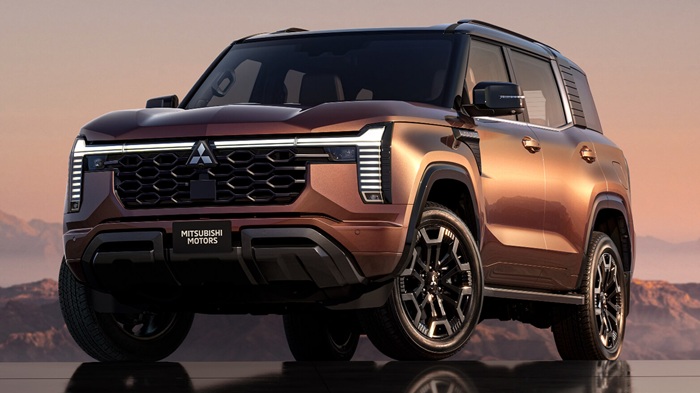
The exterior retains the upright proportions and strong horizontal design theme associated with earlier Pajero generations, but adds larger, more pronounced fenders and sculpted body surfaces.
Mitsubishi says the front-end design draws inspiration from kendo, the traditional Japanese martial art, with the intention of communicating strength, discipline and composure.
Two grille designs will be offered. One uses horizontal bars intended to reflect Japanese craftsmanship, while a second honeycomb-pattern grille provides a more functional appearance.
T-shaped headlights introduce a more contemporary lighting signature.
Several design references to earlier Pajero models have also been incorporated. The C-pillar takes inspiration from the roll bar of the original model, while a hexagonal rear treatment references the rear-mounted spare wheel associated with earlier generations.
Twin 14.3-Inch Displays Inside
The cabin uses a horizontally arranged dashboard inspired by the original Pajero.
Its centrepiece is a monolithic display incorporating two 14.3-inch screens. Mitsubishi has also recreated the Pajero’s traditional triple-meter arrangement digitally through a new Multi-Meter display.
The system can show information including altitude, compass heading, temperature, vehicle pitch and roll angles and Active Yaw Control status.
Drivers can choose from 16 background themes that change according to the time of day, while different drive modes receive their own graphics and visual effects.
Wireless smartphone connectivity is supported through the Smartphone-link Display Audio system, providing access to compatible navigation, music and other smartphone applications.
Soft-touch materials are used across the dashboard and door trims, including stitching inspired by Kimekomi, a traditional Japanese decorative craft.
Armor Copper and Phantom Blue Among Key Colours
Mitsubishi has highlighted two exterior theme colours for the new Pajero.
Armor Copper Metallic is intended to emphasise the SUV’s substantial body surfaces and proportions, while Phantom Blue Metallic combines a greyish-blue base with gold highlights visible under changing light conditions.
A Camel interior colour is also offered, designed to contrast with black trim while making signs of regular use less noticeable.
2.4-Litre Diesel Produces 480 Nm
Power comes from a specially developed 2.4-litre clean-diesel engine using a wide-range single variable geometry turbocharger.
The engine develops maximum torque of 480 Nm and is paired with a newly developed eight-speed automatic transmission with a Sport mode.
Mitsubishi says the powertrain has been tuned to deliver strong low-speed response along with smoother acceleration and improved refinement at higher speeds.
Ladder-Frame Chassis Remains
Despite the Pajero’s move upmarket, Mitsubishi has retained a traditional ladder-frame chassis rather than moving the SUV to a road-focused unibody layout.
The frame makes greater use of high-tensile steel and receives larger cross sections to improve torsional and bending rigidity while controlling weight.
The front suspension uses an independent double-wishbone arrangement, while the rear receives a newly developed five-link rigid-axle setup.
Mitsubishi says one of the development targets was what it calls “off-road comfort” — maintaining serious capability on rough terrain without making paved-road occupants feel as though they have entered an endurance rally by accident.
Revised body mounts are designed to reduce vibration on rough surfaces while improving both handling and ride quality.
Super Select 4WD-II and S-AWC
The new Pajero combines Mitsubishi’s Super Select 4WD-II system with Super-All Wheel Control.
Drivers can select from four drivetrain configurations: 2H rear-wheel drive, 4H full-time four-wheel drive, 4HLc with the centre differential locked, and 4LLc combining a locked centre differential with low-range gearing.
S-AWC integrates Active Yaw Control, Active Stability and Traction Control and the Anti-lock Braking System to manage torque and braking forces according to vehicle inputs and road conditions.
Seven selectable drive modes are available: Normal, Eco, Gravel, Snow, Mud, Sand and Rock.
The Pajero is also fitted with large 18-inch brake rotors and an electric brake booster.
New Pajero Dimensions
The all-new Mitsubishi Pajero measures 4,920 mm in length, 1,925 mm in width and 1,910 mm in height, with a wheelbase of 2,870 mm.
Front and rear track widths measure 1,630 mm.
Ground clearance stands at 230 mm, while the SUV has a 30.4-degree approach angle, 22.6-degree ramp breakover angle and 25.8-degree departure angle.
Mitsubishi has also quoted a 52:48 front-to-rear weight distribution.
Seven-Seat Cabin With Improved Third Row
The Pajero retains a three-row, seven-seat configuration.
The driver sits relatively high to improve forward visibility and make it easier to judge the vehicle’s dimensions.
Second-row seats have a 150 mm sliding range and a tumble mechanism to improve access to the rear.
Mitsubishi says the third row has been designed with enough headroom for adult occupants, while space beneath the second-row seats allows third-row passengers to position their feet more naturally.
Front and second-row seats are shaped to provide increased body support, while seat ventilation is available.
Three-zone automatic climate control allows separate temperature settings across the cabin.
More Sound Insulation for Highway Refinement
The new Pajero receives additional sound-insulation measures aimed at reducing wind, tyre and engine noise.
Acoustic glass is used for the windshield as well as the front and rear door windows.
According to Mitsubishi, the measures are intended to allow occupants across all three rows to hold conversations more comfortably even at highway speeds.
MI-PILOT and Expanded Safety Technology
The SUV receives Mitsubishi’s latest preventive safety and driver-assistance systems.
These include Forward Collision Mitigation with pedestrian, cyclist and motorcyclist detection, junction assistance, Predictive Forward Collision Warning and Emergency Assist for Pedal Misapplication.
Emergency Lane Assist is offered on the Pajero for the first time. The system uses camera and radar data to detect lane markings and surrounding vehicles, providing steering assistance when it identifies a risk of unintended lane departure.
Front Cross Traffic Alert can warn the driver about vehicles approaching from the sides at intersections.
MI-Pilot, Mitsubishi’s single-lane highway driving assistance system, combines Adaptive Cruise Control with Lane Keep Assist to help maintain a set distance from the vehicle ahead and keep the SUV positioned within its lane.
Eight airbags are fitted, including Mitsubishi Motors’ first SRS centre airbag, designed to reduce contact between front-seat occupants during certain collisions.
3D Camera System Adds Under-Floor View
The 3D Multi Around Monitor combines images from four cameras with a three-dimensional model of the vehicle.
The system processes roughly 30 frames per second and provides a real-time representation of the SUV’s surroundings to assist during parking, low-speed manoeuvring and off-road driving.
A front under-floor view can display terrain immediately beneath and ahead of the vehicle.
It activates automatically when 4HLc or 4LLc is selected and can also be switched on manually.
Mitsubishi Connect Brings Remote Vehicle Functions
Mitsubishi Connect provides a range of connected-car functions through a smartphone.
Owners can remotely operate the vehicle’s climate-control system and check vehicle information, while an SOS function can connect occupants with an emergency assistance operation centre.
Yamaha Develops 12-Speaker Audio System
The Pajero will also be available with the Dynamic Sound Yamaha Ultimate audio system, jointly developed with Yamaha Corporation.
The setup uses 12 speakers and dual amplifiers.
Noise-compensation technology automatically adjusts volume and sound tuning according to vehicle speed in an attempt to offset changing road noise.
Global Rollout to Begin in Phases
The all-new Pajero represents one of Mitsubishi Motors’ most significant product introductions in recent years, combining familiar ingredients such as a diesel engine, ladder frame and selectable four-wheel drive with a much stronger emphasis on digital technology, safety and interior refinement.
Its success will depend on whether Mitsubishi can preserve the rugged character that made the Pajero famous while convincing a new generation of buyers that an old-school off-roader can also function as a modern premium flagship.
With launches planned across approximately 100 countries from fiscal 2027 onward, the Pajero is not merely returning to Mitsubishi’s range. It is being asked to lead it.
The Pajero is sold under the Montero nameplate in some markets.