
The Range Rover Sport is one of those SUVs that can arrive outside a five-star hotel, a farmhouse, an international airport or an unexplained political meeting—and somehow look perfectly appropriate in every situation.
It is British, luxurious, powerful and exceptionally capable. More importantly, it possesses the rare ability to look expensive even when covered in mud. Most luxury SUVs become slightly embarrassed after leaving the tarmac. The Range Rover Sport, however, treats an off-road trail like an opportunity to demonstrate that its expensive shoes are also waterproof.
The Range Rover Sport was originally introduced in 2005, and the vehicle you see here belongs to its third generation. Internally known by its L461 codename, this generation arrived with cleaner styling, more sophisticated electronics and the highly flexible MLA-Flex platform shared with the full-size Range Rover.
The locally assembled Range Rover Sport range in India begins at approximately ₹1.38–1.40 crore ex-showroom, while this top-specification P400 Autobiography sits around the ₹1.60 crore mark before options. The high-performance Range Rover Sport SV occupies an even more enthusiastic tax bracket, with prices comfortably exceeding ₹2 crore. India became the first country outside the United Kingdom to locally manufacture the Range Rover and Range Rover Sport, with selected variants assembled at JLR’s Pune facility, while global production also takes place at the historic Solihull plant in Britain.
In other words, this is a British luxury SUV that can now legitimately say, “Made in India,” without immediately discussing localisation percentages.
Design: Minimalism With Maximum Road Presence
The Range Rover Sport was created under the design leadership of Gerry McGovern, the celebrated automotive designer associated with the modern Range Rover family and the current-generation Defender.
Its design philosophy is fascinatingly simple: remove unnecessary lines, hide whatever can be hidden and allow the proportions to provide the drama. While several modern luxury SUVs appear to have been designed by giving every department its own chrome strip, the Range Rover Sport takes the opposite approach.
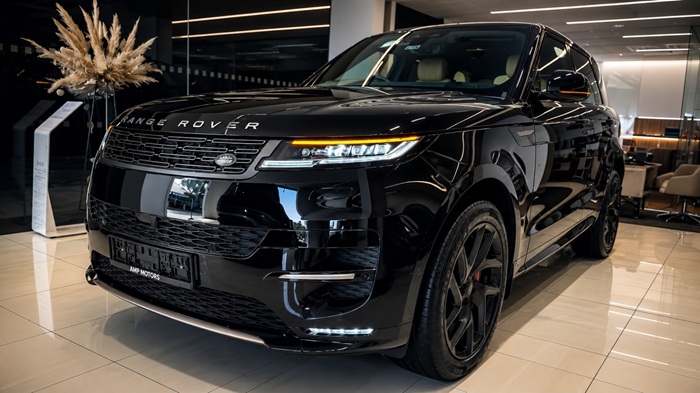
The front features a narrow, stealth-like grille accompanied by slim Digital LED headlights. These automatic headlights incorporate signature daytime-running lights, adaptive front lighting, automatic levelling, washers and image-projection technology.
The headlights do not simply illuminate the road; they appear to study it, analyse it and possibly judge the vehicle travelling ahead.
The grille is finished with a dark, technical appearance, giving the Sport a more aggressive face than the full-size Range Rover. LED fog lights sit lower down, while the sculpted bonnet includes distinctive louvres that add visual width without looking unnecessarily decorative.
There are heated washer jets, rain-sensing windscreen wipers and a solar-attenuating windscreen to reduce the amount of heat entering the cabin. That last feature is particularly relevant in India, where a car parked outdoors for twenty minutes can develop the internal climate of a commercial bakery.
The exterior mirrors are electrically adjustable, heated, power-folding and auto-dimming. They also receive memory functionality and approach lights. Therefore, even the mirrors remember you—which is more emotional support than some people receive from their relatives.
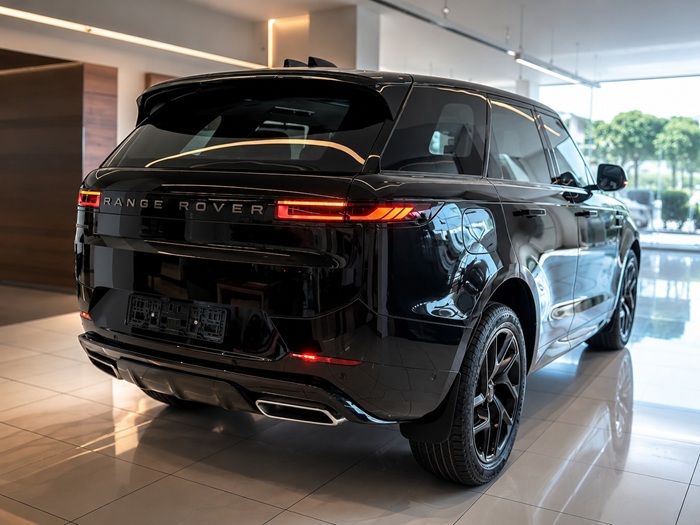
This particular Range Rover Sport is finished in Santorini Black, a colour that suits the vehicle’s clean and imposing character. Depending on the market and configurator, customers can choose from an enormous palette incorporating grey, green, silver, blue, white, gold, brown, beige and various premium matte or satin finishes.
With standard, premium and SV Bespoke finishes included, the number of possible colour combinations can extend to roughly 31. There is also the option of a contrasting black roof, although on a Santorini Black example, that would be rather like ordering black coffee with an additional black topping.
Customers can personalise the vehicle through Range Rover’s Bespoke programme, selecting special colours, materials and exterior treatments. A satin protective film is also available, adding visual distinction while protecting the underlying paint. Even the model and engine badges can be deleted for customers who prefer their ₹1.60-crore SUV to remain mysterious.
Although, realistically, nobody is going to mistake it for a budget hatchback.
Dimensions: Sporty, but Only by Range Rover Standards
The word “Sport” in its name should not mislead you into expecting something compact.
The Range Rover Sport measures approximately 4.9 metres in length, 2.2 metres in width with the mirrors included and nearly 1.8 metres in height. It has up to 283 mm of ground clearance in its raised off-road setting and a kerb weight of approximately 2,385 kg, depending on the engine and specification.
The gross vehicle weight is around 3,220 kg, while the roof can carry up to 100 kg. It can tow a braked trailer weighing as much as 3,500 kg, which means it can pull a large caravan, a horse trailer or possibly a small Mumbai apartment.
Its maximum water-wading depth is an impressive 900 mm. That makes it useful for river crossings, serious off-road adventures and those particular city roads that become honorary rivers during the monsoon.
Despite its size, the all-wheel-steering system gives the Range Rover Sport a turning circle of roughly 11 metres. At lower speeds, the rear wheels turn in the opposite direction to the front wheels to improve manoeuvrability. At higher speeds, they turn in the same direction to improve stability.
Consequently, this large SUV can negotiate tight spaces with surprising ease. You may still require three attempts inside a congested parking basement, but at least the car will not be responsible for the fourth.
Wheels, Tyres and Brakes
This P400 Autobiography rides on imposing 22-inch satin-black alloy wheels, while 21-inch and 23-inch designs are also available depending on the chosen configuration.
The vehicle shown here uses 285/45 R22 114Y Michelin Primacy All Season tyres at the front and rear. These Hungarian-made, extra-load radial tubeless tyres provide the load capacity required by a vehicle of this size and performance.
Self-sealing tyre technology is available on selected specifications, helping seal minor punctures caused by nails or similar objects. Locking wheel nuts are also provided, which is reassuring because each alloy wheel probably deserves its own insurance policy.
Large Brembo disc brakes are fitted at the front and rear. This example receives red brake calipers, although black calipers can be selected for a more discreet appearance.
The braking system has considerable responsibility. It must stop nearly 2.4 tonnes of luxury SUV, six cylinders of turbocharged enthusiasm and, occasionally, a driver who has just discovered the accelerator pedal.
Rear Design and Practicality
At the back, the design remains clean and tightly controlled. The slim LED tail lamps incorporate animated directional indicators, while the integrated twin tailpipes give the P400 a suitably sporting finish without turning the rear bumper into a collection of exhaust-themed jewellery.
A rear fog lamp, heated rear window and rear wiper with washer are included. The front and rear side windows use a combination of toughened and laminated glass, helping improve security, refinement and sound insulation.
The flush deployable door handles sit level with the body when the vehicle is locked. When approached or unlocked, they extend electronically.
They look elegant and reduce aerodynamic disturbance, although they also provide passengers with a brief moment of uncertainty the first time they encounter them. There is always a second when someone stands beside the car thinking, “I know this vehicle has doors, but Britain has hidden the evidence.”
The powered tailgate opens to reveal 647 litres of luggage capacity. Folding the 60:40-split rear seats expands the available volume to approximately 1,491 litres.
This is sufficient for airport luggage, golf equipment, expensive shopping bags, pet accessories or the emotional baggage associated with the monthly instalment.
A load-space floor partition and several boot-management accessories can also be ordered.
Platform and Chassis: Where the Sport Earns Its Name
Underneath the elegant exterior sits JLR’s Modular Longitudinal Architecture, commonly known as MLA-Flex. The platform is shared with the full-size Range Rover and was developed to support internal-combustion, mild-hybrid and plug-in-hybrid powertrains.
The architecture provides a stiff structural foundation, allowing the suspension and chassis-control systems to operate with greater precision. Selected petrol and diesel engines use a 48-volt mild-hybrid system that recovers energy during deceleration and assists the powertrain during acceleration.
Plug-in-hybrid versions are available internationally, although they are not presently part of the regular Indian Range Rover Sport line-up.
A full-time all-wheel-drive system continuously manages power delivery between the axles. The Electronic Active Differential further distributes torque across the rear wheels, helping provide traction when accelerating, cornering or driving over slippery terrain.
There is also Torque Vectoring by Braking, which can gently brake an inside wheel during cornering to improve agility and reduce understeer.
Basically, the car uses selective braking to help you turn more effectively. It is the automotive equivalent of politely taking someone by the elbow and pointing them in the correct direction.
The Range Rover Sport uses a single-speed transfer system in the applicable Indian powertrain configuration, together with sophisticated electronically controlled differentials and an eight-speed automatic gearbox.
Dynamic Air Suspension
One of the most important technologies is the Dynamic Air Suspension with switchable-volume air springs.
The air-suspension system continuously adjusts ride height and damping to balance comfort, handling and off-road capability. The switchable-volume springs alter their effective air volume according to the driving situation, allowing the vehicle to provide a softer response over poor surfaces and greater control during enthusiastic driving.
The result is a vehicle that can absorb a broken road with the composure of a limousine and then enter a corner without behaving like a luxury yacht caught in crosswinds.
Adaptive Dynamics 2 continuously monitors the road surface, vehicle-body movement, steering inputs and driver behaviour. It then calculates suitable compression and rebound damping levels in real time.
The suspension is controlled as part of the Range Rover Sport’s Integrated Chassis Control system, which coordinates the vehicle’s various dynamic technologies up to hundreds of times per second.
Land Rover says the systems work together rather than behaving as individual electronic departments. That is important because even a luxury SUV becomes difficult to manage when its software teams stop communicating.
Dynamic Response Pro
The Dynamic Response Pro system uses a powerful 48-volt electronic active-roll-control arrangement to reduce body lean during cornering.
Instead of relying entirely on conventional anti-roll bars, electrically controlled actuators apply corrective force across the axles. This allows the Range Rover Sport to remain flatter and more composed through bends while retaining the suspension movement necessary for comfort and off-road articulation.
The system works with the air suspension, adaptive dampers, all-wheel steering, electronic differential and torque-vectoring technology. These systems are coordinated through Integrated Chassis Control, creating a remarkably agile experience for such a heavy and substantial vehicle.
It does not make the Range Rover Sport feel like a lightweight two-seat sports car. Physics remains employed. But it does make the SUV feel smaller, more controlled and far less intimidating than its dimensions suggest.
Terrain Response 2 and Off-Road Ability
The Range Rover Sport may spend much of its life outside hotels and premium cafés, but it remains a proper Land Rover underneath.
Terrain Response 2 can automatically identify the type of surface beneath the vehicle and select an appropriate driving programme. It adjusts the throttle, gearbox, differentials, traction control and suspension according to conditions such as mud, sand, rocks, grass, gravel or snow.
The driver can also choose settings manually, because human beings generally enjoy pressing buttons labelled “Mud Ruts” even when travelling to an office.
The Range Rover Sport was the first Land Rover to introduce Adaptive Off-Road Cruise Control. The system allows the driver to select a target speed and one of several comfort levels when travelling across rough ground. The vehicle then manages acceleration and braking, allowing the driver to concentrate primarily on steering.
It is effectively cruise control for situations in which there is no recognisable road.
Hill Descent Control manages the vehicle’s speed on steep downhill surfaces, while Gradient Release Control helps provide smoother brake release on inclines. Hill Launch Assist reduces rollback, and Low-Traction Launch manages torque delivery when starting on slippery surfaces.
An Eco driving mode is also included. Selecting Eco mode in a 394-horsepower luxury SUV is a little like ordering sparkling water beside a seven-course meal, but the intention is admirable.
Automatic Access Height
The air suspension also provides Automatic Access Height.
When the vehicle is parked, it can lower itself by approximately 50 mm, making entry and exit easier. This is useful for children, elderly passengers and anyone wearing clothing that was designed without consideration for climbing into a tall SUV.
Once moving, the vehicle returns to its appropriate ride height automatically.
Customer-configurable automatic locking is also provided, allowing the owner to determine how and when the doors lock.
Interior: A Private Lounge With Number Plates
Open the soft-closing doors and the Range Rover Sport immediately explains where a large portion of its asking price has gone.
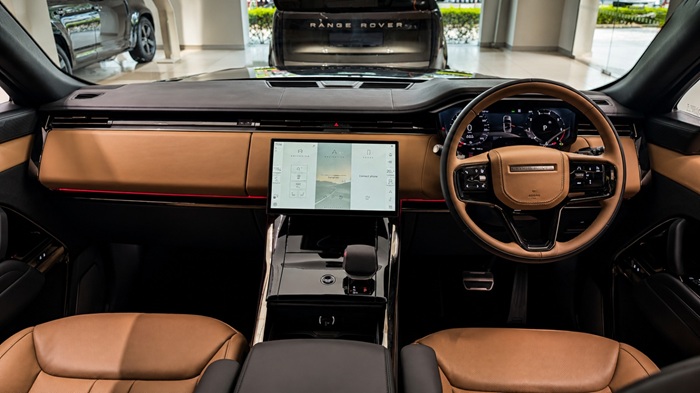
The cabin design is clean, horizontal and driver-focused. The fast-angled dashboard provides a more sporting environment than the full-size Range Rover, while the near-frameless displays and concealed controls maintain a minimalist appearance.
This example receives brown perforated semi-aniline leather upholstery, providing a soft and richly textured finish. Depending on specification, customers can choose red, black, grey and other leather combinations, along with sustainable Ultrafabrics upholstery.
Wood trim is fitted here, while carbon-fibre and aluminium finishes are also available. The choice depends on whether you want the cabin to resemble an executive lounge, a performance car or a particularly expensive architectural studio.
Thirty-colour configurable ambient lighting allows the cabin atmosphere to be adjusted according to personal preference.
You can select a calm shade for relaxed evening travel, a dramatic red for a spirited drive or another colour simply because the vehicle costs ₹1.60 crore and therefore should illuminate itself accordingly.
Illuminated seat-belt buckles make the belts easier to locate in darkness. SV Bespoke carpet mats are also available, ensuring even your footwear encounters premium materials.
A black headliner can be selected to create a more intimate and sporting cabin environment.
Seats and Comfort
The front occupants receive sports seats with 22-way electrical adjustment. The seats include heating, ventilation, four-way lumbar adjustment, memory and massage functions.
The massage facility is useful during long journeys, although it may also discourage the driver from arriving at the destination.
The rear seats receive power reclining functionality, while heating and ventilation are available depending on specification. The backrests can be folded in a 60:40 ratio when additional cargo room is required.
Soft Door Close gently pulls each door shut if it has not been fully closed. There is no need to slam anything. A Range Rover Sport regards door slamming as emotionally unnecessary.
Four-zone climate control allows separate temperature settings for different areas of the cabin. The system is supported by Cabin Air Purification Pro, an air-quality sensor, PM2.5 filtration and Nanoe-X technology.
These systems help reduce airborne particulates, odours and selected allergens. The cabin therefore filters outside pollution before allowing it near the semi-aniline leather.
A refrigerated compartment provides chilled storage for drinks, while a 230-volt power outlet allows passengers to operate compatible electrical equipment. Wireless phone charging and multiple USB connections are also provided.
Twin-blade sun visors offer additional coverage against low sunlight, and an upper glovebox adds practical storage.
Infotainment and Digital Technology
At the centre of the dashboard is a 13.1-inch Pivi Pro touchscreen.
The display uses a near-frameless design with haptic feedback and controls navigation, media, communication, climate functions and vehicle settings. It supports wireless Apple CarPlay and Android Auto, Bluetooth, FM radio, USB connectivity, Wi-Fi, live traffic information and three-dimensional navigation maps.
The “Hey Land Rover” voice-control system allows occupants to adjust selected functions using spoken commands. Artificial-intelligence-based personalisation can learn frequently used features and present them more conveniently over time.
The vehicle eventually learns your habits. Hopefully, it does not begin commenting on them.
The driver receives a 13.7-inch Interactive Driver Display, presenting speed, engine information, navigation, media and driver-assistance data. A head-up display projects important information such as speed, gear position and navigation directions into the driver’s field of vision.
The heated multifunction leather steering wheel includes controls for the phone, volume, voice assistant and instrument cluster.
A ClearSight rear-view mirror can switch from a conventional reflective surface to a camera-fed display. This provides a clear rearward view even when the luggage compartment is fully loaded or when a tall passenger is occupying the centre rear seat.
A sliding panoramic sunroof with an electric blind brings additional light into the cabin and adds to the sense of space.
Meridian Signature Sound System
The Range Rover Sport can be equipped with a spectacular 29-speaker, 1,430-watt Meridian Signature Sound System.
Its output is powerful enough to transform the cabin into a private concert hall while still maintaining impressive clarity. Speakers are carefully positioned around the cabin to create a wide and immersive soundstage.
The only difficulty is that after experiencing music through 29 Meridian speakers, your normal headphones may begin to sound like somebody singing from inside a steel bucket.
Optional 11.4-inch rear entertainment touchscreens can support HDMI connectivity, compatible wireless applications and screen mirroring. This allows rear passengers to watch individual content while the driver enjoys the revolutionary entertainment experience known as traffic.
Safety
The third-generation Range Rover Sport achieved the maximum five-star rating from both Euro NCAP and ANCAP.
Euro NCAP awarded it 85 percent for adult-occupant protection, 85 percent for child-occupant protection, 69 percent for vulnerable-road-user protection and 82 percent for safety assistance under its 2022 assessment protocol. ANCAP’s corresponding five-star rating applies broadly across petrol, diesel and plug-in-hybrid variants covered by its assessment.
Its extensive safety package includes six airbags, ABS, Electronic Brakeforce Distribution, Emergency Brake Assist, Dynamic Stability Control, Electronic Traction Control, Roll Stability Control and Cornering Brake Control.
Brake pre-fill prepares the braking system when the vehicle anticipates that hard braking may be required. Gradient Acceleration Control helps prevent unwanted acceleration on steep descents, while Trailer Stability Assist can apply selective braking if a trailer begins to sway.
The Driver Assist Pack brings technologies such as adaptive cruise control with steering assistance and Driver Condition Response. The latter can intervene if it detects that the driver has become unresponsive.
Adaptive cruise control maintains a selected speed and following distance while helping keep the vehicle centred in its lane.
There is also a three-dimensional surround-view camera, front and rear parking assistance, Park Assist, a tyre-pressure-monitoring system, speed limiter and keyless entry.
Additional safety features include an intrusion sensor, electrically operated child locks, ISOFIX child-seat mountings, towing preparation and a first-aid kit.
The 3D camera system is particularly valuable while parking because the Range Rover Sport is wide enough to make some Indian parking spaces look like administrative errors.
Accessories
Range Rover offers an enormous catalogue of accessories and option packs.
Customers can choose a Black Exterior Pack, Towing Pack, Comfort Pack, Cold Climate Pack and Convenience Pack, along with different alloy wheels, illuminated scuff plates, mud flaps and deployable side steps.
Practical lifestyle accessories include roof boxes, bicycle carriers, a deployable tow bar, dash camera, carpet mats, an ashtray container and load-space partitions.
There are also dedicated pet packs incorporating accessories intended to make journeys safer and more comfortable for animals.
The pet may not understand why the car has four-zone climate control, a refrigerator and 29 speakers, but it will appreciate that somebody finally purchased an SUV with sufficient boot space.
A secure vehicle tracker and various protective accessories are also available.
Petrol Engine: P400 Mild Hybrid
This P400 Autobiography uses a 2,996 cc inline-six turbocharged petrol engine from Land Rover’s Ingenium family.
The engine is supported by a mild-hybrid system and produces approximately 394 horsepower, or 400 metric horsepower, along with 550 Nm of torque.
Power is delivered to all four wheels through a ZF-supplied 8HP eight-speed automatic transmission.
Despite weighing nearly 2.4 tonnes, the P400 can accelerate from 0–100 km/h in approximately 5.5 seconds and reach a top speed of 242 km/h.
That is serious performance for a vehicle capable of carrying five adults, 647 litres of luggage and an unreasonable quantity of interior leather.
Throttle response is smooth rather than aggressive, and the inline-six configuration provides excellent refinement. The mild-hybrid system assists during acceleration and allows smoother engine stop-start operation.
Under gentle driving conditions, an average approaching 12 km/l may be possible according to driving conditions and testing methodology. Real-world efficiency will naturally depend on traffic, speed, terrain and how frequently the owner attempts the 5.5-second acceleration figure.
A 90-litre fuel tank provides a useful touring range, although filling it completely may result in a brief conversation with your financial adviser.
This Ingenium petrol engine family is also used across products such as the Jaguar F-Pace, full-size Range Rover, Range Rover Velar and Land Rover Defender in different states of tune.
The engines are produced at JLR powertrain facilities, including manufacturing operations associated with the UK and China.
Diesel Engine: D350 Mild Hybrid
For customers prioritising effortless torque and long-distance efficiency, the Range Rover Sport is also offered with the D350 diesel.
This version uses a 2,997 cc inline-six turbocharged Ingenium diesel engine, again supported by mild-hybrid technology.
It produces approximately 346 horsepower and an enormous 700 Nm of torque. The diesel can accelerate from 0–100 km/h in around 5.8 seconds and reach approximately 234 km/h.
That means the diesel is only marginally slower than the petrol despite being tuned more towards low-end pulling power and touring efficiency.
The claimed average can approach 16 km/l under suitable testing conditions, though actual Indian driving figures will depend heavily on traffic and driving style.
The D350 feels particularly appropriate for the Range Rover Sport’s character. Its strong wave of torque suits overtaking, highway touring, towing and off-road driving, while the six-cylinder configuration delivers much greater refinement than a conventional four-cylinder diesel.
The petrol is smoother, faster and more enthusiastic. The diesel is muscular, relaxed and probably the more sensible choice.
Of course, rational decision-making becomes a flexible concept once the configurator crosses ₹1.5 crore.
Driving Experience
On the road, the Range Rover Sport delivers an unusual combination of isolation and involvement.
The driving position is commanding, visibility is excellent and the steering remains light enough for daily use. Electric Power Assisted Steering varies assistance according to vehicle speed, becoming easier during parking and more stable on the highway.
The stainless-steel pedals, sports seats and driver-focused dashboard create a slightly more athletic atmosphere than the flagship Range Rover.
Press the accelerator and the P400 gathers speed with remarkable smoothness. There is no unnecessary drama, no violent transmission behaviour and no desperate noise from the engine.
It simply lowers its nose slightly and becomes much closer to the next horizon.
The eight-speed automatic gearbox changes ratios almost invisibly during relaxed driving. Under hard acceleration, it responds quickly enough to keep the turbocharged six-cylinder engine within its strongest operating range.
Through corners, all-wheel steering, Dynamic Response Pro, torque vectoring, active damping and the electronic differential work together to conceal much of the vehicle’s mass.
You are always aware that this is a large and heavy SUV, but it rarely feels clumsy. The body remains controlled, steering response is accurate and traction is immense.
On poor roads, the air suspension allows the Sport to glide over imperfections without becoming disconnected. Large 22-inch wheels naturally transmit more sharp-edged impacts than smaller wheels, but the overall ride remains impressively composed.
The optional 23-inch wheels look spectacular, although they are best selected by customers who believe road surfaces are a government responsibility rather than a personal concern.
Verdict
The 2026 Range Rover Sport P400 Autobiography is not merely a smaller or less expensive full-size Range Rover.
It has its own personality: cleaner, more athletic and slightly more driver-focused, while retaining the refinement, craftsmanship and all-terrain capability expected from the Range Rover name.
It offers enormous road presence without excessive ornamentation. Its interior is beautifully constructed, its technology is extensive and its performance is genuinely impressive.
More importantly, the engineering beneath the body is not decorative. The MLA-Flex architecture, full-time all-wheel drive, Dynamic Air Suspension, all-wheel steering, electronic differential, Terrain Response 2 and Dynamic Response Pro give the Range Rover Sport a depth of capability that many luxury SUVs simply cannot match.
It can accelerate to 100 km/h in 5.5 seconds, tow 3.5 tonnes, travel through 900 mm of water, massage its occupants, purify its cabin air and lower itself politely when passengers need to get out.
That is not a vehicle specification. It is a highly qualified personal assistant with number plates.
At approximately ₹1.60 crore before personalisation, the P400 Autobiography is unquestionably expensive. Add Bespoke paint, larger wheels, special upholstery, entertainment screens and lifestyle accessories, and the final price can move upwards with considerable confidence.
Yet the Range Rover Sport offers something more than a long equipment list. It delivers a distinct sense of occasion every time you approach it, enter it or drive it.
The full-size Range Rover is the luxury limousine of the SUV world. The Defender is the rugged adventurer. The Range Rover Sport sits between them wearing a tailored suit, expensive trainers and a smartwatch capable of predicting the weather on a mountain.
It is sophisticated enough for Mayfair, powerful enough for the motorway and capable enough for places where the motorway has not yet been invented.
And that is precisely why the Range Rover Sport remains one of the most complete—and most desirable—luxury SUVs in the world.