There are some cars that are remembered for their performance, some for their luxury and others because every second politician, builder or wedding organiser owns one.
The Tata Sierra, however, is remembered simply because there was nothing else quite like it.
The original Sierra was among India’s earliest lifestyle SUVs. Its enormous rear glass area, three-door body and unapologetically boxy personality made it look like something designed for a wildlife documentary rather than the morning school run. It disappeared from the market many years ago, but never completely disappeared from the Indian automotive imagination.
Now, in 2026, the Sierra name has returned in an entirely new electric form.
This is the first-generation Tata Sierra EV, although the revived Sierra family itself represents a new chapter in the historic nameplate’s story. Tata has not recreated the old SUV bolt by bolt. Instead, it has taken the emotional appeal of the Sierra and placed it inside a sophisticated, connected and surprisingly powerful electric crossover.
The Sierra EV range begins at an introductory ex-showroom price of ₹18.79 lakh, while the fully loaded model costs ₹26.48 lakh. The car featured here is the top-spec Empowered A 75 QWD ACFC, complete with the dual-motor all-wheel-drive system and a factory-supplied 7.2 kW AC charger.
For customers who are not yet emotionally prepared to remove petrol pumps from their lives, the Sierra is also available with petrol and diesel engines. Prices for the internal-combustion Sierra start at ₹11.49 lakh. The regular Sierra has already crossed the 50,000-unit sales milestone in India, proving that nostalgia is even more effective when combined with a panoramic sunroof and easy monthly instalments.
Design: The Sierra Grows Up Without Forgetting Its Childhood
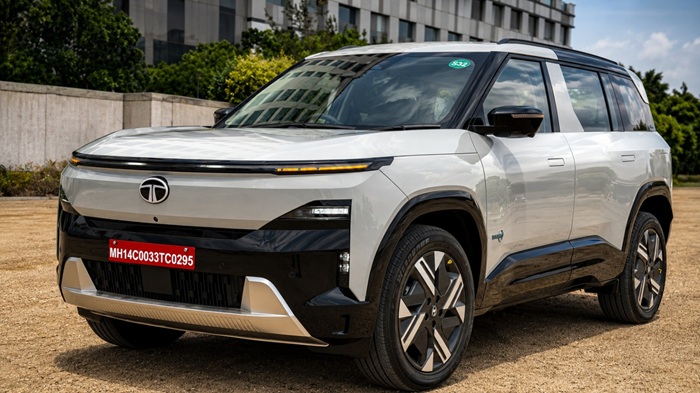
The Sierra EV has been created under the design leadership of Martin Uhlarik and Ajay Jain. It does not attempt to imitate the original Sierra literally, but it carries forward the same fundamental idea: a vehicle should look distinctive even when viewed from the next postal district.
At approximately 4.3 metres long, 1.84 metres wide and 1.7 metres tall, the Sierra EV has the dimensions of a proper midsize crossover. Its 205 mm ground clearance also gives it enough confidence for Indian roads, where an innocent-looking puddle can occasionally have its own geological history.
The body has a strong, upright stance. The bonnet is relatively flat, the shoulders are broad and the glasshouse has been shaped to recall the famous wraparound appearance of the old Sierra. It feels modern without becoming another anonymous aerodynamic jellybean.
The front features Tata’s Automatic Night Saber Bi-LED Booster headlamps, accompanied by High Beam Assist and a follow-me-home function. That name sounds less like a headlamp and more like an accessory from a science-fiction sword fight, but the lighting arrangement certainly gives the SUV a recognisable face.
Lower down, there are LED fog lamps with a cornering function. Turn the steering wheel at low speed and the corresponding lamp illuminates the side of the road, helping you spot kerbs, potholes, animals and the occasional motorcyclist who has appeared from a dimension unknown to conventional physics.
Automatic headlamps and rain-sensing wipers further reduce the number of basic tasks expected from the driver.
The electrically adjustable outside mirrors feature power folding, puddle lamps and integrated LED indicators. Flush-fitting door handles emerge with welcome illumination, giving the Sierra EV a premium appearance. They also provide a small theatrical moment every time you approach the car—because apparently even opening a door now requires an opening ceremony.
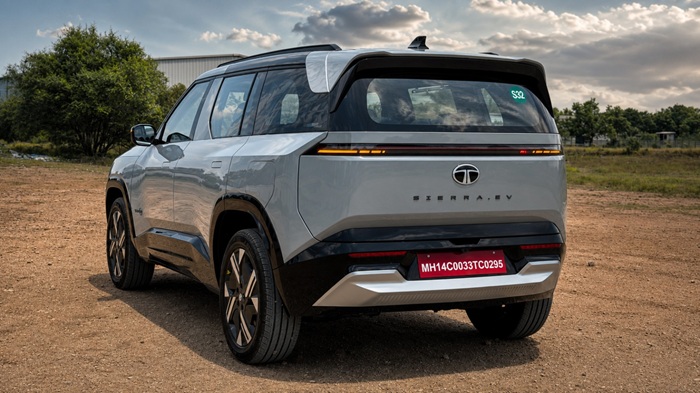
The vehicle shown here is finished in Rishikesh Rapids Grey. Depending on the variant, Sierra EV buyers can also choose shades including blue, white, yellow and red.
Wheels, Brakes and Suspension
The flagship Sierra EV receives handsome 19-inch alloy wheels, while selected lower versions are offered with 18-inch wheels.
The 19-inch setup uses 225/55 R19 99H MRF Wanderer Ecotred steel-belted radial tubeless tyres at the front and rear. These are low-rolling-resistance tyres, designed to reduce energy consumption without making the SUV look as though it has borrowed its wheels from an electric shopping trolley.
Disc brakes are provided on all four wheels.
At the front, the Sierra EV uses an independent MacPherson-strut suspension with a stabiliser bar. The rear receives an independent multi-link arrangement, again supported by a stabiliser bar.
Tata calls the overall setup Ultra Glide Suspension. It also incorporates Frequency Selective Damping, or FSD, which alters the damper response according to the frequency of road inputs.
In simple English, the suspension attempts to remain soft over sharp bumps while maintaining greater control during slower body movements. Indian roads can present both situations within approximately seven metres, so the technology should remain quite busy.
The independent multi-link rear suspension is a particularly important addition. It is intended to provide better wheel control, ride comfort and stability than a simpler torsion-beam arrangement. Tata describes the system as combining plush ride quality with precise handling.
Rear Design and Practical Details
At the rear, the Sierra EV receives slim LED tail lamps, a high-mounted LED stop lamp, a rear defogger and a neatly concealed rear wiper with washer.
The hidden wiper is a small but welcome design detail. It maintains a clean rear appearance instead of leaving the wiper arm permanently displayed like an antenna searching for FM reception.
QWD versions wear specific Quad Wheel Drive badging.
The charging port incorporates an illuminated ring, making it easier to connect the charging cable at night. It also gives the charging process a slight science-fiction atmosphere, which is helpful because standing beside a car attached to a wall socket otherwise lacks natural drama.
The Sierra EV supports 3.3 kVA Vehicle-to-Load, allowing the battery to power external electrical equipment. This means the car can operate items such as camping lights, laptops, small appliances and selected tools.
It also supports 5 kVA Vehicle-to-Vehicle charging, enabling the Sierra EV to transfer power to another compatible electric vehicle. In other words, it can rescue another EV whose owner confidently said, “We will definitely find a charger on the way.”
QWD, Terrain Modes and Off-Road Ability
This top model uses Tata’s dual-motor QWD, or Quad Wheel Drive, system.
One motor powers the front wheels and another powers the rear, creating an intelligent all-wheel-drive setup. Tata quotes a combined output of 306 PS, equivalent to approximately 302 horsepower, and a substantial 504 Nm of torque.
The result is a claimed 0–100 km/h time of 5.8 seconds.
That is properly quick for a practical Indian family SUV. Press the accelerator aggressively and everyone inside will immediately learn whether the loose items in their pockets were securely stored.
The system includes four principal drive settings: Economy, City, Sport and Boost. Economy prioritises efficiency, City balances response with everyday usability, Sport sharpens performance and Boost unlocks the most aggressive acceleration.
Boost Mode is not something you need while searching for parking at the supermarket, but it is reassuring to know that your five-seat crossover can accelerate like it has suddenly remembered an urgent appointment.
The QWD model also offers six terrain modes:
- Normal
- Grass/Snow
- Mud, Ruts and Gravel
- Sand
- Rock Crawl
- Custom
These modes alter parameters such as power distribution, accelerator response and traction management to suit different surfaces.
There is also an Off-road Assist function for controlled progress over challenging terrain. The Sierra EV claims 52 per cent gradeability, giving it serious climbing potential provided the tyres can find sufficient traction.
And, because engineers occasionally need entertainment, there is even a Drift Mode.
A Drift Mode in a family-oriented electric crossover may sound unnecessary. So do fireworks at a wedding, but that has never stopped anyone.
Officially, however, the more useful capabilities will be the intelligent all-wheel-drive system, terrain modes and controlled low-speed off-road assistance.
Regenerative Braking
The Sierra EV receives a four-level Multi-Mode Regenerative Braking system.
Regeneration allows the electric motors to act as generators when the vehicle slows down, sending energy back into the battery instead of wasting all of it as heat through the brakes.
The lower settings provide a more natural coasting sensation, while stronger regeneration delivers greater deceleration when the accelerator is released. Once accustomed to it, drivers can complete a surprising amount of urban driving using primarily the accelerator pedal.
It is efficient, smooth and particularly useful in stop-start traffic. It also turns every slowdown into a tiny financial recovery operation.
Battery and Powertrain Options
The Sierra EV is available with two LFP battery capacities and both rear-wheel-drive and all-wheel-drive configurations.
Sierra EV 75 QWD
The flagship QWD model uses a 75 kWh lithium-ferrophosphate battery and two electric motors.
It develops a combined 306 PS and 504 Nm, with the claimed 0–100 km/h sprint completed in 5.8 seconds.
Its certified driving range is 624 km.
The QWD model offers the strongest acceleration and all-weather traction, but the extra motor and performance hardware mean its range is lower than that of the most efficient rear-wheel-drive version.
Sierra EV 75 RWD
The 75 kWh rear-wheel-drive version uses a single motor.
It offers up to 665 km of claimed range, making it the long-distance champion of the range. Tata says the 75 kWh battery has been developed for effortless touring and can deliver as much as 665 km under the applicable test cycle.
This is likely to be the preferred powertrain for buyers who prioritise range over QWD acceleration. You lose the front motor, but you gain additional kilometres—and fewer opportunities to rearrange your passengers under full acceleration.
Sierra EV 63 RWD
The more accessible Sierra EV 63 uses a 63 kWh LFP battery and a single electric motor driving the rear wheels.
It offers a claimed range of 566 km, depending on the version and testing conditions.
The use of rear-wheel drive is notable. Instead of simply creating another front-wheel-drive electric crossover, Tata has given the Sierra EV a layout that should provide more natural acceleration balance and improved steering isolation.
Of course, certified range and real-world range are not identical. Actual consumption will depend on speed, climate control, terrain, traffic, payload, weather and driving style.
A driver maintaining calm highway speeds may achieve an impressive figure. A driver repeatedly demonstrating Boost Mode to relatives may achieve considerably more modest scientific results.
Charging
With the optional 7.2 kW AC home charger, the 75 kWh battery requires approximately 10.5 hours for a 10–100 per cent charge.
Using a compatible 120 kW DC fast charger, the battery can be charged from approximately 20 to 80 per cent in 26 minutes.
Tata also claims that its high-performance 1.6C charging capability can add as much as 263 km of certified range in 15 minutes, under suitable charging and battery conditions.
That makes the Sierra EV practical for long-distance travel, provided the charging infrastructure cooperates and the person already using the charger has not decided to conduct a two-hour video call beside it.
Tata also provides Sierra EV customers with access to charging specialists through 24-hour on-call assistance.
Thermal Management and Electrical Protection
The battery and power electronics use a liquid-cooled thermal-management system. This maintains the battery within an appropriate operating-temperature window during charging, highway driving and repeated acceleration.
Both the motor and battery pack receive IP67-rated protection, providing resistance against dust and temporary water immersion under defined laboratory conditions.
IP67 does not turn the Sierra into a submarine, but it provides useful protection against heavy rain, flooded surfaces and the general environmental unpredictability associated with Indian motoring.
The Sierra EV also uses an Acoustic Vehicle Alerting System, or AVAS, which generates a warning sound at low speeds. Electric vehicles can otherwise be extremely quiet, making them difficult for pedestrians and cyclists to detect.
Warranty
For the first private owner, Tata provides a lifetime, unlimited-kilometre warranty on the high-voltage battery, subject to the applicable terms and conditions.
The electric motor is covered for eight years or 1.60 lakh kilometres, while the vehicle warranty extends for three years or 1.25 lakh kilometres.
This is an important confidence-building measure. Battery replacement anxiety remains one of the most common concerns among EV buyers, even when those same buyers happily purchase smartphones whose batteries begin negotiating retirement after three years.
Steering, Braking and Vehicle Dynamics
The Sierra EV includes Dynamic Steering Torque, or DST, designed to support vehicle stability by applying corrective steering assistance in certain situations.
It also uses Tata’s Vacuum Independent Brake Control Architecture, known as i-VBAC.
Traditional combustion vehicles can use engine vacuum to support the brake booster. An EV does not have a conventional engine constantly creating that vacuum, so an integrated electronic system is used to provide consistent brake assistance.
The safety and dynamics package includes:
- Electronic Stability Programme
- Vehicle Dynamic Control
- Rollover Mitigation
- Corner Stability Control
- Traction Control
- Torque Vectoring by Brake
- Hill Hold Control
- Hill Descent Control
- Automatic Vehicle Hold
- Hydraulic Brake Assist
- Brake Fade Compensation
- Electronic Brake Pre-fill
- Intelligent vacuum-less boost and active control
- Controlled Dynamic Deceleration
- Panic Brake Alert
- After-Impact Braking
Torque Vectoring by Brake can selectively brake an inside wheel during cornering to improve stability and help the vehicle follow the intended line.
Brake pre-fill prepares the braking system when the vehicle anticipates a braking event, reducing response time. After-Impact Braking can automatically apply the brakes following an initial collision to reduce the possibility of a secondary impact.
There is also Engine Drag Torque Control, although in an EV the terminology effectively relates to managing driveline deceleration rather than controlling the drag of a conventional engine.
ADAS and Active Safety
The Sierra EV Empowered A receives an extensive Level 2+ ADAS package, supported by cameras, radar and electronic control systems.
Tata lists 23 key ADAS features on the flagship variant.
The equipment includes:
- Intelligent Speed Assist
- Forward Collision Warning
- Autonomous Emergency Braking
- Lane Departure Warning
- Lane Keep Assist
- Lane Centring System
- Adaptive Steering Assist
- Traffic Sign Recognition
- Blind-Spot Detection
- Lane Change Alert
- Rear Cross-Traffic Alert
- Rear Collision Warning
- Door Open Alert
- Blind-Spot View Monitor
- Overspeed Alert
- Adaptive Cruise Control with Stop-and-Go
- Auto Park Assist
Adaptive Cruise Control can automatically maintain a selected distance from the vehicle ahead and operate in slow-moving traffic through the stop-and-go function.
Lane Centring and Adaptive Steering Assist can provide steering support to keep the Sierra EV positioned within its lane.
Blind-Spot View Monitor displays a camera feed when the indicator is activated, while Rear Cross-Traffic Alert warns of approaching traffic when reversing out of a parking space.
Door Open Alert can warn occupants when opening a door may create a risk for an approaching vehicle or cyclist.
Auto Park Assist can manage steering and selected vehicle movements during parking manoeuvres. Tata’s e-Valet functionality can also support automated parking, summoning and path retracing, depending on the software, environment and operating conditions.
These systems are driver-assistance technologies, not replacements for an attentive driver. You must still monitor the road, which is mildly inconvenient but generally considered important.
Cameras and Conventional Safety
Six airbags are standard, covering the driver, front passenger, front side areas and curtain zones.
The Sierra EV also includes ABS with EBD, ISOFIX child-seat mounting points, a tyre-pressure monitoring system, central locking, a perimetric alarm and a tyre-repair kit.
The top model receives a 540-degree HD Surround View System.
The figure combines a 360-degree external camera view with a 180-degree transparent or underbody-style visualisation. It helps the driver understand what is around—and virtually beneath—the vehicle.
Adaptive front and rear turn cameras can activate automatically during tight manoeuvres, improving visibility near the corners of the SUV.
It is extremely useful in narrow parking areas, on rocky trails and near expensive alloy wheels. The camera cannot physically protect the wheels from a kerb, but it can provide excellent evidence that the driver was entirely responsible.
Boot, Frunk and Tailgate
The Sierra EV has a generous 622-litre boot with all seats in position.
Fold the second row and the available luggage capacity expands to approximately 1,257 litres.
The rear seats use a 60:40 split and feature a two-stage reclining backrest, allowing passengers to choose between upright family-discussion mode and relaxed long-journey mode.
The boot is accessed through a clamshell tailgate with gesture control. A movement beneath the rear bumper can open the powered tailgate when your hands are occupied.
Gesture-operated tailgates are convenient, although they occasionally interpret a harmless foot movement as an urgent command. Always stand clear unless you wish to engage in a brief argument with the boot lid.
At the front, the QWD model provides a 35-litre frunk with a claimed carrying capacity of 17 kg. The single-motor versions can offer up to 55 litres, because the absence of the front motor creates additional storage space.
The frunk is ideal for charging cables, cleaning equipment and items you would prefer not to leave rolling around the main luggage area.
Cabin Design
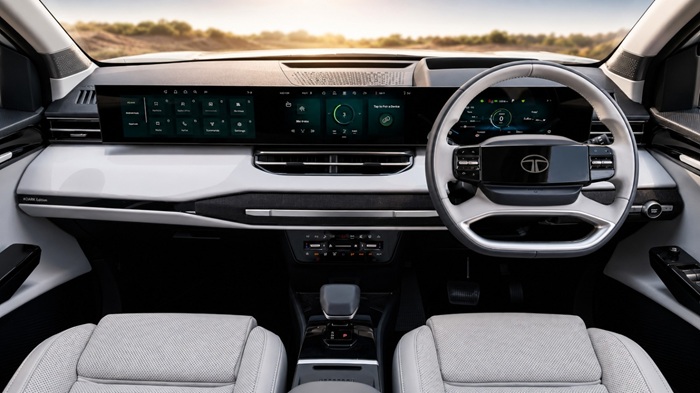
Step inside and the Sierra EV reveals a cabin that is considerably more advanced than anything associated with the original SUV.
The model shown here uses white leatherette upholstery, although black and fabric finishes are also available depending on the variant.
White interiors look elegant, spacious and expensive. They also reveal every encounter with chocolate, denim and enthusiastic children with forensic accuracy.
The dashboard has a wide horizontal layout dominated by the Horizon View Triple Screen Infotainment Experience.
There is a digital instrument cluster for the driver, a central infotainment screen and a separate passenger display. Three screens may sound excessive, but once household appliances receive Wi-Fi, the dashboard was never going to remain humble.
The design incorporates ambient lighting and floating door handrests, creating a lounge-like appearance.
The front seatbelts are height adjustable, while the steering column offers both tilt and telescopic adjustment.
Seats and Comfort
The driver receives a six-way electrically adjustable seat with memory and a welcome function.
There is also a thigh-support extender, particularly useful for taller occupants on long journeys. Tata describes it as a high-support extender, helping provide additional under-thigh support.
The front passenger receives a four-way power-adjustable seat.
Both front seats are ventilated, a feature that is considerably more valuable in an Indian summer than another decorative badge on the dashboard.
The rear bench provides a 60:40 split-folding configuration and two-stage reclining adjustment. A rear centre armrest with cupholders is also included.
The Sierra EV is fundamentally a five-seat crossover, and its long wheelbase and wide cabin should provide good passenger space. Tata has focused heavily on what it calls a “Luxury Lifespace,” meaning the cabin is intended not merely to transport passengers but to encourage them to remain inside discussing how many screens the vehicle has.
Climate Control and Air Quality
The Sierra EV receives dual-zone fully automatic temperature control.
Driver and passenger can select different temperature settings, allowing one person to recreate Shimla while the other prefers Chennai.
The system includes a cabin-sterilisation ioniser, a PM2.5 filter and Tata’s BreatheIQ air-purification technology.
There is also a cooled glovebox, useful for keeping beverages relatively chilled. It is not intended for ice cream, vaccines or family arguments.
An eight-way sliding sun visor provides greater flexibility in blocking sunlight, while the auto-dimming interior mirror reduces glare from vehicles behind.
Panoramic Sunroof
The voice-assisted panoramic sunroof features integrated ambient lighting.
Tata describes it as the largest sunroof in the segment, with a large glass area intended to improve the feeling of space inside the cabin.
Voice operation allows occupants to control the sunroof through spoken commands.
This is useful when both hands are occupied, although passengers should avoid casually discussing the roof in one of the supported languages unless they are prepared for unexpected ventilation.
Infotainment
The central 12.3-inch touchscreen supports wireless Android Auto and Apple CarPlay, USB connectivity, FM radio and connected navigation.
The system includes Harman AudioworX sound processing, Dolby Atmos and Tata’s Arcade.ev entertainment suite with more than 30 applications.
AirConsole allows compatible smartphones to function as game controllers. Drive Pay supports selected payments and transactions from within the vehicle.
The system also offers:
- Mappls navigation
- Amazon Alexa integration
- 5G connectivity
- Over-the-air software updates
- Valet Mode
- Relax Mode
- Personalised welcome messages
- MeSpace driver profiles
- More than 250 native voice commands
- Support for six languages
The passenger receives a separate 12.3-inch display, allowing the co-driver to manage entertainment and selected functions.
It is a clever idea because passengers frequently complain that the driver is controlling the music. Now they can select the music themselves, allowing disagreements to progress with greater technological efficiency.
Digital Instrument Cluster and Head-Up Display
A 10.25-inch digital instrument cluster provides speed, range, navigation prompts, energy information, ADAS status and other vehicle data.
The flagship variant also receives Tata’s HypAR head-up display.
It can present as many as 19 functions using multicolour guidance, helping the driver view key information without looking away from the road.
This may include speed, navigation directions, driver-assistance warnings and other contextual information.
The steering wheel is electrically power assisted and wrapped in leatherette. It includes controls for audio volume, phone functions, voice commands, infotainment and the adaptive cruise-control system.
JBL Black Audio System
The Sierra EV features a 12-speaker JBL Black sound system, developed with Harman.
The setup includes a subwoofer, Dolby Atmos, Harman AudioworX processing and a SonicShaft soundbar arrangement.
Tata’s Theater Pro experience combines the audio system, passenger screen and Arcade.ev applications to create an entertainment-focused cabin.
With 12 speakers and 5.1-channel-style Dolby Atmos processing, the Sierra EV should offer an immersive listening experience.
Of course, audio quality ultimately depends on the source material. Even a sophisticated JBL system cannot rescue a badly compressed voice note recorded beside a pressure cooker.
Connectivity
Tata’s iRA.ev connected-car application is included with a four-year complimentary subscription.
It provides smartphone access to approximately 70 connected functions, including:
- Remote lock and unlock
- Charging status
- Remote climate-control activation
- Trip planning
- Real-time energy monitoring
- Vehicle location
- Time fencing
- Geofencing
- Driving information
- Over-the-air updates
The ability to pre-cool the cabin remotely is particularly useful. Instead of entering a car that has been parked in the sun and experiencing instant spiritual purification, you can switch on the air-conditioning before reaching it.
Underneath these functions is Tata’s Intelligent Digital Architecture Layer, described as TiDAL 2.0, supported by 5G cloud connectivity and domain controllers.
Tata says the wider software architecture manages hundreds of millions of lines of code. That is impressive, although it also means your car now contains more software than the office computer that still asks to restart every Tuesday.
Access and Convenience
The Sierra EV includes an NFC card key in addition to smartphone-based digital access.
A wireless phone charger is provided, along with high-output USB Type-C ports for front and rear occupants.
The driver’s window offers one-touch up and down operation.
The transmission is a single-speed automatic reduction-drive system, as is conventional in modern battery-electric vehicles. There are no traditional gear changes and no clutch pedal.
Select Drive, press the accelerator and move away. It is straightforward, smooth and almost suspiciously easy.
Accessories
Tata offers a broad catalogue of accessories for Sierra customers.
Available items may include:
- Door-edge guards
- Rear entertainment screens
- Ceramic coating kits
- Air purifiers
- Car humidifiers
- Seat massagers
- Neck rests
- Inverters
- Floor mats
- Mobile chargers
- Key covers
- Blankets
- Bicycle carriers
- Umbrellas
- Additional speakers
- Microfibre cloths
- Vacuum cleaners
- Tyre inflators
- Dashcams
- Air fresheners
- Religious idols
- Valve caps
- First-aid kits
- Tissue boxes
- Waste bins
- Screen protectors
- Coffee makers
The accessory catalogue is so extensive that, with sufficient enthusiasm, you can leave the showroom with a Sierra EV, a portable café, a wellness centre and enough cleaning equipment to open a detailing studio.
Availability and compatibility will vary by model and dealership, so buyers should confirm the final list before ordering.
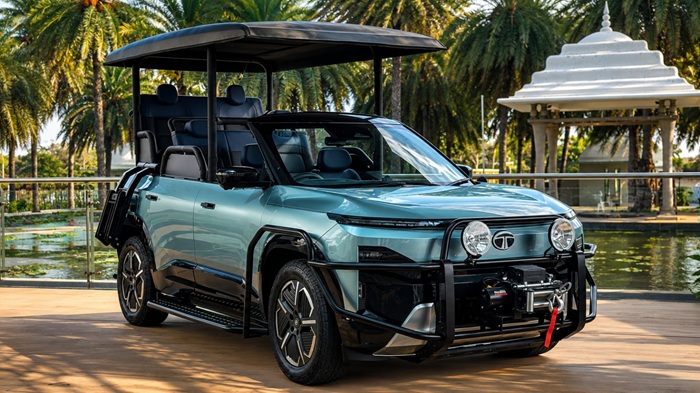
Sierra EV Sanctuary Edition
Tata has also displayed the fascinating Sierra EV Sanctuary Edition, created specifically for wildlife reserves, jungle safaris and specialised institutional use.
This is not simply a standard Sierra EV with a different seat cover. The rear body has been extensively reconfigured to create an open-air safari vehicle.
The concept features protective bull bars, underbody skid plates, side steps, all-terrain tyres and recovery equipment such as a winch.
At the rear, there is an anti-slip platform and a raised canopy roof. The passenger area uses theatre-style seating for as many as eight occupants, giving each row a better view of the surroundings.
The second-row seats can tumble to improve access, while dedicated mounting locations are provided for cameras and safari equipment. A compass is also included.
The concept can be tailored according to the operational requirements of wildlife resorts, forest departments and safari operators.
The absence of a conventional AVAS arrangement on a specialised display vehicle would only make sense in a controlled wildlife environment, where minimising noise is important. It should not be interpreted as a road-going consumer specification.
Tata has not announced an official retail price for the Sanctuary Edition. Depending on the conversion, equipment and institutional customisation, an estimated figure of approximately ₹22–25 lakh has been discussed, but it should be treated purely as an unofficial expectation.
The Sanctuary Edition remains a specialised concept rather than a standard showroom variant.
What Is the Sierra EV Like as a Complete Package?
The Tata Sierra EV attempts to combine five qualities that do not always cooperate with one another: space, range, performance, comfort and technology.
Its greatest achievement is that it does not feel like an electric version created as an afterthought.
The dedicated electric architecture allows Tata to provide rear-wheel drive, dual-motor QWD, a useful frunk, a flat cabin layout and serious charging capability.
The 75 kWh RWD model offers the longest claimed range, while the QWD provides strong acceleration and enhanced all-surface ability. The independent suspension, frequency-selective dampers and low-mounted battery should create a promising balance between ride comfort and body control.
Inside, the Sierra EV offers an enormous amount of equipment. Triple screens, ventilated electric seats, a head-up display, 12-speaker JBL audio, connected technology, air purification, ADAS and automatic parking make the flagship model feel genuinely premium.
There is also a reassuring level of practical engineering underneath the visible technology: liquid cooling, IP67 protection, four-wheel disc brakes, multi-level regenerative braking, sophisticated vehicle dynamics and a strong battery warranty.
Possible Concerns
The Sierra EV is not a small or simple car.
The 19-inch wheels could make replacement tyres expensive, and their effect on ride quality should be evaluated during a proper road test.
The large amount of software also means Tata must ensure consistent infotainment performance, reliable over-the-air updates and smooth electronic integration.
Real-world range will naturally be lower than the official figure in demanding conditions. High-speed driving, extreme temperatures, heavy loads and frequent acceleration can significantly increase energy consumption.
The top model’s ₹26.48 lakh ex-showroom price also places it near larger electric SUVs and several highly capable rivals.
However, the Sierra EV counters with a unique identity, strong equipment levels, serious range and a genuinely desirable cabin.
Verdict
The Tata Sierra EV is more than an old badge attached to a new crossover.
It successfully reconnects with one of India’s most recognisable SUV names while moving decisively into the electric age.
The design contains enough Sierra character to create nostalgia, but not so much that the vehicle feels trapped in the 1990s. The cabin is spacious, modern and loaded with technology. The QWD powertrain delivers performance that would once have belonged to expensive imported SUVs, while the 75 kWh RWD model offers a highly competitive claimed range.
Its greatest strength is versatility.
It can function as a comfortable family vehicle, a connected urban crossover, a long-distance electric tourer and—at least in QWD form—a surprisingly capable adventure SUV.
The Sierra EV does not merely offer an electric motor and a large touchscreen. It offers rear-wheel drive, optional dual-motor QWD, a 665 km maximum claimed range, rapid charging, independent suspension, a huge boot, a useful frunk and one of the most extensive feature lists in its segment.
Yes, there are three screens.
Yes, it can power appliances.
Yes, it can charge another EV.
Yes, it can park itself.
And yes, it has a Drift Mode.
The original Sierra became iconic by being different. The new Sierra EV follows the same philosophy, except now it arrives with 5G connectivity, Dolby Atmos and enough computing power to make the old Sierra believe it has encountered an alien civilisation.
The 2026 Tata Sierra EV is spacious, powerful, comfortable and unmistakably Indian.
The legend has not simply returned.
It has returned fully charged.