
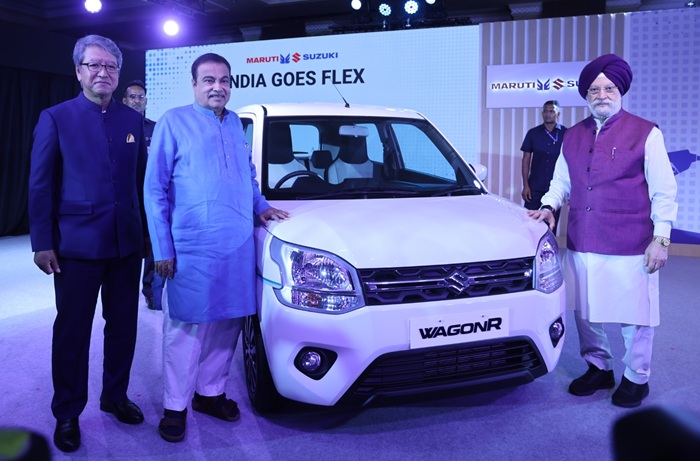
New Delhi: On the eve of World Environment Day, India’s clean mobility journey got a fresh ethanol-powered push as Maruti Suzuki India Limited launched the country’s first flex-fuel car in the presence of Union Minister for Road Transport and Highways Nitin Gadkari and Union Minister for Petroleum and Natural Gas Hardeep Singh Puri.
The company has introduced the flex-fuel technology in its popular Wagon R, a car that has already built a strong reputation in India’s alternative fuel space with CNG and LPG options. Now, with flex-fuel capability, the Wagon R is ready to sip anything from E20 to E100 ethanol-petrol blend, making it one of the most flexible members of the Indian car market. In simple terms, this is a Wagon R that is not fussy at the fuel pump.
A flex-fuel vehicle can run on different blends of ethanol and petrol, allowing customers to use fuel ranging from 20 percent ethanol blend to 100 percent ethanol. The technology is seen as an important step towards reducing India’s dependence on crude oil imports, lowering emissions and creating stronger demand for ethanol produced from agricultural sources.
The launch also aligns with the Government of India’s push for Atmanirbhar Bharat, energy security and cleaner mobility. By promoting ethanol as a mainstream automotive fuel, flex-fuel vehicles are expected to support farmers, strengthen the rural economy and reduce the country’s foreign exchange outgo on imported crude oil.
Speaking at the launch event, Nitin Gadkari, Minister of Road Transport and Highways, said, “India imports a large quantity of crude oil every year, and biofuels like ethanol are an important pathway towards reducing this dependence while strengthening our rural economy. Flex-Fuel Vehicles can create a strong and sustainable demand for ethanol, benefiting our farmers, industry, and the environment together. I appreciate Maruti Suzuki for taking this leadership step by introducing India’s first flex-fuel car and supporting the Government’s vision of clean and self-reliant mobility. I am confident that this initiative will encourage other car manufacturers to launch their flex-fuel models and oil industry to enhance ethanol distribution infrastructure.”
Hardeep Singh Puri, Minister of Petroleum and Natural Gas, remarked, “India’s ethanol journey is unstoppable. Under the leadership of Hon’ble Prime Minister Shri Narendra Modi, we have transformed our farmers from `annadatas’ to ‘urjadatas’, while strengthening India’s energy security. Flex-Fuel Vehicles are a win-win for the nation – reducing crude oil import dependence, saving valuable foreign exchange, lowering emissions, and creating new opportunities for rural prosperity. I congratulate Maruti Suzuki on taking this important step towards a cleaner, greener, and more self-reliant energy future.”
Maruti Suzuki said its flex-fuel initiative is part of its larger strategy to offer multiple technologies and fuel options for Indian customers. The company is working across battery electric vehicles, hybrids, CNG, compressed biogas and ethanol-based mobility solutions.
Hisashi Takeuchi, Managing Director & CEO, Maruti Suzuki India Limited, said, “At Maruti Suzuki, we are committed to offer cars with multiple technologies and fuels. The Company is introducing BEVs, Hybrids, CNG/CBG and ethanol flex-fuel vehicles to meet India’s twin goals of reducing oil import and carbon emissions. The ecosystem for ethanol as a fuel in India is in its early stages, and as a market leader, we think it is our responsibility to contribute to make `India Go Flex’. Once it reaches mainstream adoption, Flex-Fuel Vehicles have the potential to cut oil imports, carbon emissions, and local air pollution while enhancing domestic value addition and farmer incomes.”
Maruti Suzuki’s first flex-fuel car has been engineered specifically for compatibility with ethanol-blended fuel. The vehicle uses advanced ECU calibration that can automatically adapt to different ethanol-petrol blends between E20 and E100, ensuring smoother operation across varying fuel compositions.
The move is significant for India’s automotive industry, where fuel diversification is becoming as important as design, comfort and mileage. With ethanol gaining policy support and domestic production momentum, flex-fuel vehicles could emerge as a practical bridge between conventional petrol cars and the future of cleaner mobility.
For Indian customers, the technology promises greater fuel choice. For the country, it supports reduced oil imports and lower emissions. And for the humble Wagon R, it marks another career upgrade — from family hatchback to clean-fuel flagbearer. Not every boxy car gets to become a national energy-security statement.