
If there were ever a vehicle that could survive a zombie apocalypse, tow a house, climb a mountain, and still politely wait at a traffic signal without complaining—it would be the Toyota Hilux.
Born in 1968 and now flexing its muscles in its 9th generation avatar for 2026, the Hilux isn’t just a pickup truck—it’s a global legend with dirt under its nails and stories in its scars. From construction sites in Thailand to war zones, from Australian outback patrols to Instagram reels in Ladakh, the Hilux has done everything except maybe file income tax returns (and honestly, it probably could).
This latest generation, codenamed AN220 and designed by Nicolas Hogios, doesn’t try to reinvent the Hilux formula—it simply makes it sharper, tougher, and slightly more civilized… like a bodybuilder who now also reads philosophy.
Design: Built Like a Tank, Styled Like a Gentleman
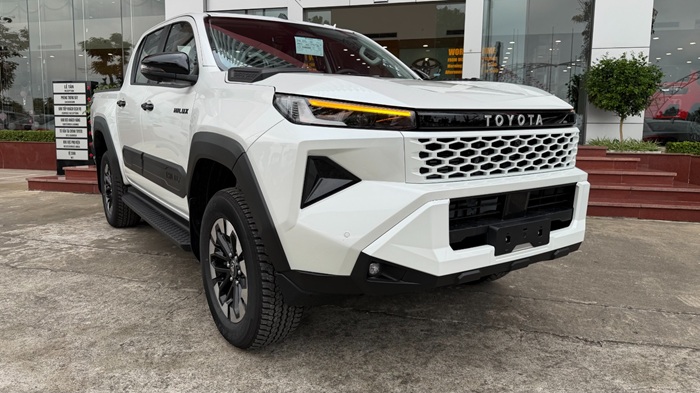
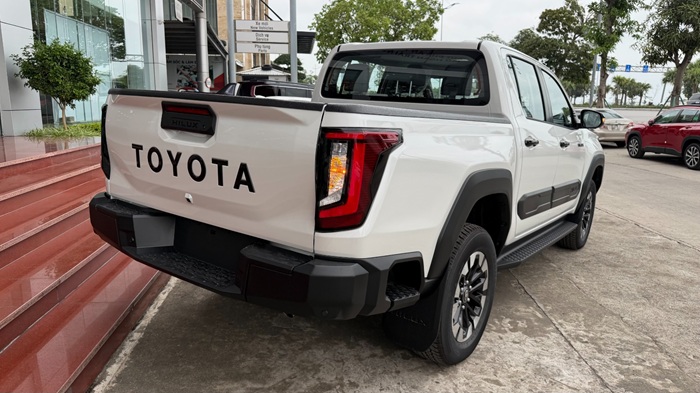
At 5.3 metres long, 1.9 metres wide and standing tall at 1.8 metres with a ground clearance of 312 mm, the Hilux doesn’t enter a road—it occupies it. The stance is unapologetically muscular, the kind that makes smaller SUVs quietly reconsider their life choices.
Up front, you get automatic LED projector headlamps with DRLs, auto high beam, leveling system and even a welcome function—because even a rugged pickup appreciates good manners. The rear gets LED combination lamps and a high-mounted stop lamp, completing a look that says: “Yes, I can tow 3.5 tonnes… but I’ll do it elegantly.”
The Trailhunter variant you’re looking at adds an extra dose of attitude—think of it as the Hilux that goes to the gym twice a day.
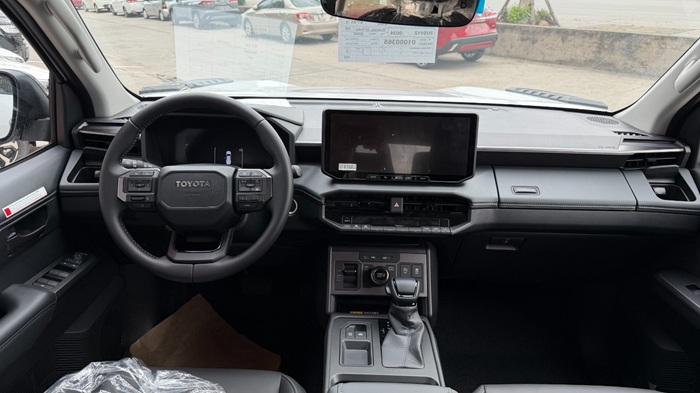
Interior: Surprisingly Plush for a Truck That Can Climb Mountains
Step inside and you realize this isn’t just a workhorse anymore—it’s a workhorse that discovered spa therapy.
Leather upholstery, a 10-way power adjustable driver seat, tilt and telescopic steering, and a dual-zone automatic AC with PM2.5 filter ensure that while the outside world is dusty and chaotic, the inside remains a calm, climate-controlled sanctuary.
The 12.3-inch touchscreen supports wireless Android Auto and Apple CarPlay, paired with an 8-speaker sound system. There’s also a 12-inch digital instrument cluster (with smaller displays on lower variants), wireless charging, auto-dimming IRVM, and even a coolbox—because nothing says “off-road adventure” like chilled beverages in the middle of nowhere.
And yes, there’s under-seat storage too—perfect for hiding snacks or, more realistically, tools.
Performance: Diesel Muscle, Petrol Simplicity, Electric Future
Under the hood, the star of the show is the legendary 2.8-litre 1GD-FTV diesel engine, producing 201 horsepower and a massive 500 Nm of torque (420 Nm in manual). This is the same engine trusted in icons like the Toyota Fortuner and Toyota Land Cruiser Prado—basically, it’s the engine equivalent of a seasoned army general.
Paired with either a 6-speed manual or automatic transmission, the Hilux isn’t about speed—it’s about unstoppable momentum. With an 80-litre fuel tank and around 13 kmpl efficiency, it’s built for long hauls and longer adventures.
You also get a petrol option with a 2.7-litre engine, and for the future-minded, an electric version with a 59.2 kWh battery is on the horizon, along with a hydrogen fuel cell variant expected by 2028. Because even legends evolve.
Off-Road Capability: Where the Hilux Becomes a Legend
This is where the Hilux stops being a vehicle and starts being a myth.
The part-time 4TREX four-wheel-drive system with an electronic transfer switch ensures you can tackle pretty much any terrain. Add to that five terrain modes—snow, mud, sand, dirt, and auto—and suddenly the road becomes optional.
Rear differential lock ensures both rear wheels rotate at the same speed, giving you maximum traction when things get tricky. Combine that with double wishbone suspension at the front and leaf springs at the rear, and you get a setup that can carry up to 1000 kg in the bed while still conquering rough terrain like it’s a casual Sunday drive.
And yes, it can tow up to 3500 kg—so if you ever decide to move your house, the Hilux is ready.
Safety: Tough Outside, Smart Inside
Safety isn’t just about toughness—it’s also about intelligence. The Hilux gets a 5-star rating from Australian NCAP, backed by Toyota’s GOA body structure.
You get 8 airbags, ABS, EBD, brake assist, stability control, hill start assist, downhill assist, TPMS, ISOFIX mounts, and a 360-degree camera.
On top of that, Toyota Safety Sense brings ADAS features like pre-collision system, lane departure alert, lane tracing assist, blind spot monitor, and rear cross-traffic alert. There’s even dynamic radar cruise control—so yes, this pickup truck can basically drive itself while you contemplate life choices.
Practicality: The Real Reason People Buy It
Let’s be honest—this is where the Hilux quietly wins.
A 470-litre cargo bed with a payload capacity of up to 1000 kg means you can carry everything from construction material to camping gear to your friend’s questionable life decisions.
Add accessories like canopy, snorkel, bull bar, roof rails, tow hooks, LED light bars, and even a cycle carrier—and suddenly the Hilux becomes whatever you want it to be: work truck, adventure machine, or Instagram influencer’s dream.
The Final Verdict
The Toyota Hilux is not trying to impress you with gimmicks. It doesn’t need to.
It’s a vehicle built on decades of trust, abuse, reliability, and global dominance. It’s the kind of machine that doesn’t ask, “Can I go there?”—it simply goes.
With prices expected between ₹22 lakh and ₹42.47 lakh (ex-showroom) and an India launch still awaited, the Hilux sits in that rare category of vehicles that are both aspirational and functional.
It’s not just a pickup truck.
It’s a lifestyle, a statement, and occasionally, a survival tool.