

Registered under Verra’s VCS program; to generate 1.7 lakh carbon credits over 10 years
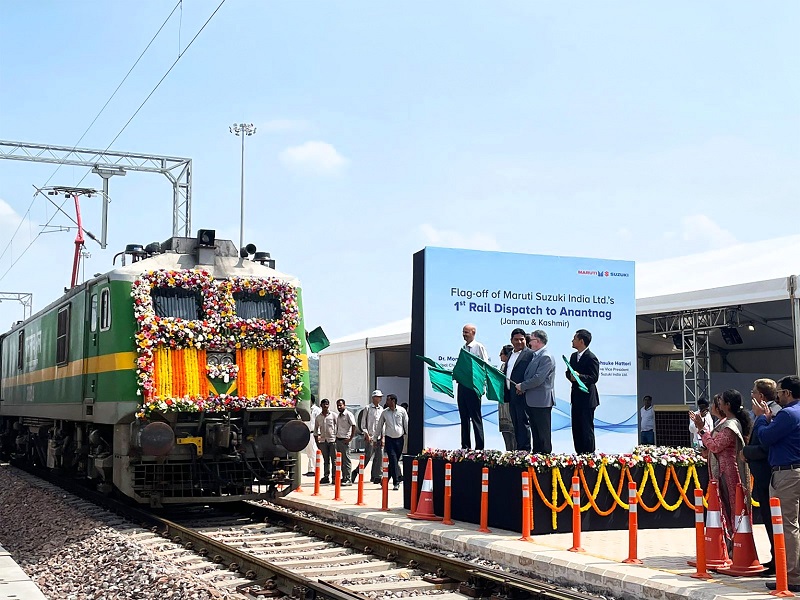
Ahmedabad/New Delhi: In a move that proves sustainability can run on steel tracks as smoothly as it runs on four wheels, Maruti Suzuki India Limited has announced that its Gujarat in-plant railway siding has been registered as the world’s first Modal Shift Transportation Project under the Verified Carbon Standard (VCS) program of Verra.
Yes, this isn’t just about building cars anymore — it’s about moving them smarter.
🚛➡🚆 From Highways to Railways: A Shift That Counts
The Gujarat in-plant railway siding project focuses on shifting vehicle dispatches from road to rail — a cleaner, more efficient mode of transportation. Over a 10-year crediting period (FY2023-24 to FY2032-33), the initiative is expected to reduce approximately 1.7 lakh tonnes of CO₂ equivalent emissions.
That’s not just good for business — that’s good for the planet.
Following independent verification of emission savings, Verra will issue around 1.7 lakh carbon credits to Maruti Suzuki under its VCS program — making this a global benchmark in sustainable automotive logistics.
In simple terms: fewer trucks on highways, more cars on rail wagons, and significantly lower emissions in the air.
📜 Backed by Global Climate Methodology
The emission reductions have been quantified using the AM0090 methodology under the Clean Development Mechanism (CDM) framework of the United Nations Framework Convention on Climate Change.
That means this isn’t just a PR-friendly green initiative — it meets internationally accepted carbon accounting standards.
What Maruti Suzuki Says
Mr. Hisashi Takeuchi, Managing Director & CEO of Maruti Suzuki India Limited, called it a “proud moment,” stating that the Gujarat railway siding demonstrates how scale, operational efficiency and environmental responsibility can seamlessly go hand in hand.
By leveraging rail transport’s inherent efficiency, the company has:
- Reduced the carbon footprint of logistics operations
- Eased road congestion
- Lowered fossil fuel consumption
- Contributed to India’s broader net-zero ambitions
And perhaps most importantly — proved that logistics innovation can be just as impactful as powertrain innovation.
🌍 Bigger Than Business: Alignment with UN SDGs
The project also contributes to key United Nations Sustainable Development Goals (SDGs), including:
- Good Health and Well-being (SDG 3)
- Decent Work and Economic Growth (SDG 8)
- Climate Action (SDG 13)
In an era where automotive headlines often focus on EV launches, hybrid debates, and horsepower figures, this milestone quietly reminds us that sustainability isn’t only about what powers the car — it’s also about how the car reaches you.
The Larger Message
For an automaker that dispatches millions of vehicles annually, logistics is no small matter. By integrating rail connectivity directly within its Gujarat plant, Maruti Suzuki has effectively turned infrastructure planning into a climate strategy.
It’s a subtle but powerful shift: while cars may still compete on torque, range, and features, companies are increasingly competing on carbon.
And in this race, Maruti Suzuki has just secured a global first — not on a racetrack, but on railway tracks.