


New Delhi: Maruti Suzuki India Limited has crossed one million cumulative vehicle dispatches through its in-plant railway sidings at Hansalpur in Gujarat and Manesar in Haryana, marking a major expansion of the automaker’s use of rail for transporting finished vehicles.
Of the 10 lakh vehicles dispatched through the two facilities, around 7.9 lakh were transported from the Gujarat railway siding, while the Manesar siding accounted for approximately 2.1 lakh vehicles.
The milestone comes three years and five months after operations began at the Gujarat siding in March 2023. The Manesar facility, which started operations in June 2025, has contributed more than two lakh vehicle dispatches in a little over a year.
Maruti Suzuki said 70% of its total rail-based vehicle dispatches in FY 2026-27 so far have been handled through the Gujarat and Manesar in-plant railway sidings.
During the current financial year up to August 31, the company has dispatched more than 3 lakh vehicles through rail.
Rail Share Rises to 26.5%
Rail has gradually become a larger part of Maruti Suzuki’s vehicle logistics network. The company said the share of vehicles dispatched by rail increased from 5% in FY 2014-15 to 26.5% in FY 2025-26.
Since FY 2014-15, Maruti Suzuki has cumulatively transported more than 3.3 million, or 33 lakh, vehicles by rail.
Of these, 10 lakh vehicles were dispatched directly through the company’s in-plant railway sidings in Gujarat and Manesar. The remaining rail shipments were handled through loading terminals located outside its manufacturing plants.
Speaking on the milestone, Hisashi Takeuchi, Managing Director & CEO, Maruti Suzuki India Limited, said, “Reaching one million cumulative vehicle dispatches through our in-plant railway sidings marks a landmark achievement in our green logistics journey. Developed under the PM GatiShakti National Master Plan, these sidings demonstrate how integrated multi-modal infrastructure can deliver both operational efficiencies and environmental benefits. With our Gujarat and Manesar in-plant railway sidings contributing to 70% of total rail-based dispatches in the current fiscal, we are making strong progress in scaling up rail-based vehicle transportation.”
He added, “Our share of rail-based vehicle dispatches has grown from 5% in FY 2014-15 to 26.5% in FY 2025-26. Our mid-term goal is to increase rail-based vehicle dispatches to 35% by FY 2030-31 # through continued investment in rail infrastructure, including an in-plant siding at our new Kharkhoda facility. This will improve the efficiency of our sustainable logistics network and support India’s Net Zero ambitions.”
Kharkhoda Railway Siding Planned
Maruti Suzuki plans to further expand its rail logistics network with an in-plant railway siding at its new Kharkhoda manufacturing facility.
The company is targeting a 35% share for rail-based vehicle dispatches by FY 2030-31, compared with 26.5% in FY 2025-26.
Maruti Suzuki said moving more finished vehicles from road to rail helps reduce fuel consumption, greenhouse gas emissions and pressure on highways. It also cuts out an additional road-transport leg when trains can be loaded directly inside the manufacturing facility.
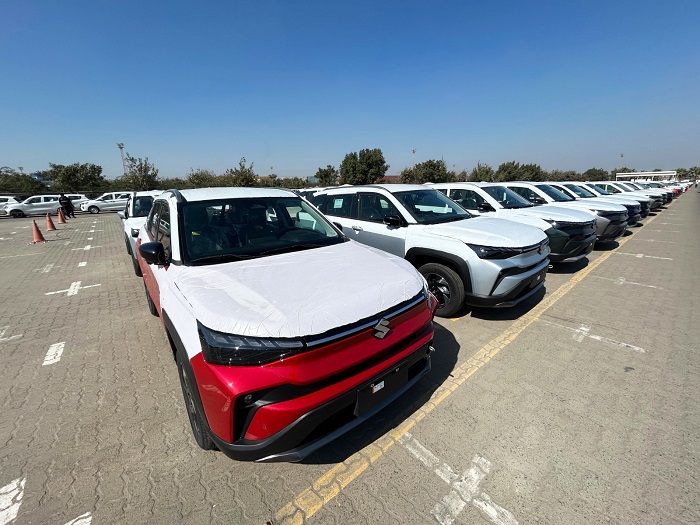
An in-plant railway siding is essentially a dedicated rail terminal within a factory complex. Vehicles can be loaded onto trains after production without first being transported by truck to an external railway terminal — a relatively simple logistical change that can save a considerable number of truck kilometres when applied at Maruti Suzuki’s scale.
The company says it is the first and only passenger vehicle manufacturer in India to operate in-plant railway sidings at its manufacturing facilities in Hansalpur and Manesar.
As Indian automakers increase production volumes and widen their distribution networks, rail transportation is emerging as an increasingly important part of vehicle logistics. For Maruti Suzuki, the 10-lakh milestone reflects a broader shift towards moving more cars by train — easing some of the burden on roads while making large-scale vehicle movement more efficient.