
There are SUVs designed to slip quietly into urban life, squeeze politely between hatchbacks and convince you that sitting 30 mm higher somehow counts as adventure. And then there is the Mahindra Scorpio-N. Nearly 4.7 metres long, close to two tonnes in weight and still built around a proper body-on-frame chassis, it approaches the mid-size SUV formula with all the subtlety of someone arriving at a dinner party wearing hiking boots. In India, that is precisely why it works.
The Scorpio name has been around since 2002 and has become one of Mahindra’s most recognisable badges. The original shape became part rural workhorse, part political convoy favourite and part family express; few vehicles have managed to collect such a wonderfully diverse résumé. The older-generation Scorpio survives today as the Scorpio Classic, with prices starting at ₹13.37 lakh, while the Scorpio-N represents the more sophisticated branch of the family tree.
What we have here is the updated 2026 version of the second-generation Scorpio-N, internally known by the Z101 codename. The model sits on Mahindra’s body-on-frame architecture, associated with the company’s rugged SUV family including the Scorpio, Thar and Thar Roxx. Mahindra and Pininfarina worked together on its development, while the design was led by Pratap Bose, whose portfolio includes the Mahindra BE 6, XEV 9e and Thar Roxx as well as the Tata Nexon, Harrier and Safari.
It is assembled at Mahindra’s Chakan facility near Pune and has grown well beyond being merely an Indian-market phenomenon, with the Scorpio-N also exported to markets including South Africa, Australia and New Zealand. More than 3.80 lakh examples have been sold according to the supplied figures, putting it among India’s more popular SUVs. It has also collected its share of SUV and family-SUV awards along the way.
Yet the statistic that matters most isn’t sales, horsepower or screen size. It is that Mahindra has resisted turning the Scorpio into another monocoque crossover wearing an unnecessarily adventurous expression. Beneath all the digital instruments and panoramic glass remains a large rear-wheel-drive SUV built around a high-strength steel, third-generation frame.
That matters.
Plenty of Scorpio for the money
The 2026 Scorpio-N range begins at ₹13.69 lakh ex-showroom, while the upper end reaches ₹25.49 lakh. Mahindra’s current listings confirm both those figures, with the latter applying to the Z8L diesel 4WD automatic.
Our subject is the fully equipped Z8L specification in rear-wheel-drive form. Buyers who actually need to disappear beyond the end of Google Maps can specify Mahindra’s 4Xplor four-wheel-drive system on the diesel, while both six- and seven-seat configurations are available. This particular vehicle is the seven-seater.
That breadth is important because the Scorpio-N can be several quite different things depending on configuration. At one end it is a relatively affordable, big, seven-seat family SUV; at the other it becomes an expensive, equipment-heavy diesel 4×4. Petrol and diesel engines are available, both with six-speed manual and six-speed automatic transmission choices.
And no, ₹25 lakh-plus is no longer shocking money for an Indian SUV. The alarming part is how quickly the industry has trained us to say that sentence without spilling our tea.
It still looks like a Scorpio — fortunately
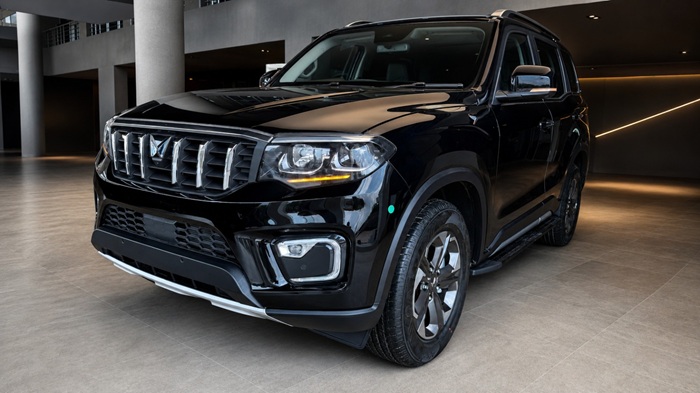
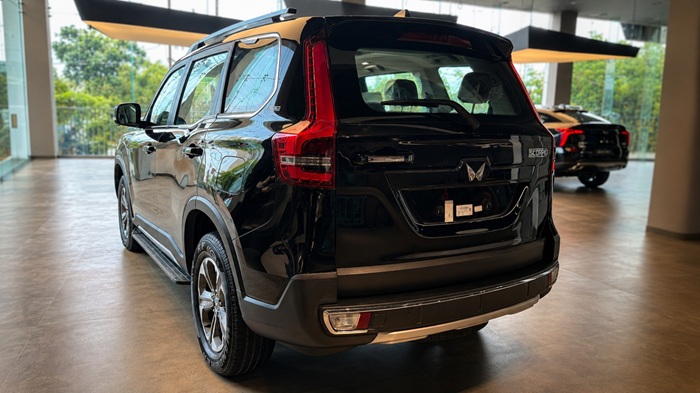
Stealth Black is an appropriate colour for the Scorpio-N, although “stealth” may be optimistic for something this large. Green, white, blue and grey choices are also available, but black emphasises its height and the considerable amount of visual mass above the wheels.
The nose remains upright and deliberately imposing. A chrome grille dominates proceedings, flanked by dual-barrel automatic LED projector headlamps with high-beam assist. Sting-like LED daytime-running lights and sequential LED indicators add some modern theatre without completely overwhelming the underlying SUV shape.
Below sit LED projector fog lamps and a silver skid-plate treatment. Whether that plate spends more time reflecting shopping-centre lighting than Himalayan rocks depends entirely on the owner, of course.
Above it all is the high-set sculpted bonnet. This is important because the bonnet is a major part of the driving experience in a Scorpio-N. You don’t merely know there is a vehicle ahead of you; you can see a substantial amount of Mahindra between yourself and the road. There is something satisfying about that in an era when so many SUVs leave you staring at the base of the windscreen wondering where the car ends.
The profile is unapologetically tall. There is the familiar metallic Scorpio-tail design element, large wheel arches and enough glass area to stop the cabin feeling like a bunker. Electrically adjustable, power-folding mirrors incorporate LED indicators and cameras, while rain-sensing wipers take care of the unpredictable business falling from the Indian sky.
The Z8L shown here wears new 18-inch diamond-cut alloy wheels with 255/60 R18 108H MRF Wanderer A/S all-season steel-belted radial tubeless tyres at both ends. Lesser variants can be had with 17-inch alloys or steel wheels. There is an 18-inch spare as well, rather than one of those emergency biscuits that look as though they were borrowed from a wheelbarrow.
Disc brakes are fitted front and rear.
At the back, tall stacked LED tail-lamps continue one of the Scorpio’s most identifiable design signatures. The treatment works because Mahindra hasn’t tried too hard to erase the vehicle’s ancestry. A rear wiper and washer plus defogger take care of practical duties.
Overall, the Scorpio-N isn’t beautiful in the classical sense. It is too tall, too square and far too pleased with its own shoulders for that. But it has presence, and presence is far more useful when you’re selling a Scorpio.
Big, but not absurdly big
Mahindra lists the Scorpio-N at 4,662 mm long, 1,917 mm wide and 1,857 mm tall, with a 2,750 mm wheelbase. The supplied specifications quote 200 mm of ground clearance and a kerb weight of roughly 2,000 kg.
Translated from specification-sheet dialect, it is a substantial machine.
The width is noticeable in tight city streets, and you will appreciate the cameras and parking sensors when threading one through basement parking built during an era when architects apparently assumed everyone would eventually drive a Maruti 800. Yet at 4.66 metres, it isn’t freakishly long by modern SUV standards.
The tall roof is more significant. It creates the upright, commanding driving position buyers expect from a Scorpio, while also helping provide useful headroom inside.
Boot space with all three rows erected is quoted at just 120 litres. That is seven-seat-SUV language for “pack lightly”. Fold the third row, however, and available space grows dramatically to 786 litres. So the Scorpio-N can carry seven people or a considerable amount of luggage; expecting it to do both simultaneously requires either careful packing or an optimistic understanding of geometry.
The fuel tank holds 57 litres.
No payload figure has been supplied for this specification, and inventing one merely because the Scorpio-N looks capable of carrying half a building would be unhelpful.
A cabin that has grown up with the rest of the car
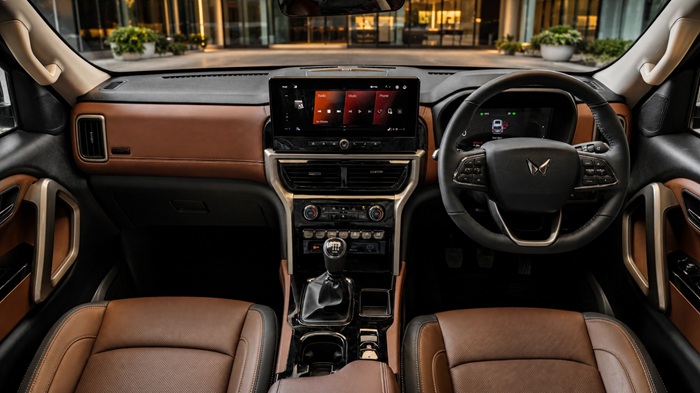
This is where the transformation from old Scorpio to Scorpio-N is perhaps most obvious. The cabin isn’t trying to imitate a German luxury SUV, nor should it, but it is considerably more sophisticated than the agricultural reputation attached to earlier Scorpios might suggest.
Brown leatherette upholstery gives the Z8L a richer atmosphere, while fabric is used in lower specifications. The colour choice brings some warmth to a cabin that could otherwise become a fairly dark collection of screens and plastics.
The dashboard remains tall and substantial, matching the exterior rather than pretending the car is a sporty hatchback underneath. You sit high, with the road laid out below and plenty of SUV around you. Visibility benefits from the upright glasshouse, though the sheer dimensions mean electronic assistance is still welcome in tight spaces.
The driver gets a six-way electrically adjustable seat, while the front seats offer height adjustment, lumbar support and ventilation. Seat ventilation in an Indian summer is one of those features that sounds indulgent until you’ve owned it, after which you begin regarding cars without it as minor human-rights violations.
The electrically assisted steering adjusts for tilt. It also houses the expected phone, volume, voice, infotainment, instrument-cluster and cruise-control switches, reducing the need to repeatedly stab at the touchscreen.
And that screen is now difficult to miss.
At 12.3 inches, the floating HD infotainment display is considerably larger than the earlier setup and uses a Qualcomm 6155 chipset. Mahindra’s official current listing confirms the 12.3-inch unit on the Z8L.
It supports wireless Android Auto and Apple CarPlay, Alexa built-in voice control, navigation, e-SIM connectivity, Bluetooth, internet functions, USB connectivity, FM/radio and the more adventure-flavoured displays including altitude, compass and g-force information.
There are also Adventure Statistics, because apparently no mountain journey is complete until you’ve converted it into data.
Lower variants receive 9-inch or 8-inch infotainment systems depending on specification.
Ahead of the driver sits a 10.24-inch HD digital instrument cluster; lower versions use a 4.2-inch TFT arrangement. A proper digital cluster suits the updated cabin and provides a suitable home for navigation and ADAS information without forcing the driver to keep looking sideways.
Wireless phone charging is included and, importantly, comes with active cooling. Anyone who has watched a smartphone become an induction hob after an hour on a badly designed wireless charging pad will understand why that detail matters.
Dual-zone fully automatic climate control deals with temperature, while an auto-dimming interior mirror handles the gentleman behind you who believes high beam is a personality trait.
Above is Mahindra’s panoramic “Skyroof”. Whether you consider a panoramic sunroof essential on a ladder-frame SUV is between you, your children and the Indian summer, but it certainly brightens the cabin.
Seven seats, with the usual seven-seat caveat
The second-row seats feature a touch-tumble function to improve access to the third row, while the rearmost seats themselves fold and tumble.
As in most three-row SUVs of this footprint, the first two rows are where adults will want to spend longer journeys. The third row adds valuable flexibility for children, shorter trips or occasional extra passengers rather than magically turning a 4.6-metre SUV into a minibus.
Customers who prioritise second-row comfort can choose a six-seat configuration instead.
The combination of the tall roof, wide body and upright architecture gives the interior a reassuring sense of space, and the Scorpio-N feels like a vehicle designed around people rather than merely around a sweeping dashboard sketch.
Front anti-pinch power windows are fitted, while UV- and infrared-cut side glass should reduce some of the heat load. Storage and charging provisions make it fundamentally suited to family travel, even if luggage capacity with seven occupants remains its obvious practical weakness.
For entertainment, the Z8L gets a 12-speaker Sony 3D Immersive audio system with a dual-channel subwoofer. It is the sort of feature that can make a long highway run rather more civilised — or enable your children to reproduce a nightclub at 8:15 on a Sunday morning.
Connected, assisted and increasingly digital
AdrenoX connected-car technology comes with a two-year complimentary subscription and allows access to more than 70 connected functions through a smartphone.
There is useful technology here, but the Scorpio-N isn’t dependent upon screens for its identity. That is an important distinction. Remove the display from some modern SUVs and there isn’t much personality left. Remove the screen from this and you still have a rear-driven, ladder-frame Mahindra weighing around two tonnes.
The Z8L also receives Level 2 ADAS. Mahindra introduced the system to the premium Scorpio-N range with Forward Collision Warning, Automatic Emergency Braking, Adaptive Cruise Control, Smart Pilot Assist, Lane Departure Warning, Lane Keep Assist, Traffic Sign Recognition, Speed Limit Assist and Front Vehicle Start Alert among the available functions. Some functions depend on the automatic-transmission specification.
ADAS can be genuinely useful on long expressway journeys, particularly adaptive cruise and collision mitigation. On chaotic urban roads, however, the quality of any assistance system is defined not by how many acronyms fit in the brochure but by how intelligently it interprets motorcycles, pedestrians, wandering lane markings and traffic that regards a two-second following gap as unused real estate.
The diesel still feels like the natural Scorpio engine
The most powerful diesel is Mahindra’s 2.2-litre, inline-four, all-aluminium mHawk common-rail direct-injection unit.
It produces 172 hp in the supplied specification. Torque depends on transmission: 370 Nm with the six-speed manual and 400 Nm with the six-speed automatic. Mahindra’s current technical listing similarly specifies 370 Nm for the manual and 400 Nm for the automatic.
Those figures suit the Scorpio-N’s character rather better than an obsession with 0–100 km/h numbers would.
This is a heavy, tall, seven-seat SUV, and torque is what makes it feel relaxed. The diesel’s ability to produce a substantial shove without being wrung towards the redline is exactly what you want when the car is loaded with passengers and luggage or when you need to get around a slow-moving truck on the highway.
With 400 Nm in automatic form, acceleration is about the sensation of the whole vehicle gathering itself and moving forward with authority rather than snapping your neck. There is enough mid-range muscle to make overtaking straightforward, and that reserve of torque is far more valuable in everyday India than shaving a few tenths from a launch-control statistic that doesn’t exist.
No 0–100 km/h or top-speed figure has been supplied here, so we aren’t going to manufacture one for the sake of appearing scientific.
There is also a lower-output version of the 2.2-litre mHawk diesel producing 130 hp and 300 Nm, quoted at 15 km/l. That engine gives buyers a more modest route into diesel Scorpio ownership.
The stronger 172 hp diesel is quoted at 14 km/l and uses the same 57-litre tank.
The alternative is Mahindra’s 2.0-litre turbocharged direct-injection mStallion petrol, another inline four-cylinder unit. It develops 200 hp, with 370 Nm in manual form and 380 Nm with the automatic.
That engine has the bigger headline horsepower figure and offers the more enthusiastic performance proposition, but physics still sends an invoice eventually. The supplied fuel-consumption figure is around 12 km/l.
For drivers covering substantial highway distances, the diesel’s torque and economy remain easy to understand. Those with lower annual mileage, a preference for petrol refinement and less concern for fuel consumption may find the 200 hp mStallion appealing.
Both petrol and diesel powertrains are offered with six-speed manual and six-speed automatic transmissions.
Rear-wheel drive makes a difference
The version considered here is rear-wheel drive, something increasingly unusual among family SUVs around this money.
Most of the Scorpio-N’s direct three-row competitors are built around front-driven monocoque platforms. The Scorpio’s layout changes its personality. You sense that the rear axle is part of the propulsion story rather than simply being towed around behind the front wheels.
It doesn’t suddenly turn a nearly two-tonne seven-seat Mahindra into a sports saloon — somebody at the Nürburgring can relax — but the traditional drivetrain layout contributes to the honest mechanical character that distinguishes it from softer crossovers.
Three drive modes are offered: Zip, Zap and Zoom. Mahindra describes Zip as the smoother mode for traffic, Zap as the more typical SUV performance setting and Zoom as the more enthusiastic option.
The names are slightly cartoonish, but the principle is sensible: alter response according to circumstance without demanding that the driver complete a postgraduate degree in vehicle dynamics.
This is where the chassis engineering matters
A tall body-on-frame SUV can go wrong remarkably quickly if suspension tuning is treated as an afterthought. Too soft and it wallows. Too stiff and every bad expansion joint makes the occupants wonder who offended the chassis engineer.
Mahindra uses double-wishbone front suspension with coil-over dampers, while the rear receives a Pentalink arrangement with a Watt’s linkage. Frequency Dependent Damping is fitted at both ends, alongside Mahindra’s Multi-Tuned Valve Concentric Land, or MTV-CL, damper technology. The same fundamental specification is shown in Mahindra’s current technical data.
That is a lot of terminology for suspension components whose ultimate job is simple: make a large ladder-frame SUV behave with some dignity.
The Scorpio-N cannot hide its height or mass completely. Nor should you expect it to. Direction changes remind you that there is close to two tonnes moving several feet above the road, and anyone trying to drive one like a hot hatch has misunderstood both the car and probably the laws of physics.
But the sophisticated suspension layout is there to control that mass while retaining the resilience required for India’s broken surfaces.
Its 200 mm ground clearance gives it useful breathing room over deep potholes and overenthusiastic speed breakers. The 255/60 R18 tyres are also sensibly substantial; there is enough sidewall to absorb punishment rather than sacrificing everything at the altar of enormous wheels.
At highway speeds, the long wheelbase and sheer mass should naturally work in favour of stability, while four-wheel disc brakes provide the necessary stopping hardware.
Electric power steering reduces the low-speed effort that an older-school SUV could demand. Don’t come expecting sports-car feedback, but for a machine intended to spend its life moving between congested cities, open expressways and poor roads, usability matters more than delicately communicating the exact texture of every pebble through the steering rim.
And if you actually intend to leave the road…
The diesel 4Xplor models are the serious toys in the range.
They receive a selectable shift-on-the-fly four-wheel-drive system, four terrain modes and an Electronic Brake Locking Differential. Mahindra has previously identified the terrain selections as Normal, Snow, Mud & Ruts and Sand.
That gives the Scorpio-N abilities many similarly priced three-row SUVs simply aren’t engineered to offer.
This distinction is important. A Tata Safari, Hyundai Alcazar or MG Hector Plus may be easier to regard as a conventional urban family crossover, but none approaches the Scorpio-N with the same ladder-frame, rear-drive-and-available-4×4 mechanical philosophy.
Approach angle, departure angle, breakover angle and water-wading figures were not supplied in the material for this review, so they won’t be guessed. But the architecture itself — clearance, frame, optional 4WD and terrain management — makes clear that the Scorpio-N’s off-road credentials extend considerably beyond fitting black plastic cladding and photographing the car beside a tent.
The complicated safety story
Safety requires more explanation than a single star graphic.
The Scorpio-N achieved five stars for adult occupant protection in Global NCAP testing, although its child-occupant score was three stars. Global NCAP noted that the vehicle it assessed was tested in its basic safety specification.
ANCAP in Australia, however, awarded the Scorpio a zero-star rating under its 2023 protocol. That assessment recorded 44% for adult occupant protection, 80% for child occupant protection, 23% for vulnerable-road-user protection and zero for Safety Assist. The Australian/New Zealand specification tested at the time lacked key autonomous emergency braking and lane-support functions required by ANCAP’s criteria.
Therefore, “five stars in India and zero in Australia” should not be interpreted as two laboratories looking at the same specification under an identical scoring system and somehow reaching opposite conclusions. They used different protocols, and equipment specifications also matter.
The current Indian Z8L has moved considerably further on the active-safety front. In addition to its Level 2 ADAS suite, the equipment supplied here includes six airbags, ABS, EBD, Electronic Stability Control, Hill Hold Control, Hill Descent Control, Driver Drowsiness Detection and tyre-pressure monitoring.
There is a 540-degree surround-view system, blind-view monitor, front and rear parking sensors and ISOFIX child-seat mounting. Three-point seatbelts are provided, with front pretensioners, while passive keyless entry also forms part of the specification.
This is a far more complete safety package than simply pointing at one historic crash-test result — positive or negative — would suggest. But buyers should still understand exactly which vehicle and protocol each rating refers to rather than treating all five-star badges as interchangeable currencies.
Living with it
The Scorpio-N’s strongest argument as a family vehicle may be its breadth.
It can take seven people, tow around a large body-on-frame chassis every day without feeling apologetic about it, deal with rough roads, offer proper 4WD if required and still give the family ventilated front seats, dual-zone climate control, panoramic glass, a large touchscreen, connected functions and a 12-speaker Sony system.
There is also an extensive accessories catalogue encompassing seat covers, mud flaps, chrome garnishes, bumper protectors, bug deflectors, a fender mirror, body cover, roof carrier, pedal covers, scuff plates, sunshades, a comfort kit and floor mats.
You could probably continue accessorising until the Scorpio develops its own gravitational field.
What has not been supplied here are current warranty terms, service intervals or extended-warranty pricing, so those are better confirmed from Mahindra at the time of purchase rather than filled in from assumption.
Mahindra’s broad SUV presence and the sheer number of Scorpios already on Indian roads are at least evidence that this isn’t some experimental niche product. The name has been around for more than two decades, and the Scorpio-N itself has become a mainstream sight remarkably quickly.
But there is serious competition
The Scorpio-N no longer occupies a quiet corner of the SUV market.
If maximum cabin sophistication, car-like road manners and a monocoque architecture appeal more, the Tata Safari deserves consideration. It feels like a different interpretation of the three-row SUV — more crossover, less traditional off-roader.
The Hyundai Alcazar is the more urban proposition. It doesn’t possess the Scorpio’s rugged mechanical character or rear-drive layout, but buyers primarily interested in polished city manners, family-friendly features and easier day-to-day use may find its approach more appropriate.
The MG Hector Plus leans heavily towards comfort, cabin technology and the big-screen school of SUV design. For someone whose adventures predominantly involve restaurants, airports and intercity expressways, that may be entirely sensible.
Then there is Mahindra’s own XUV 7XO, effectively the Scorpio-N’s awkwardly talented relative across the showroom. In current segment comparisons it sits against the Safari, Alcazar and Hector Plus as a more road-focused monocoque SUV.
The Scorpio-N’s counterargument to all of them is wonderfully uncomplicated: rear-wheel drive, a ladder frame, powerful 2.0-litre petrol and 2.2-litre diesel engines, and proper four-wheel drive if you want it.
It offers something mechanically different rather than merely another arrangement of screens, seats and ambient lighting.
Verdict
The 2026 Mahindra Scorpio-N is interesting because modernisation hasn’t completely civilised it.
The enormous new infotainment screen, digital instruments, connected-car technology, panoramic sunroof, ventilated seats and Level 2 ADAS all move it firmly into contemporary SUV territory. Yet underneath, it remains a large, tall, rear-wheel-drive machine built around a high-strength frame. That combination is becoming rare.
There are compromises. With seven seats occupied, the 120-litre boot is little more than an argument for travelling light. Its roughly two-tonne mass will always be present in corners. The width demands concentration in older car parks and narrow streets. A petrol version with 200 hp will not suddenly acquire the appetite of a hatchback just because the drive mode says Zoom. And shoppers who never intend to leave smooth tarmac may reasonably decide that a lighter monocoque rival is the more logical tool.
Logic, however, has never completely explained the Scorpio.
The 2.2-litre diesel suits it particularly well because the generous 370-400 Nm of torque matches the vehicle’s unhurried, muscular character. Specify the 4Xplor system and you have genuine mechanical capability beneath the family-SUV equipment; choose rear-wheel drive and you retain most of the personality without paying for off-road hardware you may never use.
At ₹13.69 lakh to ₹25.49 lakh ex-showroom, the range covers an enormous amount of territory, and the upper variants are no longer cheap. But the Z8L at least feels like more than a lower specification with extra chrome scattered over it. The technology, cabin equipment, safety hardware and chassis specification make a meaningful difference.
More importantly, the Scorpio-N has not forgotten why people wanted a Scorpio in the first place.
It is still a little oversized for the city, slightly theatrical in Stealth Black and far more serious mechanically than the average school-run SUV needs to be. Good.
Buy the Safari, Alcazar, Hector Plus or Mahindra’s own XUV 7XO if your priorities lean more heavily towards the behaviour of a sophisticated road-biased crossover. Buy the Scorpio-N if you want your seven-seat family car to retain some old-fashioned SUV DNA — a high bonnet in front of you, driven wheels behind you and the comforting knowledge that the road becoming terrible does not necessarily mean the journey has to stop.
After more than two decades, the Scorpio has finally learnt table manners.
Thankfully, it still hasn’t taken off the hiking boots.