

McLaren Automotive has unveiled the 788HS, a limited-production supercar positioned as the final and most performance-focused evolution of the model family that began with the 720S and later produced the 765LT and 750S.
Powered by a 4.0-litre twin-turbocharged V8 engine developing 788PS and 800Nm of torque, the 788HS can accelerate from zero to 100km/h in 2.8 seconds and reach 200km/h in 7.0 seconds. Its claimed top speed is 330km/h, or 205mph.
Production will be limited to 200 vehicles worldwide, divided equally between Coupe and Spider body styles. McLaren said every example will be individually configured through its McLaren Special Operations division, better known as MSO.
The 788HS weighs 1,265kg in dry specification, giving it a power-to-weight ratio of 623PS per tonne. According to the company, this is the highest figure achieved by any member of the 720S, 750S and 765LT series.
The new model also becomes only the third McLaren to carry the “High Sport” designation. The badge previously appeared on the MP4-12C HS and the MSO HS, making it a considerably rarer sight than the average supercar badge — not that McLarens are commonly mistaken for average cars.
“The new McLaren 788HS has been designed and engineered with a singular focus; to deliver a visceral experience and captivating drive through its precise balance of performance, sound, dynamism and individuality. It represents the ultimate expression of our supercar series that began with the 720S and becomes only the third McLaren to wear our HS designation – a fitting finale for a much loved and critically acclaimed car,” said Henrik Wilhelmsmeyer, Chief Commercial Officer, McLaren Automotive.
More downforce and an F1-inspired diffuser
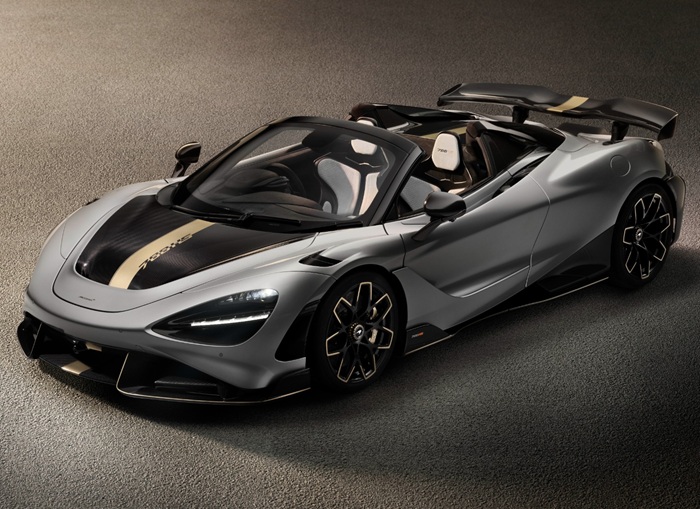
McLaren has equipped the 788HS with what it describes as the most advanced aerodynamic package yet fitted to the platform. The system is claimed to generate 10% more downforce than the 765LT while maintaining the car’s aerodynamic balance.
Major components include a multi-zone front splitter, a new S-Duct bonnet, a raised active rear spoiler and a Formula 1-inspired rear diffuser. A louvred under-wing panel has also been incorporated to support powertrain cooling and aerodynamic efficiency.
All elements of the dedicated HS aerodynamic package are made from carbon fibre.
Coupe versions receive a roof scoop finished in gloss black, while buyers can specify full Visual Carbon Fibre bodywork covering every exterior panel. The exposed-carbon option will be offered in gloss or satin finishes.
Inside, the driver-focused cabin features a lightweight carbon-fibre centre console, model-specific HS branding, a dedicated upholstery perforation pattern and an individual plaque.
The instrument display remains mounted to the steering column, while powertrain and handling mode controls are positioned on the steering wheel. The equipment list also includes McLaren Infotainment System II and the McLaren Control Launcher.
788PS twin-turbocharged V8
The 788HS uses McLaren’s M840T 4.0-litre twin-turbocharged V8, featuring lightweight forged pistons, ultra-low-inertia twin-scroll turbochargers and twin fuel pumps.
The engine produces its peak 788PS, equivalent to 777bhp, at 7,500rpm. Maximum torque of 800Nm arrives at 5,500rpm, while the engine can continue spinning to 8,500rpm.
A model-specific engine-mount calibration is intended to provide a more direct connection between the powertrain and driver without significantly affecting long-distance usability.
The V8 is paired with a revised quad-exit titanium exhaust system. McLaren said the setup produces a stronger start-up character and a richer, more intense sound as engine speeds rise.
Revised induction and exhaust sound-symposer technologies are also used to bring more of the engine’s soundtrack into the cabin. In other words, the 788HS has not been engineered to make a discreet departure.
Lower ride height and bespoke suspension tuning
The supercar is fitted with McLaren’s linked-hydraulic Proactive Chassis Control III suspension system, supported by adaptive dampers and a bespoke calibration developed specifically for the HS model.
Its front ride height has been lowered by 5mm compared with the 750S. McLaren said the changes improve body control, steering precision and responsiveness while preserving the balance required for road driving.
Stopping power comes from carbon-ceramic brake discs derived from the McLaren Senna. The braking system uses black six-piston forged aluminium monoblock front calipers and racing-inspired cooling ducts designed to improve consistency during sustained high-performance driving.
The 788HS also becomes the first car in this supercar series to receive a centre-lock wheel mechanism. It is paired with a newly developed Super Lightweight Forged Alloy wheel design.
A limited farewell to the 720S family
The 788HS completes a series that began with the introduction of the 720S and subsequently expanded through the track-focused 765LT and the updated 750S.
While the new car retains the carbon-fibre monocoque construction and twin-turbocharged V8 architecture associated with its predecessors, its increased power, lower weight, revised chassis setup and more aggressive aerodynamic package place it at the top of the family.
McLaren has not announced pricing or a delivery timetable in the information released with the car.
With only 200 examples planned, the 788HS serves as both a technical showcase and a carefully limited farewell to one of McLaren’s most recognisable modern supercar platforms. Its significance is therefore likely to extend beyond outright speed: it closes an important chapter for the British manufacturer while signalling that the next one will have a demanding benchmark to beat.