



If India had to design an electric car that perfectly captures the spirit of the modern urban Indian driver—compact, practical, tech-loaded, and just a little bit cheeky—the result would look very much like the Tata Punch EV. Launched in 2024, this is the first generation facelift of Tata’s wildly successful micro-SUV, and it represents the company’s serious push toward making electric mobility both accessible and exciting. In a market where EVs were once seen as expensive experiments for early adopters, the Punch EV walks in confidently with prices starting at ₹9.69 lakh and going up to ₹12.59 lakh ex-showroom. The car you are looking at here is the top-of-the-line Empowered+ S 40, the flagship variant of this tiny yet ambitious electric crossover.
Interestingly, the Punch nameplate itself is not new. The petrol and CNG versions of the Punch continue to exist with prices starting at ₹5.60 lakh, but the electric version is a completely different story underneath. Built on Tata’s advanced acti.ev architecture, the Punch EV is designed specifically for electric performance, better efficiency, improved range, and smarter interior packaging. In other words, this isn’t just a Punch with a battery stuffed somewhere inside—it is a properly engineered EV platform that allows Tata to integrate intelligent vehicle electronics, smart algorithms, and modern connected features seamlessly.
The design, penned by Martin Uhlarik, gives the Punch EV a fresh identity while maintaining the rugged micro-SUV stance that made the original Punch popular. It is compact yet confident, measuring 3.8 metres in length, 1.7 metres in width and 1.6 metres in height. With 195 mm ground clearance, the car is perfectly suited for Indian roads where potholes appear faster than new OTT web series. The tight 5-metre turning circle makes navigating narrow city streets effortless, while the impressive 350 mm water wading capability ensures that monsoon puddles don’t immediately become panic moments.
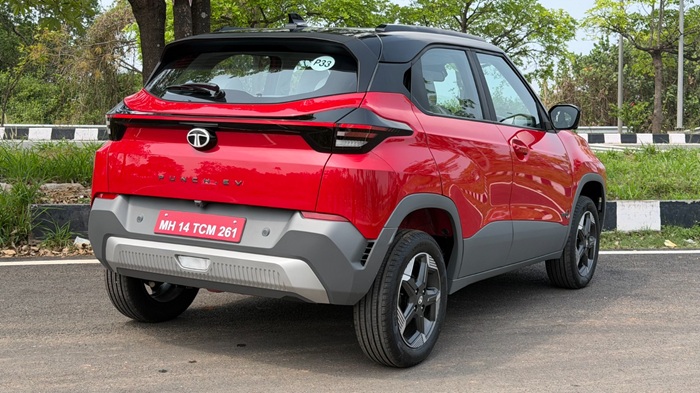
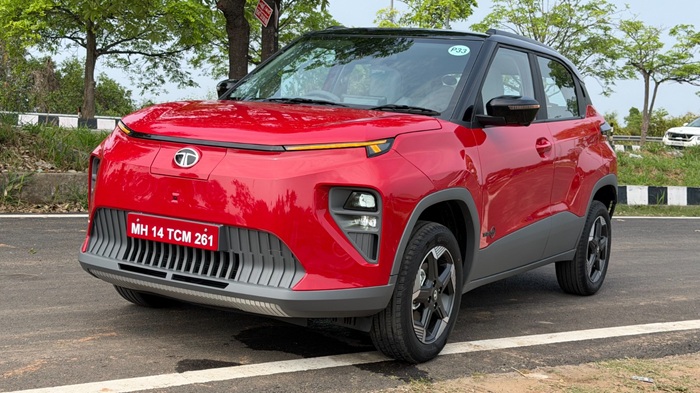
The example here is finished in a vibrant Bengal Rouge Red, a colour that looks particularly striking under sunlight. Other options include copper, white, grey, orange, and yellow, while dual-tone variants feature a black roof for added visual drama. The lighting signature is distinctly modern with automatic LED projector headlamps, digital DRLs, and sequential turn indicators. The headlamps even feature a Follow Me Home function, which politely lights your path after you park the car—something your smartphone torch has been doing for years, but now your car does it with more elegance. The LED fog lamps with cornering function improve visibility while turning, while the digital infinity glow end-to-end LED tail lamp gives the rear a futuristic vibe.
Practical touches continue with rain-sensing wipers, electrically adjustable and auto-folding ORVMs with integrated cameras and turn indicators, and a shark-fin antenna with GPS. The car rides on 16-inch diamond cut alloy wheels, though steel wheels in 15- and 16-inch sizes are available in lower trims. The tyres are 195/60 R16 Apollo Amperion low rolling resistance radials, designed specifically to improve EV efficiency. Braking duties are handled by disc brakes at the front and drum brakes at the rear. While earlier versions offered rear discs, Tata has moved to drums in standard variants—probably because they work just fine for a car of this size and help keep costs sensible.
Under the skin lies the technological heart of the Punch EV. The battery pack and motor are protected with IP67-rated sealing, meaning they can handle dust, water, and the occasional enthusiastic monsoon adventure. A liquid-cooled thermal management system ensures optimal battery temperature, improving longevity and performance in India’s diverse climate.
The Punch EV 40, which you see here, uses a 40 kWh LFP prismatic cell battery paired with a Permanent Magnet Synchronous Motor producing 127 horsepower and 154 Nm of torque. That is enough to propel this compact SUV from 0-100 kmph in just 9 seconds, with a top speed limited to 140 kmph. Tata claims a range of 468 km, though real-world usage typically delivers around 355 km, which is still more than sufficient for daily commutes and weekend drives.
There is also a Punch EV 30 variant featuring a 30 kWh battery, producing 87 horsepower with the same 154 Nm torque. It takes 13.5 seconds for 0-100 kmph and offers a claimed 375 km range, with a real-world figure closer to 275 km.
Charging flexibility is another area where Tata has been thoughtful. With a regular 15-amp plug, the battery reaches 90% charge in roughly 14 hours and 80 minutes, which admittedly sounds like a long time but is perfect for overnight charging. The included 7.2 kW AC fast charger reduces that time to about 5 hours and 30 minutes, while a 65 kW DC fast charger can charge the battery from 10% to 70% in just 30 minutes. Tata even bundles both a 7.2 kW AC charger and a 3.3 kW wall box charger with the car, which is a pleasant surprise in a world where some companies charge extra for things as basic as a spare wheel.
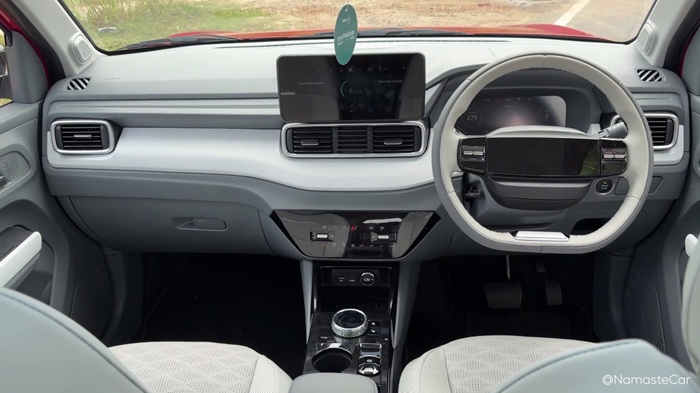
Inside, the Punch EV feels far more premium than its compact footprint suggests. The cabin features a multi-layered dashboard, mood lighting, and leatherette upholstery, though fabric seats are available in lower variants. The front seats are ventilated, a feature once reserved for luxury cars but now thankfully trickling down to affordable vehicles—because Indian summers can turn even the calmest driver into a slightly sweaty philosopher.
The driver’s seat is height adjustable, while the leatherette-wrapped digital steering wheel features controls for phone, infotainment, volume, and voice commands. Behind it sits a 10.25-inch digital instrument cluster displaying navigation, vehicle information, and EV-specific data. Paddle shifters are cleverly repurposed to adjust the four-level multi-mode regenerative braking system, allowing drivers to choose between levels 0, 1, 2, and 3. At the highest level, the car supports single-pedal driving, where lifting off the accelerator slows the car dramatically—something that feels futuristic for about five minutes before becoming wonderfully addictive.
At the centre of the dashboard sits a 10.25-inch Harman HD touchscreen infotainment system supporting Arcade.ev 2.0. This system includes navigation, wireless Android Auto, Apple CarPlay, multiple voice assistants including Hey Tata, Alexa, Siri, and Google Assistant, and a surprisingly extensive entertainment ecosystem. You can access podcasts, music apps like Gaana and JioSaavn, video platforms such as Disney+ Hotstar, Amazon Prime Video, YouTube, and even ESPN. There’s also a quirky BB Racing game, which might finally give you something to do while waiting for your car to charge.
The Punch EV also supports over-the-air software updates, meaning the car can receive improvements while sitting quietly in your parking spot—much like how smartphones update themselves overnight, except this one happens to weigh over a tonne.
Connectivity continues through the iRA EV smartphone app, which allows access to over 50 remote features including vehicle tracking, charging status, remote lock and unlock, AC control, horn activation, lighting control, geo-fencing, smartwatch connectivity, and driving score analytics. Essentially, if you ever forget where you parked the car, your phone will know—even if your memory does not.
Practicality hasn’t been forgotten either. The Punch EV offers 366 litres of boot space, plus an optional 14-litre frunk under the bonnet for storing charging cables. The doors open a wide 90 degrees, making entry and exit easy for passengers of all ages. There is even a 1 kg utility hook in the boot, which sounds small but proves surprisingly useful for hanging grocery bags.
Safety remains a strong point for Tata vehicles, and the Punch EV comes loaded with features including six airbags, ABS with EBD, Electronic Stability Program, Hill Hold Control, Hill Ascent Control, Hill Descent Control, ISOFIX child seat mounts, tyre pressure monitoring system, rear parking sensors, reverse park assist, and impact sensing auto door unlock. A 360-degree surround view camera and Blind Spot View Monitor further improve visibility in tight spaces. The car even includes a high beam alert that politely reminds you if your headlights remain on high beam for more than a minute—a subtle way of saying “please don’t blind everyone on the road.”
The music system now includes four speakers, though earlier versions offered six. Still, with the infotainment system’s streaming capabilities, even four speakers are enough to enjoy your favourite playlist while cruising silently through the city.
On the road, the Punch EV feels nimble and responsive thanks to instant electric torque and well-tuned suspension. The front setup uses Independent Lower Wishbone McPherson Struts, while the rear features a semi-independent twist beam suspension with coil springs and shock absorbers. Combined with the electric power-assisted steering, the car feels easy to drive in traffic and surprisingly stable on highways.
Overall, the Tata Punch EV represents an interesting shift in India’s EV story. It is not trying to be an expensive futuristic gadget; instead, it is a practical electric crossover designed for everyday use. It blends performance, technology, comfort, and safety into a package that feels approachable rather than intimidating.
And perhaps that is the real punchline here—pun absolutely intended. The Punch EV proves that electric cars no longer need to be niche, complicated, or outrageously expensive. Sometimes they can simply be smart, efficient little SUVs that quietly go about their business while making the future of mobility feel surprisingly normal.