



Road transportation remains the backbone of modern economies, yet it is also one of the most complex systems to manage. According to the World Health Organization, road traffic crashes claim nearly 1.19 million lives globally each year, while the World Bank estimates that traffic congestion costs cities between 2 and 5 percent of their GDP annually. At the same time, the International Transport Forum reports that global vehicle ownership is expected to double by 2050, placing unprecedented strain on existing highway infrastructure.
To address these challenges, governments and transport authorities are investing heavily in smart highway initiatives. At the center of these initiatives are AI video surveillance systems that transform traditional roads into intelligent, responsive transport corridors. These systems do far more than record footage. They analyze traffic patterns in real time, detect incidents instantly, support predictive maintenance, and enable data driven transport planning.
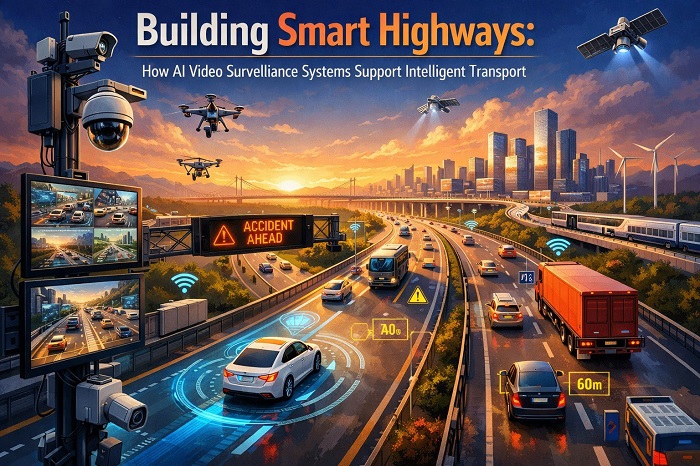
This article explores how AI video surveillance systems support intelligent transport and why they are becoming essential to building smart highways worldwide.
What Are Smart Highways?
Smart highways are road networks enhanced with digital technologies that collect, analyze, and act on data to improve safety, efficiency, and sustainability. Unlike traditional highways that rely on manual monitoring and delayed reporting, smart highways operate as living systems that continuously sense and respond to conditions on the road.
Key technologies commonly integrated into smart highways include traffic sensors, connected cameras, variable message signs, vehicle to infrastructure communication systems, and centralized traffic management platforms. Among these, AI powered video surveillance plays a foundational role because it provides visual context combined with machine intelligence.
The Role of AI Video Surveillance in Intelligent Transport
AI video surveillance systems use computer vision and machine learning to interpret live and recorded video feeds from highway cameras. Instead of relying on hterns, anomalies, and risks.
These systems can distinguish between vehicles, pedestrians, cycliuman operators to watch dozens or hundreds of screens, AI models automatically identify patsts, and debris. They can measure speed, density, lane usage, and queue length. Most importantly, they transform raw video into actionable intelligence that traffic authorities can use immediately.
Modern smart highway deployments increasingly rely on an ai video surveillance system like Coram, which combines real time computer vision with scalable cloud intelligence to turn live roadway footage into actionable transport insights. By analyzing traffic behavior, detecting incidents instantly, and integrating seamlessly with existing highway camera infrastructure, Coram enables transport authorities to move from passive monitoring to proactive, data driven traffic management.
Improving Road Safety Through Real Time Detection
Safety is the most critical objective of intelligent transport systems. Traditional surveillance cameras often capture accidents after they happen, offering little opportunity for prevention. AI video surveillance changes this by detecting dangerous situations as they emerge.
For example, AI can identify vehicles driving the wrong way, sudden braking patterns that indicate potential collisions, or pedestrians crossing restricted highway zones. Once detected, alerts are sent instantly to traffic control centers, emergency responders, or roadside warning systems.
Studies from transport authorities in Europe and Asia show that real time incident detection using AI based video analytics can reduce emergency response times by up to 40 percent. Faster response not only saves lives but also minimizes secondary accidents caused by congestion around an incident site.
Reducing Traffic Congestion and Improving Flow
Congestion is a daily challenge for highway operators. AI video surveillance systems provide continuous visibility into traffic flow, enabling proactive management instead of reactive intervention.
By analyzing lane occupancy, vehicle speed, and bottleneck formation, AI systems help traffic managers optimize signal timing at highway interchanges and manage ramp metering more effectively. Variable message signs can be updated automatically based on AI insights, guiding drivers toward alternative routes before congestion worsens.
In pilot projects across smart corridors in the United States and China, AI driven traffic optimization has led to average travel time reductions of 15 to 25 percent during peak hours. These improvements directly translate into fuel savings, lower emissions, and improved commuter satisfaction.
Supporting Incident Management and Emergency Response
When incidents occur on highways, time is the most critical factor. AI video surveillance systems enable faster and more accurate incident detection than traditional reporting methods such as emergency calls or patrol observations.
AI can recognize stopped vehicles, collisions, overturned trucks, or debris on the roadway within seconds. This allows control centers to dispatch the appropriate response units immediately and coordinate lane closures or diversions.
In addition, AI based systems provide real time visual confirmation, helping responders assess the severity of an incident before arriving on scene. This reduces uncertainty and improves coordination between traffic authorities, police, fire services, and medical teams.
Enabling Predictive Maintenance of Highway Infrastructure
Smart highways are not only about managing traffic but also about maintaining infrastructure efficiently. AI video surveillance systems support predictive maintenance by continuously monitoring road conditions and structural elements.
Computer vision models can detect cracks, potholes, faded lane markings, damaged guardrails, and malfunctioning signage. Instead of relying on scheduled inspections or citizen complaints, maintenance teams receive data driven alerts that prioritize repairs based on severity and risk.
According to infrastructure studies, predictive maintenance powered by AI can reduce maintenance costs by up to 30 percent while extending the lifespan of road assets. For governments managing thousands of kilometers of highways, these savings are substantial.
Supporting Data Driven Transport Planning
Long term transport planning requires accurate, comprehensive data. AI video surveillance systems generate rich datasets that go far beyond vehicle counts.
Authorities can analyze historical traffic patterns to understand seasonal demand, freight movement trends, and the impact of weather or special events. This data informs decisions about lane expansions, toll pricing, public transport integration, and future infrastructure investments.
Because AI systems continuously learn and improve, the quality of insights increases over time, making transport planning more adaptive and resilient.
Enhancing Environmental Sustainability
Transportation is a major contributor to greenhouse gas emissions. Smart highways supported by AI video surveillance play an important role in reducing environmental impact.
By smoothing traffic flow and minimizing stop and go conditions, AI systems help reduce fuel consumption and emissions. Real time congestion management also reduces idle time during incidents and peak periods.
In some regions, AI video analytics are used to monitor and enforce low emission zones on highways, identifying non compliant vehicles and supporting environmental regulations without manual enforcement.
Integrating with Connected and Autonomous Vehicles
As connected and autonomous vehicles become more common, highways must evolve to support them. AI video surveillance systems act as a bridge between traditional infrastructure and next generation mobility.
These systems provide situational awareness that complements vehicle sensors, especially in complex environments such as construction zones or adverse weather conditions. Data from AI enhanced highways can be shared with connected vehicles to improve navigation, safety, and efficiency.
This integration is a key step toward fully intelligent transport ecosystems where vehicles and infrastructure collaborate seamlessly.
Challenges and Considerations
While the benefits of AI video surveillance for smart highways are significant, successful implementation requires careful planning. Data privacy and security must be addressed through clear governance frameworks and robust cybersecurity measures.
System scalability is another consideration. Highways generate massive volumes of video data, so infrastructure must support real time processing without latency. Finally, workforce training is essential so that traffic operators can effectively use AI insights rather than being overwhelmed by data.
The Future of Smart Highways
The global smart transportation market is projected to exceed 250 billion dollars by 2030, driven largely by AI and intelligent infrastructure investments. As AI models become more accurate and affordable, AI video surveillance will move from pilot projects to standard components of highway design.
Future smart highways will not only react to traffic conditions but anticipate them, adjusting infrastructure dynamically to meet demand. In this vision, AI video surveillance systems serve as the eyes and intelligence that make truly adaptive transport possible.
FAQs
What makes AI video surveillance different from traditional highway cameras?
Traditional cameras primarily record footage for review after an incident. AI video surveillance analyzes video in real time, detecting events, patterns, and risks automatically and triggering immediate actions.
Can AI video surveillance systems work with existing highway cameras?
Yes. Many AI solutions are designed to integrate with existing camera infrastructure, allowing transport authorities to upgrade capabilities without replacing all hardware.
How accurate are AI based incident detection systems?
Modern AI video analytics systems achieve high accuracy rates, often exceeding 95 percent for common scenarios such as stopped vehicles or wrong way driving, especially when trained on local traffic conditions.
Do AI video surveillance systems raise privacy concerns?
Privacy concerns can be addressed through anonymization, data minimization, and compliance with local regulations. Most systems focus on object detection and behavior analysis rather than identifying individuals.
Are smart highways affordable for developing regions?
While initial investment can be significant, the long term savings from reduced accidents, lower congestion, and optimized maintenance often outweigh costs. Scalable AI solutions also allow phased deployment based on budget and priority.
Conclusion
Building smart highways is no longer a futuristic concept but a practical necessity for managing growing transport demands. AI video surveillance systems provide the intelligence needed to make highways safer, more efficient, and more sustainable.
By enabling real time monitoring, predictive maintenance, and data driven decision making, these systems transform highways from static infrastructure into dynamic, responsive networks. As cities and nations invest in intelligent transport, AI video surveillance will remain a cornerstone technology shaping the future of mobility.