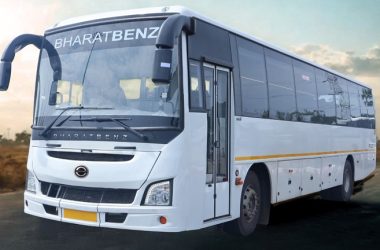
Chennai — Daimler India Commercial Vehicles (DICV), the company behind BharatBenz, has launched its latest heavyweight contender for India’s booming intercity travel market — the BB1924, a 19.5-tonne heavy-duty bus designed to make long-distance journeys more comfortable, more efficient, and perhaps finally less dependent on good luck and strong suspension.
India’s intercity bus market, valued at over USD 51 billion and growing at a healthy pace, is hungry for more capacity, better economics, and safer rides. The BB1924 arrives with the intention of ticking all three boxes, and possibly a few more that operators didn’t know they needed.
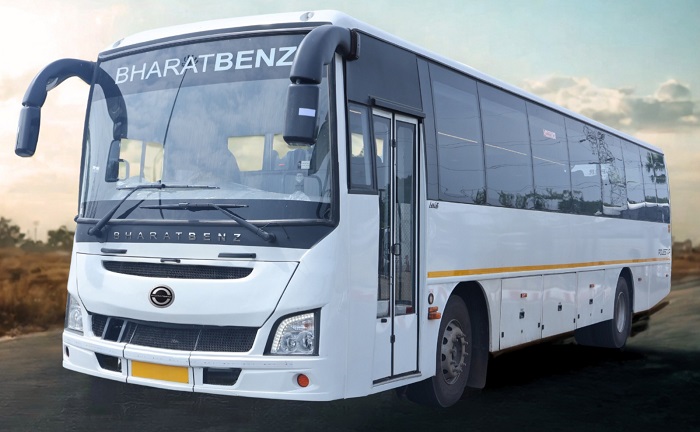
Andamuthu Ponnusamy, Head of the Bus Business at DICV, described the BB1924 as a “paradigm shift” for the sector, explaining that field trials across high-traffic routes such as Mumbai–Pune, Delhi–Jaipur, and Chennai–Bangalore have shown encouraging improvements in total cost of ownership. Behind the corporate tone lies a simple truth: operators want bigger buses with lower running costs, and passengers want a journey that doesn’t involve praying at every corner. BharatBenz believes it now has the answer.
Beyond the launch itself, the company is doubling down on a holistic support ecosystem. With nearly 400 authorized touchpoints across India, operators are rarely more than a tea break away from a service centre. Partnerships with major financial institutions, including HDFC Bank, ICICI Bank and Bajaj Finserv, ensure that owning a BB1924 does not require Olympic-level paperwork or supernatural patience. Flexible EMIs, competitive interest rates, and a smooth acquisition process make this a bus that’s not just heavy-duty but also easy to bring home.
Ownership doesn’t end with the keys. BharatBenz is extending a six-year or six-lakh-kilometre powertrain warranty, backed by round-the-clock roadside assistance. To keep downtime minimal, the company promises 95 percent parts availability within 24 to 48 hours, supported by a deeply localized supply chain. Operators can also tap into IoT-powered predictive maintenance, while drivers and technicians receive training in regional languages — a rare moment where engineering meets cultural sensitivity.
Where the BB1924 really flexes its muscles, however, is safety. The chassis is engineered from high-tensile steel for superior crash protection, while systems like ABS, electronic vehicle stability control and an ECU-controlled electromagnetic retarder work quietly in the background to ensure that control stays with the driver even on unpredictable highways. Michelin radial tubeless tyres further aid stability and durability, giving the bus stronger road manners than many passenger cars.
Under the skin, the BB1924 is powered by the BS-VI OBD-II OM926 six-cylinder diesel engine, delivering 241 horsepower and 850 Nm of torque — enough grunt to carry up to 51 passengers, their luggage, and probably the weight of a few life decisions. The engine is paired with a six-speed synchromesh gearbox designed for highway efficiency. The pneumatic suspension system, anti-roll bars and cruise control together create a driving experience that is stable, relaxed and long-haul friendly.
A fuel tank capacity of 380 litres gives the BB1924 a range of over 1,300 kilometres, making it well-suited for overnight routes where stopping is frowned upon and punctuality is a competitive sport. Service intervals are impressively spaced out — the first at 60,000 kilometres, followed by 120,000-kilometre intervals — a clear nod to operators who want their buses on the road, not in the workshop. Built for a service life of 10 to 15 years, the chassis aims to be a long-term revenue generator rather than a short-term expense.
With the BB1924, BharatBenz isn’t just launching a new bus; it is declaring its intent to dominate the premium intercity mobility space. The combination of higher capacity, stronger safety systems, longer service intervals and a wide support network positions it as a compelling choice for both established fleet operators and new entrants looking to scale.
And if all goes well, India’s long-distance passengers may soon find themselves travelling in a bus that feels less like an endurance test and more like a well-engineered experience — one where the journey, for once, doesn’t outlast their patience.