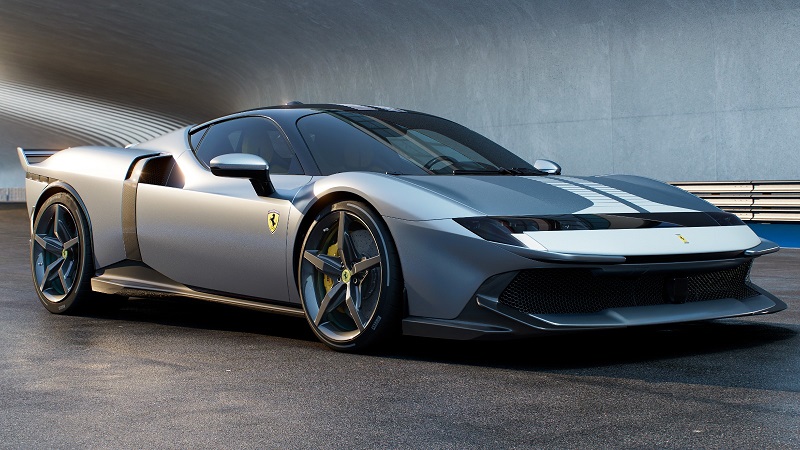
Milan — Ferrari has pulled the covers off the 849 Testarossa, a plug-in hybrid berlinetta that replaces the SF90 Stradale and revives one of Maranello’s most storied names. Think mid-rear twin-turbo V8, three electric motors and a combined 1,050 cv—plus a design brief that time-travels from 1970s Sports Prototypes to the 1984 icon and back to the future. Also: it’s called Testarossa again, so the ‘red-head’ is officially back.
Fast facts (because who reads slowly?)
- Total output: 1,050 cv (V8: 830 cv, e-motors: 220 cv)
- Powertrain: PHEV, on-demand e-4WD with torque vectoring
- Downforce: 415 kg at 250 km/h (+25 kg vs SF90) with redesigned active spoiler
- Brains & brakes: FIVE digital estimator + ABS Evo for later, harder, repeatable braking
- e-modes: eDrive, Hybrid, Performance, Qualify (up to 25 km electric range; 7.45 kWh battery)
- Weight: Same as SF90 Stradale, despite more kit; best power-to-weight for a range model
- Tyres: Co-developed options from Michelin, Pirelli, Bridgestone (incl. Cup 2 R)
- Heritage: Name echoes the 1956 500 TR and the 1984 legend—with fresh, squared-off attitude
The power play
Ferrari’s multi-award-winning V8 (project F154FC) gets a thorough re-engineering: larger turbos with low-friction bearings, new heads, manifolds and plenums, plus racing-style lightening and titanium fasteners. The result is 830 cv at a lofty specific output of 208 cv/l, 50 cv more than before, while keeping weight in check. There’s sustainability sauce too: recycled aluminium castings for major engine parts trim CO₂ in production.
Three electric motors join the party: MGU-K at the rear, RAC-e pair up front for smart torque vectoring and all-weather launch ferocity. Calibration work smooths transitions, improves cooling by 10–12°C, and makes regen feel more natural—your right foot gets the orchestra, not the metronome.
Dynamics: quicker, calmer, cleverer
Ferrari’s new FIVE estimator builds a real-time digital twin of the car, feeding hyper-accurate speed and yaw data into traction, e-diff and e-4WD controls. Translation: later braking, cleaner turn-in, and repeatable lap-after-lap heroics. ABS Evo uses those FIVE insights to squeeze every Newton out of the contact patch, while larger discs, revised calipers and better ventilation keep fade from photobombing your hot laps. Springs are 35% lighter, roll gradient drops 10%, and third-gear shove from 5,500 rpm hits harder than in the SF90.
Aero: twin tails, big brains
Downforce is up to 415 kg @ 250 km/h courtesy of a redesigned underfloor (35% of the total), SF90-XX-inspired splitter work, and a twin-tail rear architecture riffing on the 512 S. The active rear spoiler flips from Low Drag to High Downforce in under a second and can contribute up to 100 kg of the total load. Cooling performance rises 15% with sculpted door channels and enlarged intakes that push more air across intercoolers, brakes and radiators.
Sound: louder where it matters
The flat-plane V8 carries a new shift-strategy (a gift from SF90 XX) that punches up upshift drama without resorting to juvenile fireworks. Lower- and mid-range richness is boosted; push towards the 8,300 rpm limiter and it layers on the bright harmonics purists crave.
Styling: futurist with flashbacks
Flavio Manzoni’s team leans on squared, graphic volumes and bridge-style front fascia cues that nod to the 12Cilindri and F80, with a deeply sculpted door that doubles as an aero duct. At the rear, the twin tails frame the active wing and a muscular diffuser; in plan view, the forward flicks and rear sections sketch a clean, purposeful perimeter. Forged wheels feature aero profiles to tidy wheel-well flow—and your spec sheet.
Cabin & HMI: cockpit feel, Italian logic
A horizontal dash with floating upper volume, ‘C’-shaped vents and a contrasting control band keeps it technical but warm. The F80-inspired gate is back on the tunnel (collective sighs of relief from Ferrari romantics), while the new steering wheel returns to mechanical buttons for the key functions—including that iconic Engine Start. The digital cluster and eManettino flip modes quickly; CarPlay/Android Auto and wireless charging are standard, as is MyFerrari Connect.
Assetto Fiorano: when “more” is the answer
The optional Assetto Fiorano package drops about 30 kg via carbon and titanium, swaps in Multimatic fixed-rate dampers, offers 20-inch carbon wheels, and reworks aero (extra vortex generators up front; twin spoiler profiles aft) to triple rear downforce versus the twin tails with only a minor drag penalty. Yes, you can still spec a front lifter if you value both apexes and driveways.
Personalisation & colours: paint with history
Two new liveries headline: Rosso Fiammante (a shimmering evolution of Rosso Corsa) and Giallo Ambra (amber-rich yellow with depth). Inside, Giallo Siena Alcantara plays matchmaker for bolder specs, while forged-wheel geometries and finishes give you the excuse you needed to spend an evening on the configurator.
Ownership: seven years of peace of mind
A 7-year maintenance programme covers all routine services at official dealerships worldwide. Hybrid components carry a 5-year warranty, with Warranty Extension Hybrid stretching cover to year eight (and replacing the HV battery at no cost at that point). Power Hybrid then keeps the powertrain covered through year 16, again with an HV battery replacement at that milestone.
Ferrari hasn’t just ticked the “more power, less drag, more downforce” boxes—it’s also made it friendlier to drive at the limit and easier to live with the other six days of the week. The resurrected Testarossa name could’ve been a risky nostalgia play. Instead, the 849 wears it with conviction: red-headed, level-headed, and—let’s be honest—likely to make every valet’s day and every neighbour’s morning.
TECHNICAL INFORMATION
HYBRID POWERTRAIN
Maximum power 1,050 cv
INTERNAL COMBUSTION ENGINE
Layout Twin-turbo V8 – dry sump
Total displacement 3,990 cc
Bore & stroke 88 x 82 mm
Maximum power* 830 cv @ 7,500 rpm
Maximum torque 842 Nm @ 6,500 rpm
Maximum speed 8,300 rpm
Compression ratio 9.54:1
Specific power 208 cv/l
ELECTRICAL SYSTEM
Maximum power in eDrive mode 163 cv
Battery capacity 7.45 kWh
Maximum range in eDrive mode 25 km
DIMENSIONS AND WEIGHTS
Length 4,718 mm
Width 2,304 mm
Height 1,225 mm
Wheelbase 2,650 mm
Front track 1,678 mm
Rear track 1,673 mm
Dry weight* 1,570 kg
Dry weight/power ratio 1.5 kg/cv
Weight distribution 45% front / 55% rear
Tank capacity 68 litres
Trunk capacity 74 litres
TYRES AND WHEELS
Front 265/35 R20 J9.5
Rear 325/30 R20 J11.5
BRAKES
Front 410 x 223 x 38 mm
Rear 372 x 233 x 34 mm
TRANSMISSION AND GEARBOX
8-speed dual-clutch F1 gearbox
ELECTRONIC CONTROLS
Side Slip Control (SSC) 9.0, TC, eDiff, SCM, FDE 2.0, EPS, FIVE, ABS Evo and performance EBD in all positions of the Manettino
PERFORMANCE
Maximum speed >330 km/h
0-100 km/h <2.3 s
0-200 km/h 6.35 s
100-0 km/h 28.5 m
200-0 km/h 108.0 m
Fiorano lap time 1’ 17” 500
FUEL CONSUMPTION
Under homologation
CO2 EMISSIONS
Under homologation
* with optional content