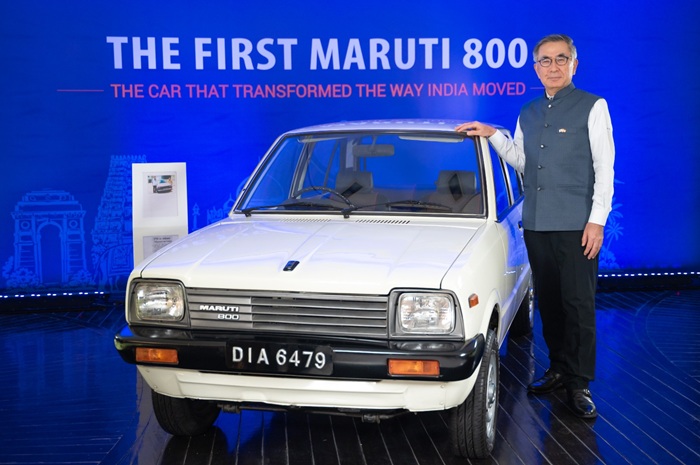
New Delhi: The Maruti 800, the humble hatchback that put millions of Indians behind the wheel and transformed the country’s automotive landscape, has received the Fédération Internationale des Véhicules Anciens (FIVA) World Vehicle Heritage Award, becoming the first and only Indian vehicle to earn the international recognition.
The iconic small car is among 21 historically and culturally significant vehicles selected worldwide for the inaugural awards, alongside automobiles from the United States, Brazil, Germany, France, Austria and Slovenia.
The recognition celebrates the Maruti 800’s contribution to democratising personal mobility, transforming everyday life and laying the foundation for India’s modern automotive manufacturing industry. For a car that once made owning four wheels an achievable dream for millions of Indian families, global recognition has arrived without the need for exotic engineering or a six-figure price tag.
From a Modest Hatchback to a National Institution
Introduced in December 1983, the Maruti 800 emerged from a joint venture between Suzuki Motor Corporation and the Government of India, established in 1982. The partnership would eventually reshape India’s passenger vehicle market, manufacturing capabilities and automotive culture.
More than 2.9 million units of the Maruti 800 were manufactured over three decades, with the model becoming synonymous with affordable, reliable and accessible personal transportation.
Mr. R.C. Bhargava, Chairman, Maruti Suzuki India Limited, said, “I thank FIVA for giving Maruti 800 this World Vehicle Heritage award. Maruti 800 started on a very small scale. It has resulted in India today becoming the third-largest car market in the world and counts for maybe the largest growing sector of manufacturing in India. The car proved that India could manufacture high-quality engineering products, something which was questioned by many at that time. The first Maruti 800 was exported to Europe in 1987. The Indian car and component industry had both grown beyond belief. Even more significant has been the influence on the lives of the people. Millions of jobs have been created as a result of Maruti and motorization. Women found that they could take part in economic activities, because they now had a reliable, easy-to-drive vehicle.”
Mr. Bhargava added, “The Indian manufacturing scene has changed beyond recognition. India today has become a viable destination for manufacturing activities from all over the world. And it all started when the visionary Mr. Osamu Suzuki decided to become a partner in Maruti and manufacture the SS80.”
The Small Car That Took Indian Manufacturing Global
The Maruti 800 also played a pioneering role in India’s automotive exports. In 1987, the model began reaching European markets, including Hungary, France and Belgium, marking an important milestone for the country’s automobile manufacturing industry.
What began with an annual production volume of 40,000 cars has since evolved into a global manufacturing and export operation. Maruti Suzuki now exports more than 400,000 vehicles annually to over 120 countries, according to the company.
Mr. Toshihiro Suzuki, President, Suzuki Motor Corporation, said, “I thank FIVA for this global honour. Suzuki Motor Corporation entered the Indian market in 1982 through a joint venture with the Government of India, and Maruti 800 was the first car to be manufactured in December 1983. At that time, Suzuki had no idea how big the Indian market would become. We started manufacturing 40,000 cars a year. Over the next 30 years, more than 2.9 million Maruti 800 cars were made. Maruti 800 is also the car that started exports from India to the world in 1987, starting with Hungary, France and of course to Belgium. Today, Maruti Suzuki exports more than 400,000 cars a year to over 120 countries. The first point in our Mission Statement is to develop products of superior value by focusing on the customer. Maruti 800 is a good example of this belief.”
FIVA Awards Look Beyond Luxury and Rarity
The Fédération Internationale des Véhicules Anciens, an international non-profit federation dedicated to historic vehicles and a non-governmental partner of UNESCO, introduced the World Vehicle Heritage Awards to broaden the recognition of automotive heritage.
Unlike conventional automotive heritage honours that often emphasise rarity, prestige or monetary value, the FIVA initiative recognises vehicles that have shaped national identities, transformed everyday mobility, contributed to industrial development or become enduring cultural symbols.
The Maruti 800’s inclusion reflects the growing recognition that automotive history is not exclusively written by rare supercars, luxurious limousines or championship-winning racing machines. Sometimes, it is written by a modest hatchback carrying an entire family’s aspirations.
A Lasting Symbol of India’s Automotive Journey
More than four decades after its introduction, the Maruti 800’s legacy extends well beyond its production figures. Its influence can be seen in India’s automotive supply chains, employment generation, manufacturing expertise and the expansion of personal mobility across generations.
As India strengthens its position in the global automotive industry and transitions towards electrification and advanced mobility technologies, the FIVA recognition serves as a reminder of where much of that journey began. The Maruti 800 may have been small in dimensions, but its place in India’s industrial and social history is anything but.