

Gurugram, Haryana: Vietnam’s emergence as a major electric vehicle manufacturing hub is drawing attention well beyond Southeast Asia, with nearly 500 experts and journalists from India and the region visiting the country in November to examine the rapid growth of VinFast. However, the visit revealed a larger story: the automaker’s rise is closely connected to an extensive business ecosystem developed by its parent conglomerate, Vingroup, which operates across mobility, real estate, healthcare, education, technology and infrastructure.
Founded less than a decade ago, VinFast has established itself as Vietnam’s best-selling automotive brand, maintaining the position for 26 consecutive months. Its expansion has been supported not only by vehicle manufacturing and competitive pricing but also by an interconnected network of businesses designed to make electric mobility more accessible.
For visitors spending several days in Nha Trang, the scale of this ecosystem became increasingly apparent. From electric taxis and charging infrastructure to universities, residential developments and public transport, Vingroup’s presence extends into numerous aspects of daily life.
And in a country where so many prominent businesses begin with the letter ‘V’, spotting the family resemblance hardly requires detective work.
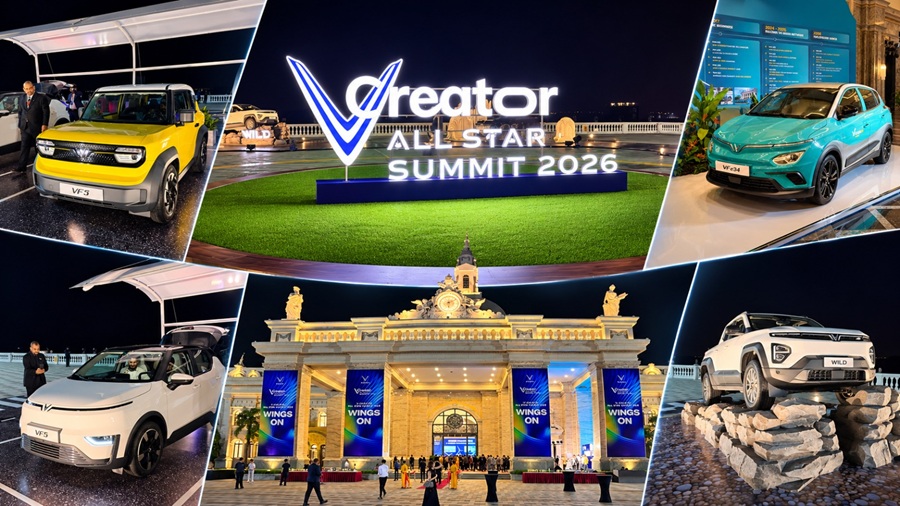
Beyond Cars: How Vingroup Is Building an EV Ecosystem
One of the biggest challenges facing electric vehicle manufacturers worldwide is that selling an EV is only part of the equation. Buyers also require accessible charging stations, reliable aftersales support, financing options and confidence in the technology.
Vingroup’s broader strategy addresses several of these requirements through businesses operating within its ecosystem or alongside companies founded by billionaire Pham Nhat Vuong.
A central component is V-Green, which is developing a nationwide charging network of approximately 150,000 charging ports across Vietnam.
According to figures presented in the source material, charging stations are spaced approximately 3.5 kilometres apart in urban areas and roughly 65 kilometres apart along national highways and expressways. The network is intended to reduce range anxiety, one of the major obstacles to wider EV adoption.
Another important participant is Green SM, an electric ride-hailing service that exclusively operates VinFast vehicles. The company has grown into one of the world’s largest all-electric ride-hailing operators, providing passengers with an opportunity to experience electric mobility without purchasing a vehicle.
VinBus extends the approach to public transportation through electric buses serving commuters.
Together, these businesses demonstrate what economists describe as the “network effect”, in which individual components become more valuable as the wider system expands.
A larger charging network makes EV ownership more convenient, while electric taxi fleets increase public familiarity with the technology. Greater vehicle adoption, in turn, creates additional demand for supporting infrastructure.
Rather than depending entirely on external companies to establish these services, VinFast benefits from businesses operating within a closely connected commercial environment.
From Residential Townships to Robotics and Renewable Energy
Vingroup’s activities extend considerably beyond automobiles.
Over the past three decades, the Vietnamese conglomerate has expanded from hospitality into residential property development through Vinhomes, healthcare through Vinmec, and education through VinUniversity and Vinschool.
Its portfolio also includes Vinpearl in hospitality, VinRobotics and VinDynamics in technology, VinSpeed in infrastructure, and VinEnergo in renewable energy.
These businesses contribute to an ecosystem in which different services can complement one another.
For example, Vinhomes residential developments can incorporate EV charging infrastructure, while Green SM taxis and VinBus services provide transportation options. VinUniversity contributes to research, engineering education and technological development, areas that could support Vietnam’s longer-term industrial ambitions.
Meanwhile, the conglomerate’s expansion into artificial intelligence, robotics, renewable energy, industrial manufacturing and high-speed rail signals a strategy extending beyond consumer products.
Although these businesses operate in different sectors, their interconnected presence creates opportunities for shared infrastructure, technological development and customer engagement.
The approach is particularly relevant to electric mobility, where widespread adoption depends on an extensive network of services rather than vehicle availability alone.
VinFast Delivered Nearly 197,000 Electric Vehicles in 2025
VinFast’s growth provides a measure of the progress made by Vietnam’s domestic automotive industry.
The manufacturer delivered nearly 197,000 electric vehicles globally in 2025, more than doubling its deliveries from the previous year.
The increase came alongside efforts to expand production capacity and strengthen international operations.
While vehicle pricing, product development and manufacturing capabilities remain important factors in the company’s performance, the surrounding ecosystem has helped address practical challenges associated with EV adoption.
This approach also reflects a broader shift in the global automotive industry.
Several manufacturers are investing in dedicated charging networks, battery manufacturing, software development and vertically integrated supply chains. Traditional automakers, meanwhile, are expanding partnerships with technology providers, charging companies and financial institutions.
The objective is increasingly similar: to make EV ownership as straightforward and dependable as conventional vehicle ownership.
What India Can Learn From Vietnam’s EV Strategy
Vietnam’s experience offers an interesting perspective for India, where electric mobility is entering a period of significant expansion.
India’s electric four-wheeler sales increased by 75% in 2025, according to figures cited in the source material, reflecting growing consumer interest, an expanding selection of electric models and continued investment in charging infrastructure.
However, vehicle sales alone cannot determine the success of the country’s electric mobility transition.
Charging accessibility, service availability, financing, battery technology and consumer confidence will continue to influence adoption, particularly as EV manufacturers expand beyond major metropolitan markets.
Vietnam’s experience suggests that greater coordination between automakers, infrastructure providers, technology companies and other industries could help accelerate this transition.
India’s larger geography, varied infrastructure requirements and competitive automotive market mean that Vietnam’s approach cannot necessarily be replicated in its entirety.
Nevertheless, the underlying principle remains relevant: electric mobility becomes more practical when the businesses supporting it develop alongside the vehicles themselves.
For Indian consumers, this could eventually mean more convenient charging, improved service access and greater confidence in electric vehicles as an everyday transportation choice.
The Bigger Picture for Electric Mobility
VinFast’s growth illustrates how the global EV industry’s priorities are evolving from manufacturing electric vehicles to developing the infrastructure and services required to support them.
Vingroup’s expanding presence across Vietnamese industries represents one approach to achieving that objective, although the long-term commercial sustainability and effectiveness of such an integrated model will ultimately depend on execution.
For emerging EV markets such as India, the central lesson extends beyond any particular automaker or conglomerate. The transition to electric mobility will depend not simply on how many vehicles manufacturers can sell, but also on how effectively charging networks, public transportation, technology and consumer services develop around them.
The future of electric mobility, it appears, may be decided as much by the ecosystem surrounding the car as by the car itself.