


Sri City, Andhra Pradesh: Isuzu Motors India (IMI) has completed 10 years of vehicle manufacturing at its Sri City facility in Andhra Pradesh, marking a significant milestone in the Japanese automaker’s Indian operations. Since its inauguration in April 2016, the plant has evolved into an important manufacturing and export hub, producing more than one lakh vehicles and supplying Isuzu products to markets across Asia and the Middle East.
The anniversary comes as the company seeks to strengthen its position in India’s automotive industry while expanding its international export operations. Isuzu says its Indian subsidiary has maintained profitability since fiscal year 2022, reflecting improvements in operational performance and business growth.
The Sri City facility has played a central role in this expansion. In FY2024-25, Isuzu Motors India emerged as India’s leading commercial vehicle exporter, according to the company, shipping 20,312 vehicles overseas, representing a 24% increase over the previous financial year.
The company has also exported more than one lakh Made-in-India engines, underlining the facility’s growing importance within Isuzu’s global manufacturing network.
Isuzu’s India Manufacturing Journey Reaches a Decade
Established as part of Isuzu’s long-term commitment to Indian manufacturing, the Sri City plant began operations in April 2016 with the rollout of the Isuzu D-MAX V-Cross.
The facility was inaugurated by Andhra Pradesh Chief Minister N. Chandrababu Naidu, who attended the launch of the vehicle that Isuzu positioned as India’s first Adventure Utility Vehicle.
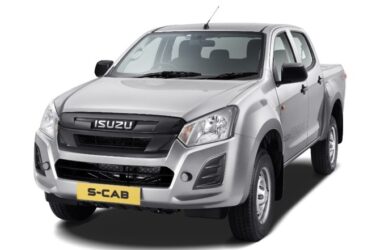
Over the following decade, the plant expanded its manufacturing portfolio to include the D-MAX and S-CAB ranges, serving both commercial and lifestyle vehicle customers.
In 2017, Isuzu began exporting locally manufactured vehicles to neighbouring countries and introduced its premium full-size SUV, the mu-X, in the Indian market.
International operations expanded further in 2019 when the company commenced exports to Gulf Cooperation Council (GCC) markets.
The facility also underwent significant expansion between 2019 and 2020, with Phase II operations introducing a new press shop and engine assembly plant.
In 2024, Isuzu Motors India celebrated the production of its 100,000th Made-in-India vehicle, another milestone in its manufacturing journey.
India Remains Strategically Important for Isuzu
The anniversary celebrations were attended by senior executives from Isuzu Motors Limited and Mitsubishi Corporation, alongside representatives of the Andhra Pradesh government and Sri City.
Among the chief guests were Naohiro Yamaguchi, President and Representative Director, CEO, Isuzu Motors Limited, Japan, and Shigeru Wakabayashi, Group CEO, Mobility Group, Mitsubishi Corporation, Japan.
They were joined by Dr. N. Yuvaraj, IAS, Secretary, Industries & Commerce, Government of Andhra Pradesh, and Dr. Ravindra Sanna Reddy, Founder and Managing Director, Sri City.
Speaking at the event, Yamaguchi highlighted the progress made by the Indian subsidiary and outlined its future priorities.
“Our collective dedication and hard work have delivered significant results. Since fiscal year 2022, IMI has maintained consistent profitability, while our export business has witnessed strong growth. India continues to be a strategically important market for ISUZU’s global operations. Looking ahead, our focus remains on strengthening our export business while accelerating growth in the domestic market,” he said.
His remarks indicate that India will continue to serve a dual purpose for Isuzu: as a domestic automotive market and as a manufacturing base supporting the company’s wider international operations.
Wakabayashi emphasised the need to strengthen Isuzu’s relationship with Indian customers while developing products and services suited to local requirements.
“I am truly proud that we have successfully reached our 10th anniversary built on IMI’s business foundation. Going forward, it is important to remain closer to our domestic customers, understand their needs, develop vehicles and services that suit them. Globally, ISUZU has always supported transportation, people’s daily lives and society, and we need to further expand this role here in India.”
Export Markets Expand Across the Middle East and Asia
One of the most significant developments in Isuzu’s Indian operations has been the expansion of its export business.
Vehicles manufactured at Sri City are supplied to several international markets, including Saudi Arabia, Bahrain, Qatar, Kuwait, Oman and Jordan in the Middle East.
Within Asia, the company’s export destinations include Nepal, Bhutan and Bangladesh.
The expansion demonstrates how the Indian facility has moved beyond meeting domestic demand to supporting Isuzu’s international supply chain.
Its export performance in FY2024-25, when overseas shipments reached 20,312 units, illustrates the scale of that transition.
The company’s ability to manufacture vehicles and engines for multiple markets also reflects its emphasis on localisation and manufacturing standards aligned with its global operations.
Isuzu India Reports Stronger Profitability
Rajesh Mittal, President & Managing Director, Isuzu Motors India, described the anniversary as an important achievement for the company’s employees, dealer network and customers.
“The last ten years have been an important journey for Isuzu Motors India, and our Sri City facility has been at the heart of it. From the first Made-in-India vehicles to the milestone of one lakh vehicles and our exports, this journey reflects the commitment of ISUZU, its employees, dealer partners and the trust of our customers. In the recent years, IMI has witnessed a strong traction in business and operations, which has resulted in a 2.5 times profitable growth last year.”
The company did not disclose detailed financial figures in its anniversary announcement, but its management highlighted continued profitability and export growth as important indicators of its business performance.
For Isuzu, maintaining momentum in domestic sales while expanding overseas shipments will be central to its next phase of development.
Over 1,300 Employees, With 82% Local Employment
Beyond manufacturing and exports, the Sri City facility has contributed to employment and technical skill development in the surrounding region.
Isuzu Motors India currently employs more than 1,300 people at the facility, with local workers accounting for approximately 82% of its workforce.
Women represent around 28% of production-line employees, reflecting the company’s efforts to increase workforce diversity in manufacturing operations.
A majority of the production workforce comprises diploma engineers who receive in-house technical training.
The company has also introduced artificial intelligence into its skill-development programmes to help employees improve their proficiency in complex manufacturing tasks.
As part of its engagement with technical educational institutions, Isuzu donates cut-section engines to support practical engineering education.
These initiatives are intended to help bridge the gap between classroom-based technical instruction and the skills required in modern automotive manufacturing.
The company also says it has incorporated sustainability measures into various areas of its operations in recent years, although specific environmental performance figures were not provided in the announcement.
Japanese Manufacturing Philosophy Meets Indian Capabilities
The Sri City facility operates according to Isuzu’s monozukuri manufacturing philosophy, a Japanese approach that emphasises craftsmanship, production quality and continuous improvement.
Over the past decade, the company has combined this philosophy with local engineering capabilities, workforce development and component localisation.
Takeshi Hirano, Deputy Managing Director, Isuzu Motors India, said the facility has supported the company’s broader commitment to providing mobility solutions for both people and goods.
“Globally, ISUZU is committed to deliver right products and solutions for the mobility of goods and people, creating value, supporting the growth of customers while enriching the society at large. IMI’s Sri City plant stands testimony in delivering exciting and robust products of the same global quality standards. Over the decade, we have understood the evolving market requirements and have continuously supported customers’ growing business aspirations. In the next decade, we will continue to build on our “Never Stop” philosophy delighting the growing ISUZU community in India and the world.”
The company’s emphasis on local capabilities combined with international manufacturing standards reflects a broader trend among global automakers using India as a production base for both domestic consumption and export markets.
Key Milestones in Isuzu Motors India’s 10-Year Journey
- April 2016: Sri City manufacturing facility inaugurated, with the rollout of the Isuzu D-MAX V-Cross.
- 2017: First Made-in-India vehicle exported to neighbouring countries; Isuzu mu-X launched in India.
- 2019: Exports to GCC markets commenced.
- 2019–2020: Phase II manufacturing expansion introduced a press shop and engine assembly facility.
- 2024: Production of the 100,000th Made-in-India vehicle.
- FY2024-25: Commercial vehicle exports reached 20,312 units, increasing 24% year-on-year and placing Isuzu at the top of the company’s reported export category.
- 2026: Sri City facility completed a decade of manufacturing operations, with more than 1,300 employees and over one lakh engines exported to date.
What’s Next for Isuzu Motors India?
As Isuzu Motors India enters its second decade of manufacturing, its priorities include expanding exports, increasing domestic market penetration and continuing to develop products suited to evolving customer requirements.
The company has reiterated its commitment to its global “Never Stop” philosophy, which it associates with reliability, operational improvement and long-term customer support.
The next stage of growth will also depend on how effectively Isuzu balances its established strengths in pickup trucks and utility vehicles with the changing expectations of India’s automotive customers.
After ten years, the Sri City plant represents more than a manufacturing investment. It demonstrates how an international automaker can develop local production capabilities while integrating India into its global supply network.
With production milestones behind it and ambitious export objectives ahead, Isuzu’s next decade in India will be measured not by anniversary celebrations, but by its ability to sustain profitability, strengthen its domestic presence and remain competitive in international markets.