
There are cars that spend their lives trying desperately to be noticed, and then there is the Maruti Suzuki Baleno. It does not need to shout particularly loudly because, by now, practically everyone in India knows what one is. Since its original launch in 2015, the Baleno has become one of Maruti Suzuki’s most recognisable premium hatchbacks, selling more than 19 lakh units and settling into Indian traffic with the sort of ubiquity normally reserved for scooters, tea stalls and people stopping exactly where the “No Parking” sign is mounted.
The car here is the 2026 facelift of the second-generation Baleno, known internally by the WB2 codename, and this particular example is the range-topping Alpha (O). It still follows the familiar Baleno philosophy of offering a roomy, light, efficient hatchback without pushing its price uncomfortably close to SUV territory, but this facelift adds a surprisingly serious amount of technology to the recipe — including Level 2 ADAS, adaptive cruise control, ventilated front seats and a 360-degree camera.
The Baleno name itself comes from an Italian word meaning a flash of light or lightning. That may sound rather dramatic for a family hatchback with 81 horsepower, but automotive naming departments have rarely been constrained by horsepower-to-metaphor ratios. Suzuki describes the car’s design theme as “Dare to go Glam”, which gives you some idea of where the emphasis lies: this is meant to look more sophisticated than the company’s entry-level hatchbacks without becoming visually exhausting.
And, judging by the numbers, India rather likes that formula. The supplied figures suggest around 1.70 lakh Baleno sales annually in India, with cumulative sales already above 19 lakh units. The car is assembled in India and exported to several overseas markets, while Toyota also sells related versions under the Glanza and Starlet names. Underneath, the Baleno uses Suzuki’s HEARTECT platform, an architecture shared across a broad family that includes the Solio, Ignis, Swift, Dzire, Xbee, WagonR, S-Presso, Celerio, Alto and Fronx, along with Toyota-badged relatives such as the Glanza, Urban Cruiser Taisor and Vitz, and the Mitsubishi Delica.
Pricing: still playing the sensible card
The 2026 Baleno range begins at around ₹6 lakh ex-showroom and extends to approximately ₹10 lakh for the top version, with both petrol and CNG powertrains offered. Our Alpha (O) sits at the expensive end of that spread.
Ten lakh rupees for a Baleno might cause anyone whose mental price list is still stuck in 2015 to stare silently into the middle distance, but the modern equipment list goes some way towards explaining where the money has gone. This is no longer simply a hatchback with climate control, alloys and a touchscreen. The Alpha (O) attempts to bring technology once associated with significantly more expensive cars into the Baleno universe.
Suzuki backs the Baleno with a three-year/1,00,000 km warranty, a useful ownership reassurance in a car whose appeal is based as much on everyday dependability as specification-sheet fireworks.
Exterior: polished rather than theatrical
The Baleno remains unmistakably a hatchback, and that itself is becoming something of a statement in an Indian market increasingly populated by vehicles wearing black plastic cladding and calling themselves SUVs.
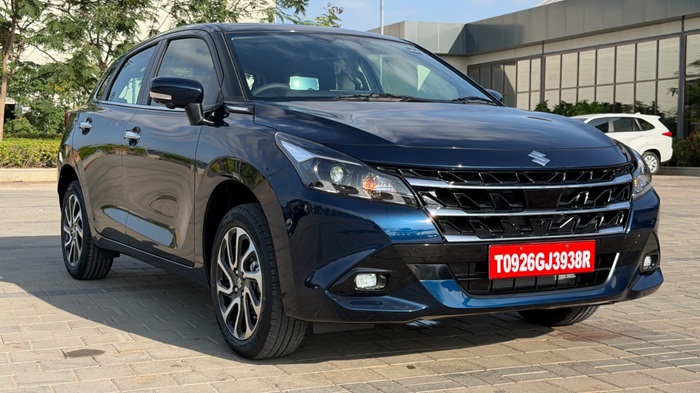
The facelift’s nose is centred around a new NEXWave chrome grille, flanked by automatic LED projector headlamps incorporating LED daytime-running lights, High Beam Assist and a follow-me-home function. LED fog lamps sit lower down.
It is a busier face than earlier Balenos, but not excessively so. There is still enough restraint here that the car does not appear to be permanently angry at the traffic ahead. A chrome garnish on the front fender adds a small amount of jewellery without turning the bodywork into a mobile cutlery drawer.
The outside mirrors are electrically adjustable and automatically folding, and integrate turn indicators as well as cameras for the 360-degree viewing system. Those cameras are considerably more useful in daily life than a decorative styling insert, particularly when squeezed between motorcycles, delivery scooters and parking pillars designed apparently by someone who dislikes alloy wheels.
Dimensionally, the Baleno is around 4 metres long, 1.7 metres wide and 1.5 metres tall. It weighs roughly 1,000 kg kerb, while the supplied gross vehicle weight is 1,400 kg. Its 4.8-metre turning radius reinforces the urban-friendly brief: this is still a car designed to negotiate city streets rather than dominate them.
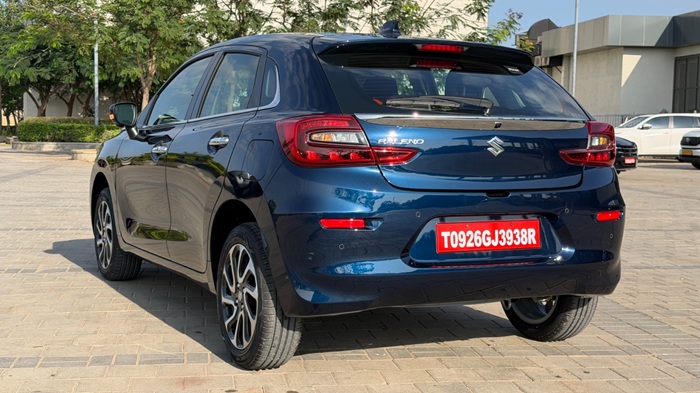
The Alpha (O) wears 16-inch painted precision-cut alloy wheels wrapped in 195/55 R16 87H Apollo Alnac 4G radial tubeless tyres. Lower specifications can also be had with 15-inch steel wheels. Braking hardware consists of discs at the front and drums at the rear.
Our car is finished in Nexa Blue, one of seven listed exterior colours alongside green, red, white, silver, grey and black. Blue suits the Baleno rather well because the colour gives definition to the body without making it look as if it is trying desperately to qualify for an Instagram reel.
At the rear are LED tail lamps with an Emergency Stop Signal, together with a rear wiper and washer and rear defogger. There is no attempt to turn the back of the Baleno into a faux off-roader; practicality remains the more important theme.
Underneath: conventional, light and uncomplicated
Suspension hardware follows a familiar front-wheel-drive hatchback formula: MacPherson struts with coil springs at the front and a torsion-beam arrangement with coil springs at the rear.
There is nothing exotic here, but exotic suspension would rather miss the point. The Baleno’s mechanical package is designed around low weight and everyday usability. At around one tonne, the car is substantially lighter than the typical compact SUV, and less mass means the engine, brakes and suspension have less work to do.
The supplied material does not provide an official ground-clearance figure, wheelbase measurement or detailed road-test ride observations, so inventing pothole heroics would be rather less professional than admitting that. What the hardware tells us is that the Baleno stays with a conventional layout rather than chasing complexity for its own sake.
Cabin: the Baleno grows up
The Baleno’s interior specification is where the 2026 Alpha (O) most obviously moves beyond the traditional definition of an economical hatchback.
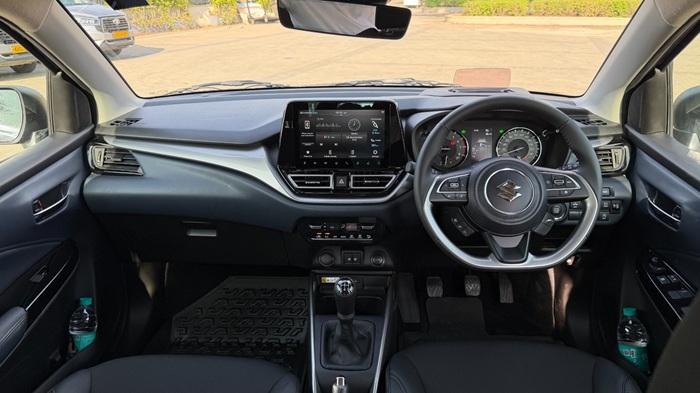
Front occupants get ventilated seats, a feature that stops sounding frivolous approximately eleven seconds after climbing into a car parked under an Indian summer sun. The driver’s seat is height adjustable, while the steering column offers both tilt and telescopic adjustment, giving the driver useful scope to find a comfortable position.
The steering wheel itself is wrapped in leatherette and carries controls for telephone functions, voice commands and the infotainment system. Leatherette upholstery is available, while fabric trim is also offered.
There is an auto-dimming inside rear-view mirror, automatic climate control and footwell lighting. The driver’s power window has one-touch auto up/down operation with anti-pinch protection, while the glazing includes UV-cut glass.
None of those items individually transforms the ownership experience, but collectively they make the Alpha (O) feel considerably removed from the old-school Indian hatchback in which power windows were once treated as a luxury worth printing in large letters on the brochure.
Practicality remains central to the Baleno. There is a 318-litre boot, and the rear seat can be folded in a 60:40 split when more luggage room is required.
The supplied notes do not provide actual rear knee-room, headroom or shoulder-room measurements, so there would be little point fabricating tape-measure theatre. What can be said is that the split rear backrest and sensible boot volume preserve the everyday versatility expected of a five-door hatchback.
Screens, connectivity and the inevitable app
At the centre of the dashboard sits a 9-inch SmartPlay Pro+ touchscreen infotainment system supporting USB connectivity, wireless Android Auto and Apple CarPlay, FM/radio, Suzuki’s Hi Suzuki voice assistant and ARKAMYS Surround Sense processing.
Lower variants use a smaller 7-inch infotainment unit.
Sound comes through a six-speaker Clarion audio system, while wireless smartphone charging includes active cooling. That last detail sounds amusingly overengineered until you remember how hot wirelessly charging smartphones can become while simultaneously running navigation.
There is also a head-up display, allowing useful driving information to be projected into the driver’s line of sight rather than requiring repeated glances down at the instrument cluster.
The main instrument binnacle incorporates a TFT display, although the supplied specification does not detail every individual readout available through it.
Then there is Suzuki Connect, which effectively turns the smartphone into a remote interface for the car. Its listed functions include emergency alerts, remote door locking or cancellation, hazard-light control, headlamp-off commands, alarm functions, an immobilizer request, battery-health monitoring, smartwatch connectivity, Alexa Skill connectivity, stolen-vehicle tracking, tow-away tracking, geofencing, time fencing, valet alerts, AC-idling information, trip summaries, driving-behaviour data, vehicle-location sharing and overspeed alerts.
It is an enormous menu.
Whether an owner regularly uses every one of those features is another question. Nobody has ever walked away from a restaurant feeling deprived because the menu contained only 30 dishes rather than 47. Still, stolen-vehicle tracking, battery information, location sharing and remote alerts are the sort of connected functions that can genuinely become useful rather than merely helping a salesman occupy another five minutes during delivery.
Two accessory themes are also available: the Elegrande Collection and Novo-Spirit Collection.
Level 2 ADAS comes to the Baleno
Perhaps the most significant addition to this 2026 specification is the driver-assistance package.
The Baleno is equipped with Level 2 ADAS, incorporating Lane Keep Assist, Lane Departure Prevention, Lane Departure Warning, Vehicle Sway Warning, Advanced Emergency Braking and Forward Collision Warning.
It also gets Adaptive Cruise Control with Curve Speed Reduction.
That is a considerable amount of driver assistance for a mainstream hatchback in this price region. More importantly, it moves the Baleno’s technological positioning forward rather than simply decorating the facelift with different bumpers and calling it progress.
The usefulness of such systems ultimately depends on calibration, road markings and conditions, and the supplied notes do not contain an independent test of intervention quality. But on equipment alone, this is a notably more sophisticated Baleno than the nameplate began life as in India.
Safety: plenty of hardware, but mixed crash-test headlines
Standard safety equipment listed for the Baleno includes six airbags, ABS, EBD, Electronic Stability Program, hill-hold assistance, traction control, brake assist, a 360-degree camera, rear parking sensors, tyre-pressure monitoring, ISOFIX child-seat mounting points, high-speed alerts and seatbelt reminders.
There are also three-point ELR seatbelts with pretensioners and force limiters, central locking, keyless entry and a security alarm.
The car complies with full-frontal impact, frontal-offset impact, side-impact and pedestrian-protection requirements according to the supplied information.
Crash-test scores, however, tell a less straightforward story. The specification supplied for this review lists the Baleno at four stars out of five under Bharat NCAP while also noting a two-star Latin NCAP result. Those are the figures provided, and they mean the Baleno’s safety story is not one where a single badge can conveniently end the conversation.
The strongest argument for the 2026 car is therefore not simply a star score, but the sheer breadth of active and passive safety technology fitted to the Alpha (O), particularly the addition of ADAS.
The new Z12E three-cylinder
Beneath the bonnet is Suzuki’s 1.2-litre Z12E petrol engine, an inline three-cylinder unit producing 81 horsepower and 112 Nm of torque.
This engine has replaced the previous K12 family and is also used in models including the Swift, Dzire, Solio and Xbee.
Transmission choices include a five-speed manual and five-speed AMT automatic. The engine is E20 compliant, and the Baleno remains front-wheel-drive in character rather than trying to complicate matters with unnecessary driveline hardware.
The important thing to understand from the figures is that this is not a performance hatchback and makes no attempt to impersonate one. Eighty-one horsepower pushing roughly a tonne of Baleno should be viewed through the lens of economy and urban usability rather than stopwatch bragging rights.
No official 0–100 km/h time or maximum-speed figure is supplied in the source material, so there is little value in inventing one. This is a car whose more relevant numerical achievements happen at the fuel pump.
The petrol manual is rated at 23 km/l, while the AMT improves the claimed figure slightly to 24 km/l. Fuel-tank capacity is 37 litres.
That efficiency is central to the Baleno’s character. A car like this is expected to spend far more time commuting, carrying families and sitting beneath flyovers than attacking mountain passes. Fuel economy therefore matters enormously more than shaving a few tenths from an acceleration run.
CNG: efficiency taken even further
The CNG version uses the same 1.2-litre three-cylinder Z12E engine.
When running on CNG, output drops to 68 horsepower and 101 Nm. On petrol it retains the full 81 horsepower and 112 Nm.
Claimed economy is 33 km/kg with the manual transmission and 34 km/kg with the automatic, according to the supplied specification. The CNG configuration lists a 55-litre CNG tank as well as the 37-litre petrol tank.
The source material also states that the CNG version will be offered with both five-speed manual and automatic transmission options.
That makes the CNG derivative particularly interesting for buyers whose annual running is high enough for fuel costs to outweigh any desire for maximum performance. Losing 13 horsepower and 11 Nm when running on CNG will obviously alter the performance equation, but 33–34 km/kg is the sort of claimed efficiency number capable of making spreadsheet-minded buyers unusually cheerful.
What the chassis promises
The Baleno’s light kerb weight, modest dimensions and 4.8-metre turning radius all point towards an urban-biased personality.
The steering hardware is not described in detail by the supplied notes, and neither are measured braking distances, body-roll figures or NVH measurements. What we do know is that the front MacPherson-strut and rear torsion-beam arrangement is conventional for this class, while the relatively light body means it does not need enormous tyres or brakes merely to control its own mass.
Front discs and rear drums may look less glamorous on a specification sheet than discs all round, but glamour has never actually stopped a car.
The 195/55 R16 tyres fitted to the Alpha (O) also avoid the temptation to chase absurdly low-profile rubber. In a country full of expansion joints, broken road surfaces and speed breakers with ambitions of becoming small hills, that restraint deserves acknowledgement.
The Baleno’s remit remains clear: easy to manoeuvre, easy to place and compact enough that parking should not become an event requiring walkie-talkies.
Living with it
This is where the Baleno’s strongest argument emerges.
It combines familiar hatchback proportions with equipment that, not very long ago, would have sounded ambitious even on significantly more expensive cars. Ventilated seats, a head-up display, 360-degree cameras, wireless smartphone integration, active-cooled wireless charging, adaptive cruise control and Level 2 driver assistance are not token additions.
Neither has practicality disappeared beneath the technology. The 318-litre boot remains available, the rear backrest splits 60:40, and the car’s compact dimensions make it inherently easier to use in crowded cities than many taller and heavier alternatives.
Owners can also personalise it through the Elegrande and Novo-Spirit accessory packages, although one suspects the Nexa Blue Alpha (O) already has enough visual and technological activity without needing every box in the accessories catalogue ticked.
The Toyota connection
The most direct alternative contained within the supplied information is Toyota’s Glanza, essentially the Baleno’s close relative sold through Toyota’s network, while the Starlet name is also used for a Toyota version in other markets.
That relationship is useful because it illustrates how mature the underlying Baleno formula has become. Few manufacturers agree to place their badge on somebody else’s hatchback unless the basic package makes commercial sense.
For buyers, the final decision between closely related versions is therefore likely to come down to variant equipment, pricing, dealership preference and ownership considerations rather than radically different engineering.
Within Suzuki’s own extended family, the Baleno also shares its HEARTECT foundations with everything from the Swift and Dzire to the Ignis, Fronx and several overseas models. The architecture may not be glamorous dinner-table conversation, but shared engineering at this scale is precisely how manufacturers make mainstream cars affordable to build, maintain and develop.
Verdict
The 2026 Maruti Suzuki Baleno Alpha (O) is interesting because it shows just how far the definition of an ordinary Indian hatchback has moved.
Its fundamentals are still reassuringly straightforward. It is roughly four metres long, weighs about a tonne, uses a naturally aspirated 1.2-litre three-cylinder engine and sends its power through either a five-speed manual or AMT. There is a conventional torsion beam at the rear, drum brakes behind the back wheels and enough boot space to make the car genuinely useful.
None of that sounds terribly exotic.
Then you reach the rest of the specification: six airbags, a 360-degree camera, head-up display, ventilated seats, active-cooled wireless charging, connected-car technology, Adaptive Cruise Control, Curve Speed Reduction and Level 2 ADAS.
Suddenly, the humble hatchback appears to have been reading luxury-car brochures after bedtime.
The 81 hp and 112 Nm petrol engine will not turn this Baleno into a hot hatch, and buyers seeking outright excitement are clearly looking at the wrong brief. Likewise, the contrasting Bharat NCAP and Latin NCAP scores prevent the safety story from being reduced to one triumphant headline.
But the Baleno has never succeeded because it excels at one spectacular party trick. It succeeds because so many ordinary things appear to have been considered together: compact dimensions, low weight, useful luggage capacity, high claimed fuel economy, multiple fuel choices, a broad price spread and, increasingly, a serious equipment list.
At approximately ₹6 lakh to ₹10 lakh ex-showroom, the range covers a wide section of the hatchback market, while this Alpha (O) is aimed at someone who wants nearly every available convenience without abandoning the size and efficiency advantages of a traditional hatchback.
Petrol buyers get claimed economy of 23–24 km/l, while the CNG version stretches that claim to 33–34 km/kg. That matters rather more to the Baleno’s typical owner than whether the car produces an exciting exhaust note outside a tunnel.
And perhaps that is the best way to understand the latest Baleno.
It has not suddenly become an enthusiast’s toy, nor is it pretending to be a miniature SUV. It remains a sensible hatchback — only now the sensible hatchback has ventilated seats, watches the lane markings, projects information onto the windscreen and can warn you through your smartwatch if somebody is towing it away.
Progress, apparently, comes to everyone eventually.