
There is a point in an SUV’s life when it stops trying to prove that it belongs and starts behaving as though the parking space was reserved for it all along. The Kia Sorento appears to have reached that stage.
First launched in 2002, the Sorento has spent more than two decades evolving from a fairly traditional Korean SUV into a large, technology-heavy family crossover with increasingly premium ambitions. What you are looking at here is the facelifted fourth-generation model for 2026, known internally by the MQ4i codename. And rather than quietly sitting between mainstream family SUVs and luxury machinery, it appears determined to occupy as much of the territory between the two as possible.
In India, the range starts at a claimed ₹28 lakh ex-showroom and stretches to ₹40.39 lakh for the top model. The car here is that flagship HTX(A) AWD, configured as a six-seater with captain chairs in the middle row, although a seven-seat version is also available. Underneath all the visual theatre sits a unibody structure, so despite the considerable dimensions and a selection of terrain modes, this is fundamentally a modern road-oriented crossover rather than an old-school ladder-frame expedition vehicle.
The name, incidentally, is borrowed from the Italian city of Sorrento. Kia has apparently dropped one of the Rs for the badge, but the Mediterranean aspiration remains. The Sorento itself has travelled considerably farther than the Italian coastline: Kia’s SUV has been sold across 132 countries, with more than 48 lakh examples claimed to have found buyers globally. Annual worldwide sales are said to sit at roughly 2.40 lakh units. That makes it not merely another model in Kia’s catalogue but one of the company’s genuine international heavyweights.
A familiar family, dressed for a more expensive neighbourhood
Karim Habib is credited in the supplied material with the Sorento’s design, which is significant because his résumé includes vehicles from Kia as well as BMW and Mercedes-Benz. Names associated with his work include the EV9, EV4, K4, Seltos, Sonet, Carnival and Optima, along with BMW’s 5 Series, X6, X3 and 7 Series and the Mercedes-Benz F800 concept.
The Sorento rides on the Hyundai-Kia N3 architecture, an exceptionally busy corporate platform family underpinning products including the Kia Carnival, Sportage, K8 and K5 as well as Hyundai’s Tucson, Staria, Santa Fe, Sonata, Santa Cruz, ST1, Mufasa, Mistra, Grandeur and Custo. In other words, the Sorento is not built upon some strange engineering island. It shares its foundations with a substantial collection of vehicles, which is usually good news for development maturity and component commonality.
Assembly is listed across India, South Korea, the USA, Vietnam, Malaysia and Pakistan, giving an idea of just how international the Sorento operation has become.
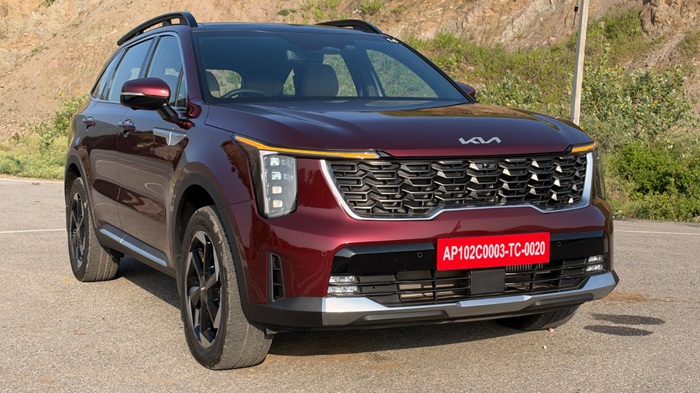
Visually, however, Kia has clearly attempted to give the facelift its own identity. The company calls the theme its “Digital Tiger Face”, which sounds like something that might attack you inside a video game but works rather better in metal.
The nose is upright and imposing, with Crystal Cube LED projection headlamps providing much of the visual signature. They are backed by High Beam Assist, a follow-me-home function and automatic light control. LED fog lamps sit lower down, while a skid-plate treatment attempts to remind you that this SUV has AWD and terrain modes even if its most frequent obstacle is likely to be a badly designed mall ramp.
Rain-sensing aero wipers are fitted, and the front windshield gets both solar and acoustic treatment. That latter detail matters more than it sounds. Large SUVs present a lot of surface area to wind noise, and anything that keeps the cabin calmer on a long highway journey is worth considerably more than another animated menu buried three pages deep inside the infotainment system.
The electrically adjustable and power-folding outside mirrors incorporate LED indicators and cameras, contributing to the Sorento’s extensive visibility and parking technology.
Then there is the sheer amount of car.
The Sorento is approximately 4.8 metres long, 1.9 metres wide and 1.8 metres tall. Ground clearance is quoted at 209 mm, while kerb weight sits at about 1,929 kg and gross weight at 2,600 kg. Kia also claims towing capacity of up to 2,500 kg.
Those dimensions place it firmly in big-SUV country. Kia says it is the longest and widest vehicle in its segment, although that is the sort of manufacturer comparison that inevitably depends upon exactly which competitors are invited to the measuring tape.
What is beyond dispute is that 1.9 metres of width will make itself known on crowded Indian streets. A Sorento may have cameras, parking sensors and driver assistance coming out of its metaphorical ears, but technology has yet to develop an app that makes a narrow basement pillar move politely out of the way.
Big wheels, big stance, surprisingly restrained detailing
The HTX(A) here runs 19-inch crystal-cut alloy wheels, though 18-inch wheels are also available. The supplied specification lists 235/55 ZR19 101Y Vredestein Ultrac Vorti radial tubeless tyres front and rear, with disc brakes on both axles.
Those wheels help the Sorento carry its bulk without looking under-tyred, an occupational hazard for large crossovers. Yet there is enough sidewall remaining in the 55-profile tyre to suggest somebody remembered Indian roads do occasionally contain surfaces apparently created by artillery.
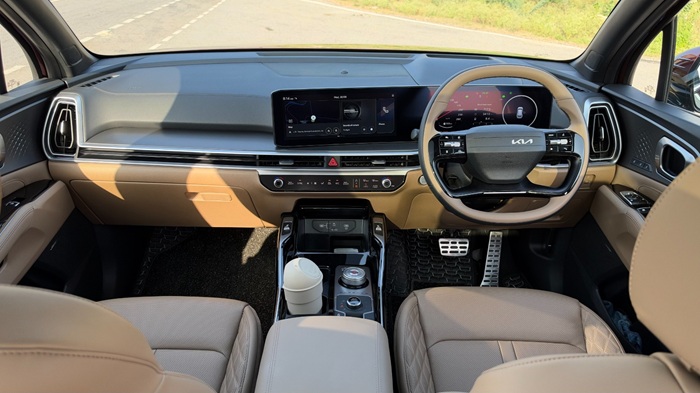
The car photographed here wears Magma Red, with black, white, blue, olive, grey, silver and matte black also listed as available colours.
From the rear, there is an intriguing claim in the notes: the design has a Rolls-Royce Cullinan flavour. That is not to say your Kia has suddenly become a ₹10-crore British luxury SUV simply because you have walked around the back of it, but the upright proportions and vertically emphasised tail treatment do lend it a more expensive-looking stance than one might expect from the badge.
Star Map LED tail lamps incorporate an Emergency Stop Signal. There is a rear washer and wiper, a defogger, an LED high-mounted stop lamp and a roof spoiler. The wiper itself is hidden, helping clean up the tailgate visually. An 18-inch steel spare wheel is also provided, which is refreshingly practical in a world increasingly convinced that tyre sealant and positive thinking constitute a spare tyre.
Six adults, three rows and a battle with luggage
The Sorento can be specified with six or seven seats, and the flagship shown here uses the more indulgent six-seat arrangement.
That means captain chairs in the second row rather than a conventional bench. They slide, recline and can be folded remotely, while ventilation offers three stages of cooling. Rear passengers also get sunshade curtains, and Kia provides what it calls Wing Type headrests.
The practical cost of carrying three rows is predictable. With every seat in use, boot capacity is 179 litres. Fold the 50:50 split third row and the luggage area expands dramatically to 813 litres.
That difference tells the entire three-row-SUV story. With seven humans aboard, everyone should pack as though the airline has lost their suitcase already. With the third row down, however, the Sorento becomes genuinely useful for luggage, airport runs and the sort of family holiday where somebody insists an electric rice cooker is an essential travel item.
A power tailgate with anti-pinch protection makes loading easier, while grab handles incorporate touch sensors and pocket lighting. One-touch anti-pinch power windows, conveniently, are also part of the equipment.
The cabin is where the Sorento starts aiming higher
Open the door and the Sorento makes a much stronger attempt at premium-car theatre than older generations ever did.
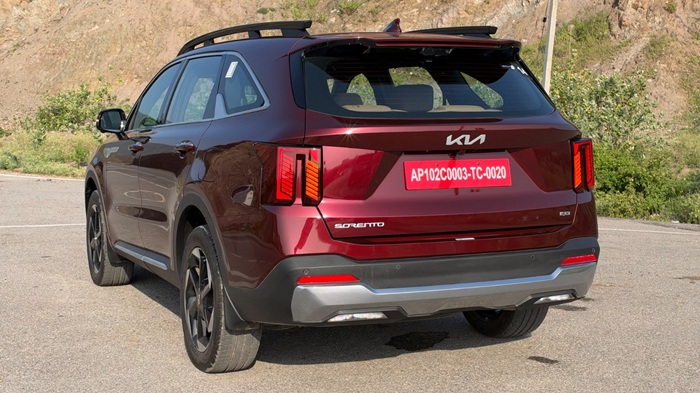
Brown leatherette upholstery is fitted here, with grey also available. Up front are electrically adjustable relaxation seats with 10-way adjustment, lumbar support, sliding headrests and three-stage ventilation. The driver gets an Ergo Motion seat with a welcome retract function.
The second row is not treated as an afterthought. Apart from ventilation and adjustable captain chairs, there is Boss Mode, allowing a rear occupant to move the front passenger seat. It is the kind of feature that will delight anyone being chauffeured and mildly annoy whichever family member has been appointed temporary driver for the afternoon.
There is also a 220-volt power outlet, which broadens the Sorento’s usefulness considerably on long journeys.
Across the dashboard sits a panoramic curved display panel. Ahead of the driver is a 12.3-inch HD digital instrument cluster, while lower variants are said to use a 4.2-inch TFT display. Alongside it is another 12.3-inch HD touchscreen infotainment unit.
The system supports wireless Android Auto and Apple CarPlay, built-in navigation, Bluetooth, USB connectivity, FM and radio, OTA software updates and the Kia Connect Store. The supplied specification also describes a Kia AI Assistant using real-time generative-AI capabilities, Perplexity intelligence, SoundHound AI voice technology and Nvidia CCNC.
At some point the modern automobile quietly stopped being a machine into which software was installed and became a software platform surrounded by suspension. The Sorento appears fully committed to that transition.
India also gets, according to the source notes, nine Disney, Marvel and Pixar themes for the infotainment and instrument cluster. Whether you consider Captain America appearing on the dashboard an exciting technological advancement or evidence that civilisation has peaked is very much a matter of personal taste.
More useful everyday technology includes a head-up display, a digital auto-dimming rear-view mirror and navigation-linked Smart Cruise Control. The leatherette-wrapped four-spoke steering wheel carries controls for the phone, infotainment, volume and voice functions, and offers both tilt and telescopic adjustment.
A dual-pane panoramic sunroof adds the obligatory big-SUV sense of occasion, while 64-colour ambient lighting allows owners to spend approximately the first three weeks deciding which shade they like before leaving it unchanged forever.
A 12-speaker Bose premium audio system handles entertainment. There is wireless phone charging, dual-zone automatic climate control, a dial-type shift-by-wire selector and a switch that allows the climate and infotainment control interface to swap functions. Alloy pedals add a slightly sportier visual note.
In short, Kia has not been shy with equipment. The more interesting question is not whether the Sorento has features, but whether its many layers of technology remain intuitive enough to use while actually travelling at speed. Feature density and usability are not always the same thing.
Diesel muscle or hybrid cleverness
The diesel powertrain is probably the easiest to understand in traditional large-SUV terms.
It is a 2.2-litre, inline-four CRDi Smartstream D2.2 engine producing 190 hp and 442 Nm. Drive goes through an eight-speed wet dual-clutch automatic transmission, and the same basic diesel engine is also stated to be used in the Kia Carnival and Hyundai Santa Fe.
The engine uses an aluminium block and is claimed to be 38 kg lighter than the older unit. Interestingly, the notes specify that it uses a timing belt rather than a timing chain.
A 67-litre fuel tank is paired with a 14-litre DEF tank. Claimed fuel economy is listed at 15 km/l for AWD versions and 17 km/l for 2WD models.
That 442 Nm figure is the one that matters most conceptually in a nearly two-tonne family SUV. Large vehicles need effortless middle-order shove far more often than they need theatrical high-rpm horsepower, especially when loaded with passengers and luggage. The diesel specification certainly looks appropriately torquey for the job, though no independently measured acceleration figures are supplied in the source material and therefore none should be invented.
The petrol-based hybrid is considerably more interesting.
Its Smartstream 1.6 Turbo-GDi four-cylinder engine works with an electric motor and a 1.49 kWh lithium-ion battery. Combined output is listed at 212 hp with 264 Nm of torque. Claimed efficiency rises to 17 km/l in AWD form and 19 km/l with 2WD.
The source also describes the Sorento Hybrid as Kia’s first hybrid vehicle in India and the first AWD hybrid in its segment. It adds regenerative braking, a Virtual Engine Sound System and V2L functionality. Kia gives the hybrid battery an eight-year/1.60 lakh km warranty.
Meanwhile, other Sorento versions sold internationally include 2.5-litre four-cylinder petrol engines, a 3.5-litre V6 and plug-in hybrid configurations, but the supplied material states that these particular versions are not available in India.
Petrol automatic versions are listed with a six-speed automatic transmission, while both petrol and diesel models use a rotary shift-by-wire selector.
AWD without pretending to be a mountain goat
The Sorento’s suspension hardware is conventional but appropriately sophisticated: MacPherson struts with a stabiliser bar at the front and an independent multi-link arrangement at the rear.
That independent rear suspension matters on a three-row crossover because the vehicle must balance several competing jobs. It needs to keep passengers comfortable, control nearly two tonnes of mass and avoid making the third row feel as though it has been positioned directly above a commercial-vehicle axle.
Kia provides four drive modes — Eco, Sport, Smart and Normal — plus Snow, Mud and Sand terrain modes. AWD obviously gives the Sorento a broader operating envelope than a front-driven family crossover, while 209 mm of clearance should make rough roads, badly shaped speed breakers and mild trails less intimidating.
However, the supplied data does not include approach, departure or breakover angles, water-wading depth, low-range gearing or locking differential specifications. It would therefore be misleading to present the Sorento as a hard-core off-roader. Its unibody construction and terrain software suggest a capable all-weather, poor-road family SUV rather than something designed primarily to spend weekends winching itself out of forests.
There is also remote parking through the key, a particularly useful trick for an SUV this size. When somebody in a shopping centre parks six centimetres from your driver’s door, the Sorento may be able to rescue you from a manoeuvre otherwise involving considerable abdominal compression and vocabulary unsuitable for children.
Kia also says considerable effort has gone into NVH suppression, including door-trim insulation and other engineering measures. Again, without inserting road-test measurements that were not supplied, the sensible takeaway is simply that acoustic refinement has clearly been treated as a development priority.
Safety: the Sorento arrives heavily armed
The safety specification is extensive.
Ten airbags are listed, alongside ABS, brake assist, electronic stability control, Vehicle Stability Management, hill-start assist, downhill brake control, seatbelt reminders, a rollover sensor and a multi-collision braking system.
There are three-point seatbelts, ISOFIX child-seat mounts and child locks, plus speed-sensing automatic door locking and impact-sensing automatic unlocking. Rear Occupant Alert is included too.
Visibility support includes a 360-degree camera, front and rear dashcams and parking sensors at the front, rear and sides. A high-line tyre-pressure monitoring system is also part of the package.
The Level 2+ ADAS suite includes Forward Collision-Avoidance Assist, Lane Departure Warning, Lane Keeping Assist, Lane Following Assist, Driver Attention Warning, Leading Vehicle Departure Alert, Blind Spot Collision Avoidance Assist, Rear Cross Traffic Collision Avoidance Assist, Safe Exit Warning, Blind View Monitor, Highway Driving Assist and Parking Collision Avoidance Assist.
There is a philosophical divide surrounding ADAS in India. Properly calibrated, such systems can reduce fatigue and add an important safety net. Poorly calibrated, they can behave like an anxious driving instructor who has recently discovered warning beeps. The hardware list here is certainly comprehensive; actual calibration and behaviour are ultimately what determine whether the systems become trusted companions or buttons owners hunt for after every restart.
The source material states that the Sorento has received five-star ratings from Euro NCAP and Australasian NCAP, while the IIHS assessment is described as its highest “Good” rating. Those ratings apply within the contexts and protocols of the respective organisations and markets.
Kia has also accumulated a lengthy awards list for the Sorento over the years, including recognition associated with Good Design, Red Dot, J.D. Power vehicle dependability, Car of the Year, Best Large SUV and Best Buy honours.
Connected ownership, with a respectable warranty
Kia Connect 2.0 provides smartphone access to more than 85 connected-car functions. Features listed include Remote Vehicle Immobilization, Digital Key 2.0 and Find My Car.
The Sorento itself carries a three-year, unlimited-kilometre warranty according to the supplied information, with the possibility of extending coverage to five years. That unlimited-kilometre provision should appeal particularly to high-mileage owners who regularly use the vehicle for intercity travel.
The hybrid battery, as mentioned earlier, receives a separate eight-year/1.60 lakh km warranty.
No detailed servicing schedule, maintenance pricing or resale-value data has been supplied, so anything more precise on ownership cost would be guesswork.
So what is the Sorento really competing with?
At ₹28 lakh to ₹40.39 lakh ex-showroom according to the supplied notes, the Sorento enters a fascinating area of the Indian SUV market.
It is expensive enough that buyers will expect more than space and reliability. They will expect technology, material quality, visual presence and a sense that the vehicle is meaningfully more sophisticated than mainstream mid-size SUVs. Yet it remains priced below the territory occupied by many comparably sized traditional luxury SUVs.
That gives the Sorento a familiar Kia advantage: equipment density.
Three seating rows, available AWD, a sophisticated second row, twin 12.3-inch displays, Bose audio, ADAS Level 2+, 10 airbags, 360-degree cameras, connected-car technology, a panoramic roof and the choice of strong diesel torque or hybrid efficiency create a formidable specification.
But specification alone cannot settle the argument.
Buyers who prioritise a more rugged ladder-frame construction or serious off-road hardware may prefer a fundamentally different kind of SUV. Those chasing an established luxury badge may also find the Sorento’s badge positioning difficult to ignore once the price approaches ₹40 lakh.
And anyone buying primarily for urban use should consider whether they genuinely need 4.8 metres of family SUV every time they leave the house. No number of parking cameras can physically shrink a car.
The Sorento instead makes most sense for the buyer who actually intends to use its space: families travelling regularly with six or seven occupants, highway users, owners wanting genuine second-row comfort and people attracted to premium equipment without automatically stepping into a traditional luxury brand.
Verdict
The 2026 Kia Sorento is not trying to be simple.
It is big, heavily equipped, technically ambitious and apparently determined to offer an electronic solution to virtually every inconvenience other than relatives arguing over the third row.
Yet beneath the sprawling equipment list is a sensible basic formula.
You get a unibody three-row SUV measuring around 4.8 metres long, with independent rear suspension, up to 209 mm of ground clearance, available AWD, a 2.2-litre diesel producing a useful 442 Nm, or an electrified 1.6-litre turbo alternative offering stronger claimed efficiency. The second row has been treated almost as seriously as the first, the third row can disappear to create 813 litres of cargo capacity, and the safety specification is unusually comprehensive.
Its weaknesses are equally predictable. With all seats raised, 179 litres is not much luggage space. Its considerable width will require care in older Indian city centres. The flagship’s ₹40.39 lakh ex-showroom price puts expectations very high. And with this much software, AI integration, display technology, drive modes and assistance technology, some buyers may reasonably wonder whether a family SUV needs quite so many digital layers.
But perhaps that complexity is precisely what defines the modern Sorento.
The original 2002 model belonged to an era when SUVs proved themselves with mechanical toughness. This fourth-generation facelift belongs to an era in which they must be family lounge, long-distance cruiser, mobile entertainment hub, safety supervisor and occasionally a remote-controlled parking device.
The Sorento has grown up with the market.
And after more than 48 lakh global sales, it no longer feels like a Korean SUV asking whether it deserves to sit beside the established names. It feels more like one that has already taken the chair, adjusted its ventilated seat, selected one of 64 ambient-lighting colours and is wondering what took everyone else so long.