



Monterey, California: Aston Martin has unveiled the Valen, a new limited-production V12 supercar developed through its Q by Aston Martin bespoke division, claiming the title of the world’s most powerful front-engined production car. With 850PS, 1,000Nm of torque, extensive carbon-fibre construction and production restricted to 150 examples, the Valen becomes the most powerful front-engined Aston Martin in the company’s 113-year history.
Powered by an uprated version of Aston Martin’s 5.2-litre twin-turbocharged V12, the Valen produces its 1,000Nm peak torque from just 2,500rpm. The engine is paired with a recalibrated eight-speed ZF transmission, helping the car accelerate from 0-60mph in a claimed 3.0 seconds. Top speed is electronically limited to 214mph, or around 344km/h.
First deliveries are scheduled to begin in the second quarter of 2027.
The Valen is the latest limited-production model to emerge from Q by Aston Martin, following cars including the Valour, Valiant and DBR22. The programme was developed with the company’s newly formed Special Vehicle Operations department, which has been tasked with bringing together bespoke design and specialised engineering projects.
Aston Martin CEO Adrian Hallmark said: “The latest in a bloodline of limited production special series models from our bespoke service, Q by Aston Martin, Valen’s world-beating performance required a design to capture the raw motion and unmatched output of our V12 powertrain. With more power, less weight, and a spectacular soundtrack, the dramatic design is backed up by equally dramatic performance.”
The Valen name comes from the Latin word valens, referring to “strong” or “powerful”, while maintaining Aston Martin’s long-running tradition of performance models carrying names beginning with the letter V.
More Power, Less Weight
Beyond the headline V12 output, Aston Martin has concentrated heavily on reducing mass. The company says the Valen can weigh up to 110kg less than its existing core V12 platform, thanks to extensive use of carbon fibre, aluminium, titanium and magnesium.
An optional lightweight package goes further, replacing components with machined-from-solid aluminium suspension arms and knuckles alongside titanium chassis bolts. Aston Martin says those measures alone remove 16.9kg.
Lightweight magnesium wheels are standard, reducing unsprung mass and intended to improve steering response, wheel control and ride quality.
The wheels use specially developed Aston Martin-specification Pirelli P Zero R tyres measuring 275/35 ZR21 at the front and 325/30 ZR21 at the rear. P Zero Winter 2 tyres in corresponding sizes will also be available.
The Valen additionally uses Pirelli Cyber Tyre technology, which communicates real-time tyre information with the car’s electronic control systems. Developed with Bosch Engineering, the system integrates tyre data with the ESP, ABS and traction-control systems, allowing their operating thresholds to be adjusted continuously.
It is a rather sophisticated way of ensuring that 850PS does not simply turn every enthusiastic throttle application into an impromptu lesson in tyre smoke.
Sharper Eight-Speed Gearbox and Three Driving Modes
Aston Martin says the eight-speed ZF automatic transmission has been given quicker shifts using strategies developed for the Vantage GT4 racing programme.
Drivers can choose between Sport, Sport+ and Track modes, with each altering the Valen’s powertrain and dynamic character.
Throttle response also changes according to the selected setting. Sport and Sport+ use a shorter pedal map, introducing more throttle earlier in the pedal’s travel. Track mode adopts a longer, more progressive map, intended to provide finer control when driving close to the car’s limits.
Aston Martin Director of Vehicle Performance Simon Newton said: “When your basis for a project is the world’s most powerful front-engined production car you know you’re going to have fun. Valen channels the more overt dynamic purpose of a true sportscar and amplifies that energy and focus to further unleash Valen’s potential. Everything we’ve done to the powertrain and chassis has been driven by the same objective; to intensify the character and capability to deliver a truly thrilling experience that’s accessible to all skill levels, but keen drivers will absolutely relish.”
Chassis Retuned for a More Focused Character
The suspension, steering, braking system, electronic stability control and chassis calibration have all been modified specifically for the Valen.
Aston Martin says the changes increase lateral stiffness at both ends of the car while reducing body roll and pitch. The aim is to make the Valen respond more quickly to driver inputs while retaining the compliance required for long-distance road use.
A solid-mounted rear subframe is combined with model-specific springs, helper springs and Bilstein DTX semi-active dampers.
The steering has also undergone extensive calibration, with Aston Martin aiming to make the Valen feel more agile than its dimensions might suggest and to improve the sense of connection between the front tyres and driver.
Braking is handled by carbon-ceramic discs measuring 410mm at the front and 360mm at the rear. A specifically calibrated brake booster is intended to maintain a firm pedal and provide consistent modulation at both road and track speeds.
Titanium Exhaust Turns Up the V12
A bespoke lightweight titanium exhaust system has been developed specifically for the Valen, combining reduced mass with a more distinctive V12 soundtrack.
The system incorporates new micro-mufflers to satisfy homologation requirements and four titanium exhaust outlets arranged across two levels. The tailpipe finishers are produced using 3D-printing technology.
The upper outlets remain permanently open, while the lower pair use valves that open according to the selected driving mode.
Aston Martin says engineers deliberately reduced some lower-frequency sounds while emphasising higher tones as engine speed rises. The upper outlets have even been tuned in a manner comparable to organ pipes to encourage resonance at higher revs.
In other words, the Valen’s engineers appear to have taken the traditional instruction to “turn the volume up” rather more scientifically than most.
Full Carbon-Fibre Body Brings a New Look
The Valen’s appearance represents a more aggressive interpretation of Aston Martin’s traditional front-engined, rear-wheel-drive proportions.
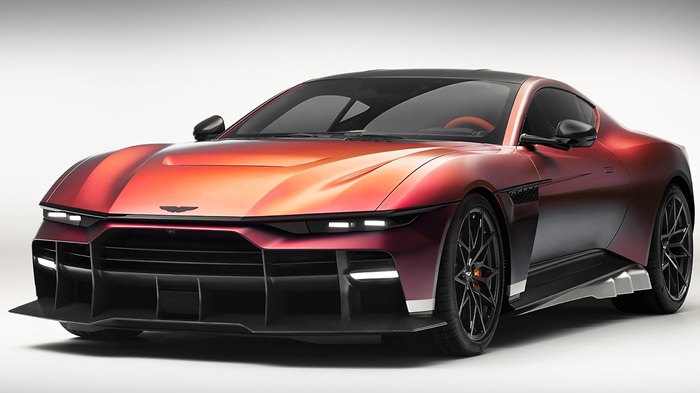
The entire body is manufactured from carbon fibre. At the front are deeply recessed slim headlamps positioned beneath the leading edge of the bonnet, together with a redesigned radiator opening, geometric mesh grille and sharply angled splitter.
A large bonnet vent aids airflow, while the traditional Aston Martin side strake has been extended and incorporated into a functional outlet that extracts air from the front wheel arches.
That feature stretches towards the doors before the body widens into prominent rear haunches.
Stepped side sills create a tightly drawn waistline, while saw-tooth vortex generators positioned towards their trailing edges manipulate airflow beneath the car to reduce lift and generate downforce.
New rear-quarter windows further distinguish the Valen from Aston Martin’s regular production models.
Aston Martin EVP and Chief Creative Officer Marek Reichman said: “Valen gave us the opportunity to explore and express more extreme emotions through a new form language and surface treatment. As such, Valen is a significant departure from what has gone before; sharply sculpted lines to reflect the aggressive dynamics, an attacking stance that emphasises the front-engine rear-drive layout and a bespoke interior design that creates a more sporting cockpit environment. Valen is a provocative front-engined supercar exuding increased potency and sporting intent, yet still celebrating the elevated luxury, meticulous detailing and unmistakable design signatures expected of a flagship Aston Martin.”
Unusual Tailgate Replaces Conventional Rear Window
The rear adopts one of the Valen’s more unconventional design decisions.
Rather than using a traditional fixed rear window and separate boot lid, Aston Martin has fitted a solid tailgate incorporating an aerodynamic wing in its upper section.
The arrangement opens to reveal a 170-litre luggage compartment. An optional Touring Pack adds bespoke luggage, while a tailored protective cover can be unfolded over the bodywork when loading or removing cases.
Beneath the tailgate is a full-width light bar and a sharply upswept rear surface that functions as a Gurney flap, producing downforce without requiring a large conventional wing.
A perforated section below the light bar helps release heat generated around the exhaust system, while a rising rear diffuser completes the car’s heavily aero-influenced treatment.
Satin Andromeda Red Show Car
The Monterey show car has been finished in a Q Ultra paint called Satin Andromeda Red.
According to Aston Martin, the finish combines deep red, copper and golden highlights with blue undertones, using Chromaflair pigments to change its appearance as lighting conditions and viewing angles vary.
Customers can alternatively specify fully exposed carbon fibre bodywork, complete with a herringbone weave running along the centre line of the car.
The exposed carbon can also be tinted in different colours with either satin or gloss finishes. Q by Aston Martin customers will be able to work with the company’s designers on bespoke colour treatments.
New Cabin Architecture
Inside, the Valen adopts a new cockpit architecture designed around the same visual-lightness philosophy as its weight-saving programme.
A slim centre console uses advanced 3D-printed components and incorporates a performance-focused switch arrangement derived from the mid-engined Valhalla. The console is angled towards the driver, while the central touchscreen has been reclined further into the dashboard.
Customers can choose between newly developed Sports Plus seats, designed to provide greater comfort on longer journeys, and lightweight carbon-fibre performance seats for more focused driving.
Aston Martin has also revised the way buyers configure the cabin.
Customers first select either Semi-Aniline Leather with Alcantara or full Semi-Aniline Leather upholstery, followed by one of five material treatments: Monotone, Duotone, Light Duotone, Tritone or Driver Focused.
Different specifications expand the areas receiving Valen’s newly developed quilting pattern, progressing from door panels through seats and, at the highest level, the headlining.
A Driver Focused option highlights the driver’s seat, while an additional accent package introduces contrasting colours.
More 3D-printed components appear throughout the interior, following an approach previously used on limited-production Aston Martins including the Valkyrie and DBS Zagato. Redesigned air vents and new anodised finishes are intended to reduce visual clutter while expanding the possibilities for personalisation through Q by Aston Martin.
Only 150 Examples
Production of the Aston Martin Valen will be strictly limited to 150 cars worldwide, positioning it as another highly exclusive chapter in the manufacturer’s growing series of specialised V12 models.
While its 850PS output and 214mph maximum speed provide the obvious headline numbers, the Valen is notable equally for the lengths Aston Martin has taken to combine power with lower weight, sophisticated tyre technology, extensively recalibrated chassis systems and bespoke carbon-fibre construction.
At a time when electrification is steadily reshaping the upper reaches of the performance-car market, the Valen also serves as an emphatic reminder that Aston Martin’s V12 story is not quite ready for its closing credits. For the 150 customers who secure one, there will be considerably more than nostalgia involved: there is still 1,000Nm of torque to deal with.