
At a time when practically every new vehicle wants to become an SUV, the Hyundai Verna continues to stand its ground as a proper Indian sedan. It is low, long, aerodynamic and unapologetically interested in giving its passengers a comfortable ride rather than pretending that every office commute is an expedition across the Himalayas.
The Verna nameplate was originally introduced in 1994, although the car has also been sold as the Hyundai Accent in several international markets. What you are looking at here is the facelifted version of the sixth-generation Verna, carrying the internal codename BN7.
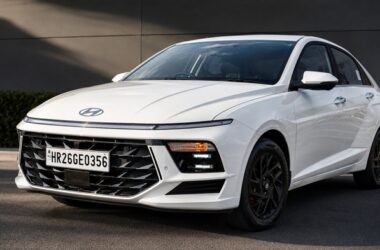
The model shown here is the range-topping Hyundai Verna HX10 DCT, finished in Atlas White. It sits at the top of a petrol-only range that starts at approximately ₹11 lakh ex-showroom and stretches to ₹18.41 lakh for the fully loaded variant.
That is serious money for a mid-size sedan, but this is also no longer a simple three-box family car with four doors and a boot. The new Verna combines futuristic styling, a spacious and luxurious interior, connected technology, strong safety equipment, turbocharged performance and enough electronic assistance to make the driver feel like the least intelligent component inside the car.
Exterior Design: Sensuous Sportiness Gets More Sensuous
Hyundai describes its modern design philosophy as Sensuous Sportiness, which sounds less like an automotive design language and more like the title of a luxury perfume. Nevertheless, the philosophy has produced some genuinely distinctive vehicles, and the Verna is certainly not short of visual drama.
The sixth-generation Verna was designed under the direction of Min-chul Koo, and its appearance draws inspiration from newer Hyundai models such as the Kona, Staria, Sonata, Stargazer and Elantra.
The result is a sedan that looks futuristic without appearing as though it has accidentally driven out of a science-fiction film.
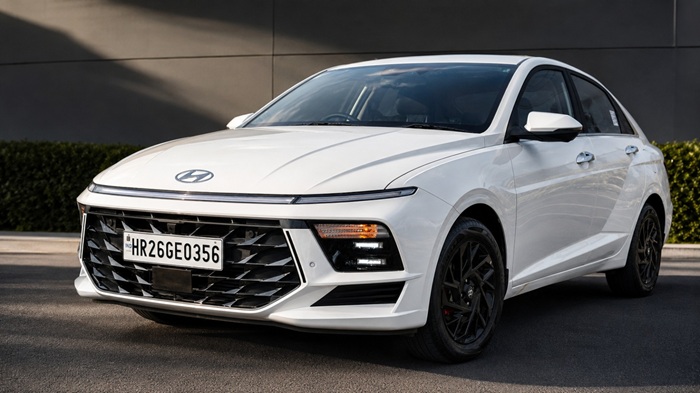
At the front, the Verna receives a wide black-chrome parametric radiator grille that visually lowers and broadens the car. The grille is accompanied by prominent satin-chrome detailing, a radar unit for the advanced driver-assistance systems and front parking sensors.
Running across the upper section of the nose is a full-width LED light bar, one of the Verna’s most recognisable design elements. It gives the car a modern identity, particularly at night, when the front resembles a digital signature moving through traffic.
Below it sit the automatic dual LED projector headlamps. These come with High Beam Assist, an escort function, LED positioning lamps and cornering lamps. The lighting arrangement is sophisticated, although first-time observers may need a few seconds to locate the actual headlights because the daytime-running light is busy taking all the attention.
Rain-sensing wipers are provided, while an ADAS camera and associated sensors continuously monitor the road ahead. Therefore, even before you enter the cabin, the Verna has already started judging the surrounding traffic.
The electrically adjustable and electrically folding outside mirrors include integrated turn indicators. Their shape complements the sharp bodywork and contributes to the Verna’s aerodynamic appearance.
In terms of dimensions, the Verna measures approximately 4.5 metres in length, 1.7 metres in width and 1.5 metres in height. The long wheelbase, low roofline and wide stance help it achieve a premium road presence.
Along the sides, Hyundai has used dramatic Z-shaped character lines. These sharp creases break up the large door surfaces and make the car look energetic even when it is stationary in a parking lot waiting for its owner to finish arguing over a restaurant bill.
The top model rides on 16-inch diamond-cut alloy wheels. Lower versions can also be equipped with 15-inch alloy or steel wheels. The HX10 receives disc brakes at both the front and rear, whereas some lower variants use rear drum brakes.
The car shown here wears 205/55 R16 91H Apollo Alnac 4G radial tubeless tyres. Red brake calipers at the front add a sporty touch. They do not automatically turn every traffic signal into a racetrack, but visually, they certainly encourage such thoughts.
The suspension setup consists of MacPherson struts with coil springs at the front and a coupled torsion-beam axle with coil springs at the rear. Gas-type shock absorbers are used at both ends.
This is a conventional and cost-effective arrangement, designed to balance ride comfort, handling and maintenance requirements. It is also a reminder that beneath the futuristic lights and connected technology, the Verna still understands the practical realities of Indian roads.
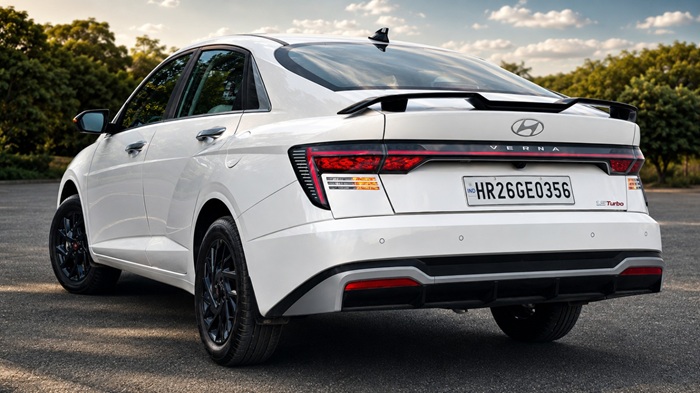
At the rear, the parametric connected LED tail-lamp arrangement stretches across the boot lid and mirrors the visual width of the front light bar. The facelift also introduces a revised spoiler, giving the rear a slightly more athletic appearance.
A rear defogger with a timer is included. This may not be the most glamorous feature in the brochure, but on a foggy or rainy morning, clear rear visibility is considerably more useful than another illuminated logo.
The Atlas White paint shown here gives the Verna a clean and sophisticated appearance. Depending on the variant, buyers can also choose black, grey, blue and matte-grey exterior colours. Dual-tone versions are available with a contrasting black roof.
Safety: Five Stars and Plenty of Electronic Supervision
The Hyundai Verna has received a five-star safety rating from Global NCAP, giving buyers additional confidence in its structural protection and safety equipment.
The HX10 is equipped with seven airbags, including frontal, side and curtain protection. It also receives ABS with EBD, hill-start assist, electronic stability control and vehicle stability management.
There are parking sensors at both the front and rear, along with a rear-view camera and a surround-view monitor on the top model. The highline tyre-pressure monitoring system displays individual tyre information, reducing the possibility of discovering a puncture only after the steering begins behaving like it has developed its own political ideology.
Additional safety equipment includes an emergency stop signal, central locking, impact-sensing automatic door unlocking, speed-sensing automatic door locking, keyless entry, seat-belt reminders and a speed-alert system.
An engine immobiliser, burglar alarm and ISOFIX child-seat mounting points are also included. All seating positions receive three-point seat belts, while the front seat belts are equipped with pretensioners and height adjustment.
The Verna also features Hyundai SmartSense Level 2 ADAS. The system includes Forward Collision-Avoidance Assist, Blind-Spot Collision-Avoidance Assist, Lane-Keeping Assist, Lane-Departure Warning and Driver Attention Warning.
Safe Exit Warning helps occupants avoid opening a door into approaching traffic, while Lane-Following Assist helps keep the car centred within its lane. Leading Vehicle Departure Alert informs the driver when the car ahead has moved away—particularly useful when the traffic signal has turned green but the driver is still examining a notification on the infotainment screen.
Rear Cross-Traffic Collision-Avoidance Assist adds another layer of protection while reversing out of parking spaces.
These systems are designed to support the driver, not replace one. Therefore, hands should remain on the steering wheel and eyes should remain on the road, despite the car’s best efforts to make you believe it has everything under control.
Boot Space: More Practical Than It Looks
The Verna offers a substantial 528-litre boot, making it one of the more practical sedans in its class.
It can accommodate multiple suitcases, airport luggage, shopping bags and the emotional baggage of someone who was told by their family to buy an SUV instead.
A 15-inch steel spare wheel is stored beneath the luggage floor. The spare may not match the appearance of the diamond-cut alloy wheels, but in an emergency, visual symmetry becomes surprisingly unimportant.
Interior: Premium, Spacious and Thoroughly Digital
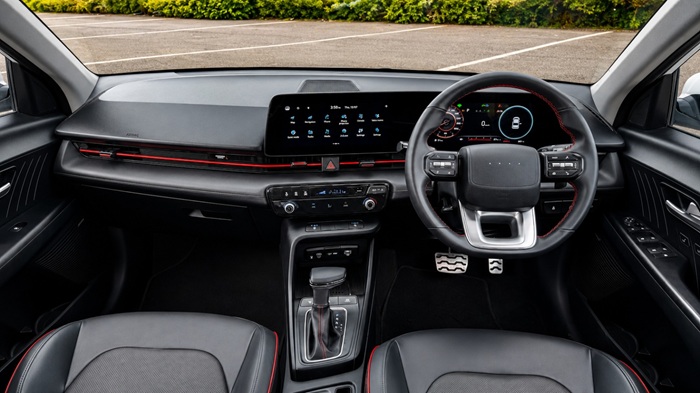
Open the doors and the Verna presents a cabin designed to feel considerably more expensive than a conventional mid-size sedan.
The top variant features black leatherette upholstery, while beige and fabric upholstery options are also available on other versions. The black interior gives the HX10 a sportier and more premium atmosphere, though lighter colours may make the cabin appear even more spacious.
The dashboard has a clean, horizontal layout dominated by two 10.25-inch displays. Hyundai has managed to package a significant amount of technology without making the interior look like an electronics shop.
A 64-colour ambient-lighting system allows occupants to personalise the cabin atmosphere. You can select a calm shade for relaxed evening drives or something more dramatic when you want the interior to resemble an airport lounge run by a nightclub.
The front seats are ventilated, an especially useful feature in the Indian summer. The driver receives an eight-way electrically adjustable seat, while the front passenger gets four-way electric adjustment.
A rear manual curtain is included for improved privacy and protection from direct sunlight. It also gives rear passengers the opportunity to sit like visiting dignitaries, even if the destination is simply a neighbourhood grocery store.
The steering wheel offers both tilt and telescopic adjustment, making it easier for drivers of different heights to find a comfortable position.
The new leatherette-wrapped steering wheel uses a two-spoke design and features Hyundai’s four-dot Morse-code logo. The four dots represent the letter “H,” giving the steering wheel a minimalist appearance while also creating an excellent conversation topic when passengers ask where the Hyundai badge has gone.
Controls are provided for the phone, infotainment system, audio volume, voice assistant, cruise control and instrument cluster.
The Verna uses a D-cut motor-driven electric power-steering system. A flat lower section adds a sporty touch, although most owners will appreciate the light steering during parking more frequently than the racing-inspired shape.
Metal pedals further enhance the sporty cabin ambience. Nearby controls operate the traction-control system, automatic start-stop function and exterior lights.
A conventional handbrake is provided with some transmissions, while the DCT-equipped version receives an electric parking brake. The centre console also incorporates a sliding armrest and useful storage spaces.
The dual horn ensures the Verna can communicate effectively in Indian traffic, where horn usage occasionally appears to form an unofficial second language.
Infotainment and Technology: The Verna Is Constantly Connected
At the centre of the dashboard is a 10.25-inch HD touchscreen infotainment system.
It supports Hyundai Bluelink, wireless Apple CarPlay, Android Auto, built-in navigation, Bluetooth, USB connectivity, FM and radio. Models positioned lower in the range receive an eight-inch touchscreen.
The infotainment system also provides 10 ambient sounds of nature. This means that while you are surrounded by traffic, construction work and impatient horn usage, the cabin can peacefully simulate a forest, ocean or rainfall.
It also includes a surround-view monitor, valet mode, over-the-air software updates and Hinglish voice commands. Approximately 350 embedded voice commands are supported, allowing occupants to operate multiple vehicle functions without physically touching the display.
The system can understand a combination of Hindi and English instructions, which is useful because many Indian drivers naturally communicate in a language that changes halfway through the sentence.
The Verna also comes equipped with a Bose premium audio system featuring eight speakers. The system offers good clarity and a richer soundstage, whether you are listening to classical music, podcasts or a song with enough bass to make the outside mirrors reconsider their career choices.
A wireless smartphone charger is positioned in the centre console. The glovebox is cooled, allowing occupants to store beverages or temperature-sensitive items.
The inside rear-view mirror is electrochromic, automatically reducing glare from vehicles behind. It also houses telematics switches for emergency and connected-car functions.
A factory-fitted dashcam adds another layer of convenience and security. In a country where road incidents often generate five different versions of the same story, video evidence can be extremely persuasive.
The electric sunroof is voice-operated. You can open or close it using a command, although standing through it while the car is moving remains unsafe regardless of how cinematic the moment appears.
Digital Instrument Cluster and Driver Information
The Verna receives a 10.25-inch digital instrument cluster with a TFT multi-information display.
The layout changes according to the selected driving mode and displays essential information such as speed, engine data, trip details, fuel economy and active safety-system status.
One of the highlights is the Blind-Spot View Monitor, which can display a camera feed from the relevant side of the vehicle when the turn indicator is activated.
This is particularly helpful while changing lanes in dense traffic, although drivers should still use the mirrors and physically check their surroundings. Technology is an assistant, not a legal witness.
The Verna also features cruise control with stop-and-go functionality. This can reduce fatigue in slow-moving traffic by automatically maintaining distance from the vehicle ahead and bringing the car to a stop when necessary.
A switchable display allows selected controls and information to change according to the operating requirement, helping Hyundai reduce the number of physical switches without removing access to important functions.
Climate Control: Designed for Indian Summers
The fully automatic temperature-control system is integrated with an air purifier.
The purifier monitors and improves cabin-air quality, an increasingly relevant feature in heavily polluted urban environments. The Bluelink application can also display in-vehicle air-quality information.
The climate-control system can be operated remotely through the connected-car application, allowing owners to cool the cabin before entering. In peak summer, this is not merely a convenience; it is a form of personal survival.
Hyundai Bluelink: Seventy Features in Your Pocket
The Verna comes with a three-year complimentary subscription to Hyundai’s Bluelink connected-car platform.
Through the smartphone application, users can access approximately 70 connected functions.
These include remote engine start and stop, remote climate control, remote door locking and unlocking, horn and light operation, vehicle-status information and remote seat-ventilation control.
Owners can also check tyre-pressure information, locate the vehicle, share its location, access a vehicle-health report and receive maintenance alerts.
Safety-related connected functions include automatic crash notification, stolen-vehicle tracking and stolen-vehicle immobilisation.
Valet mode allows owners to monitor vehicle usage when the car is handed to another driver. Geo-fencing, speed alerts and time-fencing can also be configured.
Real-time traffic information, live vehicle tracking and driving data are available through the application.
In other words, the Verna does not simply know where it is going. It also remembers how quickly it went there, when it left, whether its tyres were properly inflated and whether the person driving it behaved responsibly.
Engines and Transmissions
The Hyundai Verna is offered exclusively with petrol engines.
The flagship powertrain is the 1.5-litre Smartstream G1.5 T-GDi turbocharged petrol engine, identified by the G4LH engine code.
This inline four-cylinder unit produces approximately 157 horsepower and 253 Nm of torque.
It is paired here with a seven-speed dual-clutch automatic transmission. A six-speed manual gearbox is also available with the turbo engine, depending on the variant.
The DCT provides quick gear changes and contributes to the Verna’s performance-oriented character. It is particularly effective during open-road driving, where the engine’s strong mid-range torque makes overtaking effortless.
An official fuel-efficiency figure of around 20 kmpl is claimed under test conditions. Real-world mileage will naturally depend on traffic, driving style, road conditions and how frequently the driver selects Sport mode purely because the red instrument display looks exciting.
The fuel tank holds approximately 45 litres.
Three driving modes are available: Normal, Eco and Sport.
Normal mode is suitable for everyday use. Eco mode moderates throttle response to support improved efficiency, while Sport mode sharpens the powertrain and steering responses.
Sport mode does not change the Verna into a track car, but it does make the turbo engine considerably more eager. The strong torque output allows the car to accelerate confidently, and the low-slung sedan body gives it a more engaging character than many similarly priced crossovers.
For buyers who prioritise smoothness and fuel efficiency over outright performance, Hyundai offers a naturally aspirated 1.5-litre Smartstream G1.5 MPi petrol engine.
This inline four-cylinder unit produces approximately 113 horsepower and 143 Nm of torque.
It can be paired with a six-speed manual transmission or an IVT automatic gearbox. Claimed efficiency is approximately 18 kmpl with the manual and 19 kmpl with the automatic.
The naturally aspirated engine is better suited to relaxed urban driving. Its power delivery is linear and predictable, while the IVT automatic prioritises smooth operation.
The 1.5-litre petrol engine family is also used across several Hyundai and Kia products, including the Creta, Alcazar, i30, Kia Carens, Seltos and Ceed, depending on the market.
Modified versions of related engines are also found in vehicles such as the Hyundai Custo, Lafesta, Mistra, Sonata and Tucson, as well as the Kia K5 and Sportage.
This widespread usage helps demonstrate the flexibility of Hyundai Motor Group’s Smartstream powertrain family.
Ride and Handling
The Verna’s low seating position and long wheelbase immediately distinguish it from the growing number of compact and mid-size SUVs.
The MacPherson-strut front suspension and torsion-beam rear setup are tuned to provide a balance between comfort and control.
At city speeds, the suspension absorbs ordinary surface imperfections effectively. The gas-filled shock absorbers help control body movement, while the relatively generous tyre sidewalls provide additional cushioning.
The steering is light during low-speed manoeuvres, making the 4.5-metre-long sedan easy to park despite its size. Front parking sensors, rear sensors, multiple cameras and the surround-view display reduce the possibility of embarrassing conversations with concrete pillars.
At higher speeds, the Verna feels stable and planted. The low centre of gravity gives it more natural cornering behaviour than a tall vehicle, and the 205-section tyres provide adequate grip.
The red front brake calipers may be visually dramatic, but the more important feature is the presence of disc brakes at all four corners on this top variant. The braking performance is supported by ABS, EBD, electronic stability control and vehicle stability management.
Enthusiastic drivers may still find the electric steering slightly isolated compared with older hydraulic systems, but the Verna is fundamentally designed as a fast, refined and comfortable road car rather than a hardcore sports sedan.
Rear-Seat Experience
A major strength of the new Verna is its rear-seat space.
The long wheelbase provides generous legroom, while the wide cabin gives passengers adequate shoulder room. The seat cushioning is supportive, making the Verna suitable for both daily commuting and longer journeys.
The low roofline does create a sportier seating position than an SUV, but Hyundai has packaged the cabin intelligently enough to preserve useful headroom.
The manual rear curtain provides protection from sunlight, while the flat floor and thoughtful cabin design improve overall comfort.
This is a sedan in which owners may genuinely be tempted to sit in the rear while someone else drives—especially after discovering the rear space, ambient lighting and Bose audio system.
Ownership and Peace of Mind
Hyundai offers the Verna with a three-year, unlimited-kilometre standard warranty.
The warranty can be extended for up to seven years, depending on the selected package. Buyers also receive three years of roadside assistance.
According to the stated maintenance estimate, the Verna’s average annual periodic service cost over five years is approximately ₹3,289.
That is an attractive figure for a car carrying this level of equipment and performance. Naturally, actual ownership costs may vary depending on usage, location, consumables and authorised service-centre pricing.
Hyundai’s extensive service network also remains an important advantage. A premium car is considerably easier to enjoy when its nearest authorised workshop does not require a separate road trip.
Verdict
The 2026 Hyundai Verna facelift is a confident response to a market increasingly dominated by SUVs.
It offers a dramatic exterior, a spacious cabin, a huge 528-litre boot, strong connected technology, Level 2 ADAS, a five-star Global NCAP rating and a choice of two very different petrol engines.
The naturally aspirated 1.5-litre engine is the sensible option for relaxed driving and lower running stress. The 1.5-litre turbo engine, particularly with the seven-speed DCT, is the one for buyers who want genuine performance along with everyday usability.
The top HX10 DCT is expensive by traditional mid-size-sedan standards, but it also comes equipped with features once associated with considerably more premium vehicles.
Ventilated and electrically adjustable front seats, dual 10.25-inch screens, Bose audio, a dashcam, a surround-view monitor, connected-car functions, adaptive cruise control, a voice-operated sunroof and extensive safety equipment make the Verna feel thoroughly modern.
More importantly, it retains the fundamental strengths of a sedan: a low centre of gravity, stable highway behaviour, aerodynamic styling, a comfortable rear seat and a properly separated boot.
The design may not appeal to everyone. Its sharp lines, full-width lighting and unconventional front end are intentionally bold. But being forgettable has never been one of this Verna’s problems.
The new Hyundai Verna is futuristic without becoming impractical, powerful without becoming intimidating and luxurious without completely abandoning value.
It represents a strong combination of design, interior space, technology, safety, performance and ownership peace of mind.
And in a world where every second car arrives wearing black body cladding and claiming to be adventurous, the Verna deserves credit for remaining a sedan.
A very fast, very intelligent and occasionally overqualified sedan.