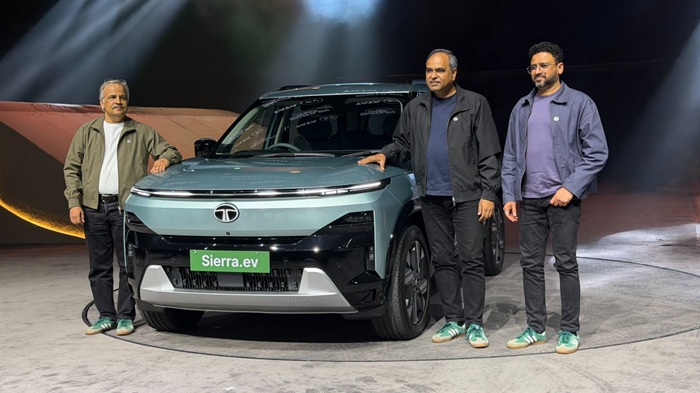
The Sierra.ev has been detailed with a wide-ranging package of electric performance, connected cabin technology and comfort-focused features, including a 75 kWh battery pack, a claimed 500+ km real-world range, L2+ ADAS and a triple-screen infotainment setup aimed at turning the SUV into a living room on wheels — minus, thankfully, the remote-control arguments.
At the centre of the Sierra.ev’s electric credentials is a 75 kWh battery pack. The company says the SUV can deliver more than 500 km of real-world range, with the advanced battery technology offering up to 665 km of P1+P2 range and a C75 real-world range between 510 km and 530 km.
Fast charging is also a major focus. The Sierra.ev is claimed to add 263 km of range in 15 minutes, while charging from 20% to 80% takes around 26 minutes. The SUV also supports Vehicle-to-Load and Vehicle-to-Vehicle functions, allowing it to power external devices or assist another EV.
The Sierra.ev will come with what the company describes as a lifetime HV battery warranty with unlimited kilometres. However, “lifetime” refers to 15 years from the vehicle’s first registration date at the local regional transport office. The warranty is applicable only to private individual registrations and company perk car scheme registrations for employees, including later transfer to the same employee. It becomes void if the vehicle is sold or transferred to a third party.
Performance is another key pillar. Built on the Acti.ev+ pure EV architecture, the Sierra.ev features a Quad Wheel Drive system with a dual-motor setup for on-demand all-wheel-drive traction. The system uses a 140 PS front induction motor and a 209 PS rear permanent magnet synchronous motor, producing a combined 504 Nm of instant torque.
The company says the Sierra.ev can accelerate from 0 to 100 km/h in 5.8 seconds, calling it India’s fastest homegrown SUV. For off-road use, it gets six terrain modes: Normal, Grass/Snow, Mudruts/Gravel, Sand, Rock Crawl and Custom. The SUV also offers Off-road Assist, 205 mm ground clearance and more than 50% restart gradability.
A 540-degree HD camera system, branded as Transparent Mode, combines a 360-degree HD surround-view system with 180-degree visibility and adaptive front and rear turn cameras. In practical terms, it is meant to make tight trails, narrow parking spots and awkward urban corners slightly less dramatic.
Inside, the Sierra.ev places strong emphasis on what the company calls a “Luxury LifeSpace.” The cabin features a Theater Pro setup with a Horizon View triple-screen infotainment experience, including a 12-inch personal infotainment screen for the co-passenger.
The entertainment package includes Dolby Atmos, a 12-speaker JBL Black sound system with a SonicShaft soundbar, 13 JBL modes, Arcade.ev for gaming, OTT streaming and web browsing. The Sierra.ev is also claimed to be India’s first vehicle with AirConsole, bringing connected in-cabin gaming to the SUV.
Comfort features include Ultra Glide Suspension with Frequency Dependent Damping, powered driver and co-driver seats, memory and welcome functions for the driver’s seat, and a thigh support extender aimed at reducing fatigue on longer journeys.
The SUV has a 2,730 mm wheelbase and is claimed to offer a spacious cabin. Key interior figures include 900 mm couple distance, 973 mm second-row legroom, 1,451 mm first-row shoulder room, 1,415 mm second-row shoulder room, 315 mm second-row gangway space and 996 mm second-row headroom. The company claims the second-row legroom and headroom are best in segment.
The Sierra.ev also gets a 622-litre boot with a gesture-controlled powered tailgate, claimed to be the best in its segment. A large PanoraMax sunroof measuring 1,525 mm by 925 mm is also listed as the biggest in the segment.
Technology features extend beyond entertainment. The SUV gets a HypAR head-up display with 19 features, Digi Access through smartphone Ultra Wide Band, NFC card or a new Digi Access remote key fob, and an e-Valet Auto Park Assist Suite with 16 features. The system allows Auto Park Assist, Remote Park and Summon functions.
For connected services, the Sierra.ev will offer iRA.ev with 5G connectivity and 75 connected-car features. Over-the-air updates will also be supported through the 5G connection. An EV Route Planner with Android Auto is included to help drivers plan journeys around charging needs.
The SUV also features DrivePay, which brings e-commerce, payments and food ordering services into the vehicle. In a market where cars increasingly double up as devices, offices and occasional waiting rooms, the Sierra.ev appears keen to make the cabin do more than simply move people from one place to another.
On the safety and driver assistance front, the Sierra.ev comes with L2+ ADAS offering 22 features. The system is positioned to support smart and safer driving, adding to the broader package of connected and semi-automated functions.
With its blend of long-range EV capability, high-output dual-motor performance, connected entertainment and comfort-led cabin design, the Sierra.ev is being positioned as a technology-heavy electric SUV for buyers seeking both practicality and a premium digital experience. Its success, however, will ultimately depend on how these claims translate on Indian roads, where range, charging convenience and real-world comfort matter as much as headline numbers.